
Yes, Virginia residents with Tourette’s syndrome may qualify for medical cannabis if a registered practitioner determines the diagnosis or its symptoms could benefit from treatment. There’s no fixed condition list to check off. You’ll need proof of Virginia residency and a valid ID, and telemedicine appointments are fully allowed. Your next move is straightforward: book an evaluation with a Virginia-registered practitioner, such as the same-day consults offered through Virginia Medical Cannabis Certifications, and let a clinician assess your case directly.
Table of Contents
- How Virginia’s Medical Cannabis Program Works for Tourette’s Patients
- What Does the Research Say About Cannabis and Tourette’s?
- How to Prepare for Your Cannabis Evaluation
- How Much Cannabis Can You Actually Get in Virginia?
- Your Path From Certification to Your First Dispensary Visit
- Why Individualized Tracking Matters More Than the Diagnosis Itself
- Get Certified Without the Waiting Room Hassle
- Sources
- FAQ
How Virginia’s Medical Cannabis Program Works for Tourette’s Patients
Virginia doesn’t run its medical cannabis program off a checklist of approved diagnoses. Instead, practitioners decide case by case whether your diagnosed condition, or the symptoms tied to it, would likely benefit from cannabis. For Tourette’s, that means your clinician weighs tic severity, how much the condition disrupts daily life, and what else you’ve already tried.
Not every provider can issue this certification. Only physicians and osteopaths licensed by the Board of Medicine, physician assistants licensed by the Board of Medicine, and advanced practice registered nurses jointly licensed by the Boards of Nursing and Medicine can sign off. The good news for anyone juggling tics, appointments, and daily life: real-time audiovisual telemedicine counts as a valid visit, so you don’t need to sit in a waiting room.
Here’s what the process actually involves once you find an eligible practitioner:
- Confirm Virginia residency and bring a valid government-issued ID to your appointment.
- Discuss your Tourette’s history, symptom pattern, and any treatments you’ve already tried.
- Have your practitioner submit the certification electronically through the CCA portal once approved.
- Set up your patient account to view, download, or print your digital certification card.
- Decide whether to register a caregiver or registered agent, who can pick up product for you and may serve up to two patients at once.
Registration beyond the certification itself is optional, but it’s worth setting up early if tics or fatigue make dispensary trips harder on certain days.
What Does the Research Say About Cannabis and Tourette’s?
The clinical picture is promising but far from settled. A 2024 systematic review of nine studies covering 401 patients found that cannabis-based medicine produced statistically significant drops in tic severity and premonitory urges, the uncomfortable sensations that build before a tic fires.
By the numbers: the review reported an average reduction of nearly 24 points on the Yale Global Tic Severity Scale (YGTSS) and about 5 points on the Premonitory Urge for Tics Scale (PUTS). Neither result, though, came with a large enough sample to call it settled science, and the studies varied widely in design. Notably, cannabis showed no significant effect on obsessive-compulsive symptoms measured by the Y-BOCS scale, so it isn’t a universal fix for every symptom that rides alongside Tourette’s.
The Tourette Association of America echoes that caution. Their position is blunt: patient reports are mixed, some people see meaningful tic reduction, others notice no change or unwanted side effects, and the overall evidence base isn’t yet strong enough to recommend cannabis broadly. CBD alone, they note, doesn’t have sufficient evidence behind it for Tourette’s specifically.
What patients commonly report trying cannabis for includes:
- Reduced frequency or intensity of motor and vocal tics
- Easing of the premonitory urge sensation before a tic
- Better sleep and lower background anxiety
- Adverse effects can include drowsiness, dry mouth, mood shifts, or short-term memory fog
The practical takeaway is that this works best as an individualized trial. You and your practitioner track your specific tics, urges, and side effects rather than assuming a one-size-fits-all response.
How to Prepare for Your Cannabis Evaluation
Practitioners can’t read your daily life from a diagnosis code alone. The more concrete evidence you bring, the better they can judge whether cannabis fits your situation.
- Gather your documents. Bring a valid ID and proof of Virginia residency, plus any notes on tic frequency, severity, and how they affect school, work, or sleep.
- List your treatment history. Note medications you’ve tried, what worked, what didn’t, and any current prescriptions or substance use your practitioner should know about.
- Record short symptom videos if you can. A 10 to 30 second clip showing a typical tic episode often communicates more than a verbal description ever could.
- Set up your telemedicine environment. Stable internet and good lighting matter, since you’ll likely need to hold documents up to the camera for verification.
- Arrange consent if you’re under 18. A parent or guardian will need to participate in the evaluation and sign off on certification.
Pro Tip: Don’t just tell your practitioner you have tics. Show them. A short video of a tic episode, paired with a simple log of how often it happens, tends to carry more weight than a description alone.
If approved, your written certification can last up to a year, and it may include a designated registered agent for pickup and any usage notes your clinician thinks are relevant.
How Much Cannabis Can You Actually Get in Virginia?
Virginia caps how much THC you can take per dose and how much product you can walk away with. Registered products carry a standard THC-per-dose limit, and botanical cannabis (flower) is capped at four ounces every 30 days. Dispensaries can also limit dispensing to a 90-day supply, a figure your pharmacist or certifying practitioner helps determine.
That structure shapes what you’ll actually buy:
- Flower purchases are capped by weight per 30-day window, not by THC content alone.
- Measured products like oils, tinctures, and capsules make dosing more predictable, especially for tic management where consistency matters.
- Pharmacists check ID at every visit and confirm your certification status before dispensing anything.
- A registered agent or guardian can pick up your supply if travel or symptom flares make that difficult for you.
For many Tourette’s patients, this pushes treatment planning toward low-dose, pre-measured products rather than raw flower, since predictable dosing makes it easier to track what’s actually helping.
Your Path From Certification to Your First Dispensary Visit
Getting certified isn’t one giant leap. It’s a short sequence of manageable steps.
- Pull your paperwork together first. You’ll need ID, proof of Virginia residency, and any symptom documentation, videos, or treatment history you’ve collected.
- Book your evaluation. Choose a Virginia-registered practitioner who offers telemedicine if in-person visits aren’t practical, and be ready to discuss your Tourette’s history candidly.
- Wait for the clinician’s decision. Certification depends entirely on their professional judgment. Missing ID, unclear residency proof, or an incomplete symptom history are the most common reasons an appointment doesn’t result in approval.
- Access your digital card and visit a dispensary. Once certified, your card appears in your patient portal account. A pharmacist will walk you through product options and help match a format to your dosing needs.
Red flags that can stall the process usually come down to paperwork gaps or a practitioner deciding the clinical picture doesn’t support cannabis right now, not some hidden disqualifying list.
Why Individualized Tracking Matters More Than the Diagnosis Itself
Tourette’s responds unevenly to cannabis, and that’s the honest starting point. Some patients see real reductions in tic frequency and premonitory urges. Others notice little change or run into side effects that outweigh any benefit. That variability means the diagnosis on your chart matters less than how closely you and your practitioner track outcomes.
Keep a simple log: tic frequency, sleep quality, mood, and any side effects, week over week. Share it openly with your prescriber and pharmacist rather than assuming a set dose will work indefinitely. Cannabis for Tourette’s works best as a monitored trial, not a set-and-forget prescription.
— Jonathan
Get Certified Without the Waiting Room Hassle
Virginia Medical Cannabis Certifications is built for exactly the situation Tourette’s patients face: unpredictable symptoms, tight schedules, and a preference for skipping crowded waiting rooms altogether. New patients pay a flat $50 for a certification evaluation, completed online in about 10 minutes, with a full refund if you don’t qualify. Renewals run $40.

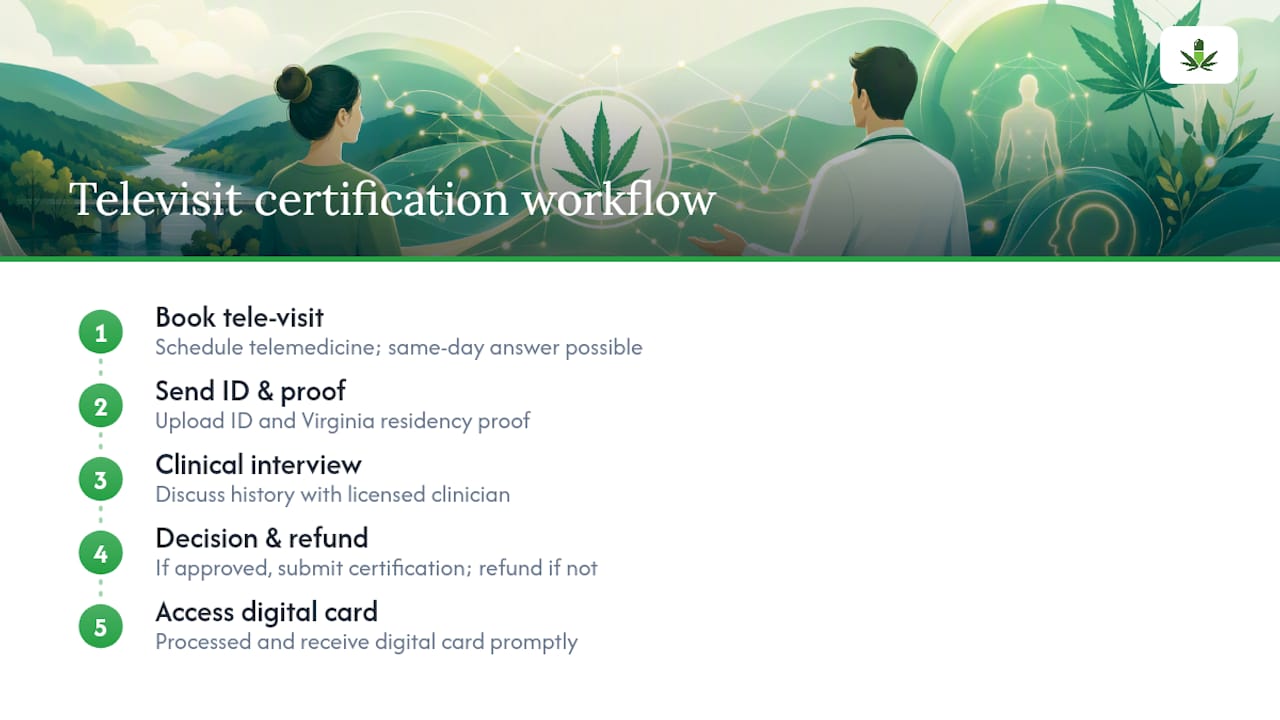
The workflow matches what this guide just walked through. You book a telemedicine appointment, provide ID and residency proof, discuss your medical history with a licensed clinician, and if approved, your certification is submitted for processing so you can access your digital card promptly. This fits especially well if symptom flares make in-person visits difficult, or if you simply want an answer today instead of waiting weeks for a specialist appointment.
If you’re ready to find out whether you qualify, book your evaluation now and get a same-day answer, with your money back if you don’t qualify.
This article is general information, not a substitute for advice from a qualified doctor. Consult a qualified healthcare professional about your own circumstances before acting on anything here.
Sources
- Patients & Caregivers — Virginia Cannabis Control Authority
- Efficacy of cannabis-based medicine in the treatment of Tourette syndrome — systematic review / meta-analysis (PMC)
- Medical Marijuana — Tourette Association of America
- Code of Virginia — Medical Cannabis Program (dispensing and product rules)
FAQ
What Conditions Qualify for Medical Marijuana in Virginia?
Virginia doesn’t use a fixed list of qualifying diagnoses. A registered practitioner decides whether your specific condition and symptoms, including Tourette’s, are likely to benefit from cannabis treatment.
Can CBD Help With Tics?
CBD alone doesn’t currently have enough evidence behind it specifically for Tourette’s, according to the Tourette Association of America. Full-spectrum cannabis-based products showed more promising results in small clinical studies, though research remains limited.
What Disqualifies You From Getting a Medical Cannabis Card?
The most common issues are missing ID, incomplete proof of Virginia residency, or a practitioner determining that cannabis isn’t clinically appropriate for your case. There’s no specific diagnosis that automatically disqualifies you.
Who Qualifies for a Virginia Medical Marijuana Card?
Any Virginia resident whose diagnosed condition or symptoms a registered practitioner believes could benefit from cannabis may qualify, including people with Tourette’s syndrome. You’ll need valid ID and proof of residency, and services like Virginia Medical Cannabis Certifications offer same-day telemedicine evaluations for $50, fully refundable if you’re not approved.