
Current research on cannabis for sickle cell pain is mixed, with small trials showing safety and mood benefits but no clear pain relief. Virginia residents with sickle cell disease can still legally access medical cannabis through a licensed practitioner and the Virginia Cannabis Control Authority portal. The right next step is talking with your hematology team first, then getting evaluated by an eligible practitioner if cannabis fits your broader pain plan.
Table of Contents
- What the Clinical Research Says About Cannabis for Sickle Cell Pain
- How Does Virginia’s Medical Cannabis Program Work?
- Is Cannabis Safe to Combine With Other Sickle Cell Treatments?
- How Do You Prepare for and Get a Medical Cannabis Certification in Virginia?
- Choosing Safe Cannabis Products at Virginia Dispensaries
- Coordinating Cannabis Use With Your Sickle Cell Care Team
- Getting Certified Through Virginia Medical Cannabis Certifications
- Sources
- FAQ
What the Clinical Research Says About Cannabis for Sickle Cell Pain
The most rigorous study on this topic is a small randomized crossover trial published in JAMA Network Open. It found inhaled cannabis was safe for adults with sickle cell disease and meaningfully reduced how much pain interfered with mood. But over five inpatient days, pain ratings themselves did not drop significantly compared to placebo.
That gap between “feels better” and “hurts less” matters. Only a small number of patients completed the trial, and the cannabis used had a specific THC to CBD ratio that may differ from typical dispensary products.
Statistic Callout: In that trial, mood interference improved with inhaled cannabis, yet pain scores showed no significant difference from placebo, a distinction that gets lost in headlines about the study.
Outside the lab, real-world data gets messier:
- Some retrospective, propensity-matched studies found some studies have reported fewer annual hospital admissions among sickle cell patients using cannabis daily than non-users.
- Other observational research found higher rates of vaso-occlusive crisis hospitalizations among cannabis users.
- Reviewers point to inconsistent THC/CBD ratios, varied delivery methods, and concurrent opioid use as reasons these studies contradict each other.
- Everyone studying this agrees on one thing: larger, better-controlled trials are still needed.
The honest takeaway is that cannabis remains investigational for sickle cell pain, not a proven replacement for standard care. Preclinical and clinical reviews suggest cannabinoids may help dial down certain pain pathways, but that signal is still early. Treat it as a potential adjunct you discuss with your care team, not a substitute for your existing treatment plan.
How Does Virginia’s Medical Cannabis Program Work?
Virginia doesn’t use a fixed list of qualifying conditions the way some states do. Instead, the Virginia Cannabis Control Authority leaves the qualifying decision to your practitioner’s clinical judgment. If a licensed provider determines cannabis could reasonably help your condition, including sickle cell disease and its associated chronic pain, they can certify you.
Here’s how the process actually runs:
- Confirm residency and age. You need valid Virginia identification, and the program covers both adults and minors with appropriate guardian involvement.
- Find an eligible practitioner. Certifications can come from an MD, DO, PA, or APRN, provided they hold an active Virginia license and have registered in the CCA Portal.
- Complete an evaluation. Telemedicine visits are explicitly permitted, so you don’t need to sit in a waiting room to get assessed.
- Receive counseling. Practitioners are required to walk you through risks, benefits, and proper use before certifying you.
- Get your digital certification. Once issued through the CCA Portal, it’s valid for up to one year and grants access to state-licensed dispensaries.
This flexibility is genuinely useful for sickle cell patients, since your pain pattern, medication history, and crisis frequency are unique enough that a rigid checklist would poorly fit your situation.
Is Cannabis Safe to Combine With Other Sickle Cell Treatments?
The CDC’s sickle cell toolkit calls for individualized pain plans built with your provider, and it’s explicit that standard opioid guidelines don’t apply cleanly to sickle cell disease. Cannabis has not been established as a standard therapy for sickle cell pain, so any use should sit inside that individualized plan, not outside it.
A few safety points deserve your attention:
- If you’re on opioids for pain management, tell your prescriber before adding cannabis. Combined use needs coordination, not guesswork.
- Vaping and smoking carry documented respiratory risks, and CDC alerts have linked vaping and adulterated products to severe lung injury and clotting problems, both concerning for people with sickle cell disease.
- Unregulated over-the-counter cannabinoid products have shown up adulterated with synthetic compounds in past outbreaks. Stick to state-licensed dispensary products with lab-verified Certificates of Analysis.
- Keep your hematology team informed of any cannabis use so they can monitor for interactions and track how it affects your crisis frequency.
Pro Tip: Bring a simple written log of when you use cannabis and how your pain and mood responded. It gives your hematologist real data instead of a vague impression at your next visit.
How Do You Prepare for and Get a Medical Cannabis Certification in Virginia?
Getting certified is more paperwork than hassle once you know what to gather.
Before your appointment:
- Pull together recent medical records related to your sickle cell diagnosis and treatment history.
- List current medications, including any opioids or pain management prescriptions.
- Have a valid Virginia ID or proof of residency ready.
During the telehealth evaluation, expect the practitioner to review your history, discuss why cannabis might help your specific symptoms, and counsel you on risks before deciding whether to certify you.
After certification:
- Your digital certification appears in the CCA Portal, ready to present at any licensed Virginia dispensary.
- Look up dispensary product Certificates of Analysis before purchasing.
- Update your hematologist on your certification status and any product you start using.
Virginia Medical Cannabis Certifications offers this evaluation online in about 10 minutes, with same-day certification emailed once approved. New patients pay a fee for evaluation, which may be refunded if not qualified.
Choosing Safe Cannabis Products at Virginia Dispensaries
A Certificate of Analysis, or COA, is your first line of defense against contaminated products. Every legitimate batch sold at a licensed Virginia dispensary should have one available, showing test results for pesticides, residual solvents, heavy metals, and microbial contamination. If a budtender can’t produce one, that’s a signal to walk away.
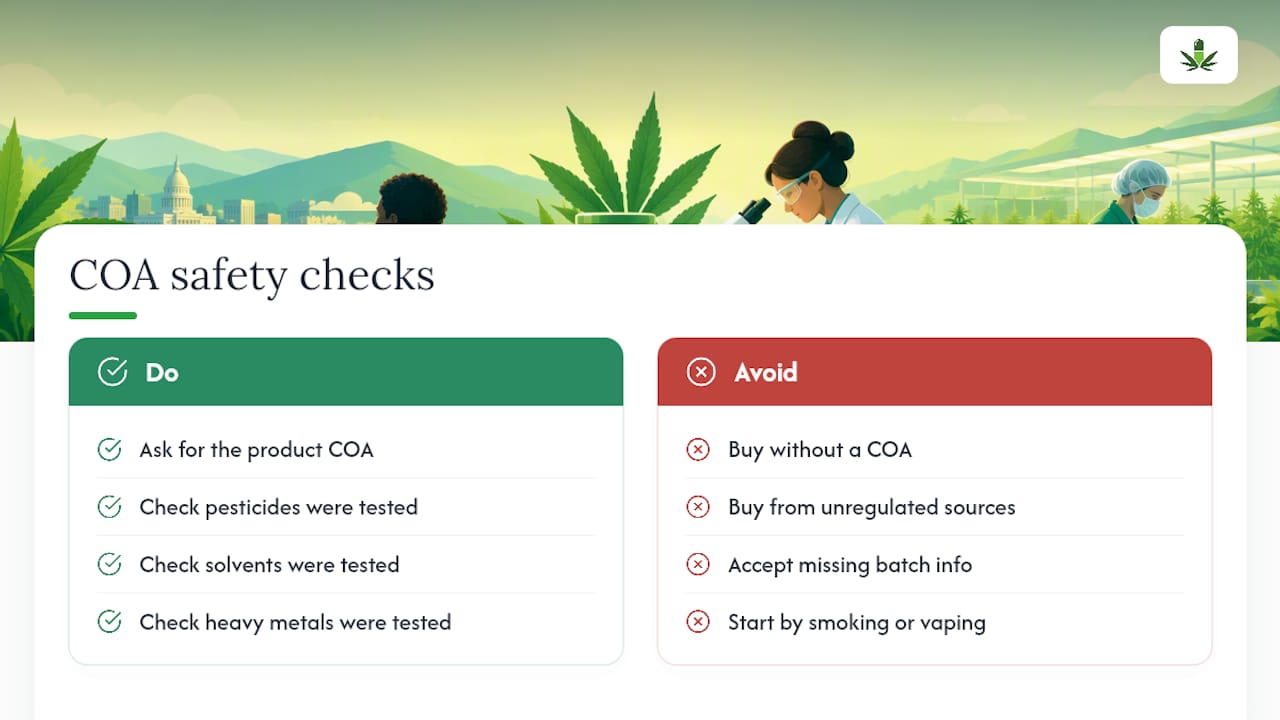
For sickle cell patients specifically, measured-dose oils and lab-tested edibles are generally a safer starting point than smoking or vaping, given the respiratory concerns already noted. Research on cannabis and sickle cell pain notes that state-regulated products with verified COAs reduce, though don’t fully eliminate, contamination risk compared with unregulated sources.
Ask staff for the batch number and COA link on any product you buy, and keep that documentation. It matters if you ever need to trace a reaction back to a specific product.
Coordinating Cannabis Use With Your Sickle Cell Care Team
Cannabis works best as one piece of a bigger plan, not a solo decision made outside your medical record. Tell your hematologist what you’re using and how it affects your symptoms.
Getting a fast, transparent certification when it’s clinically appropriate shouldn’t be the hard part of this process. The medicine should get the attention.
— Jonathan
Getting Certified Through Virginia Medical Cannabis Certifications
Some services offer quick online evaluations with fast certification delivery, designed for patients who have decided to pursue certification without delay.

New patients pay $50 and renewals are $40, and if you’re not approved, that fee is fully refunded. That refund guarantee matters for sickle cell patients specifically, since qualification depends on clinical judgment rather than a fixed checklist, and you deserve certainty that you’re not paying for a maybe. Every evaluation is reviewed by a practicing Virginia clinician, and once your certification lands in the CCA Portal, you can walk into any licensed dispensary in the state.
If you’re ready to move forward, you can book your evaluation now and get a same-day answer.
Sources
- Medical cannabis program overview — Virginia Cannabis Control Authority
- Effect of Inhaled Cannabis for Pain in Adults With Sickle Cell Disease — JAMA Network Open
- Considerations for Cannabis Use to Treat Pain in Sickle Cell Disease — PMC
- CDC sickle cell toolkit: managing chronic pain
FAQ
What Drugs Should Sickle Cell Patients Avoid?
Sickle cell patients should be cautious with any medication that increases bleeding risk, sedation, or respiratory depression without medical supervision, and should never combine opioids with other sedating substances, including cannabis, without their prescriber’s knowledge. The CDC recommends an individualized pain plan built with your provider rather than following general population guidelines, since standard opioid protocols don’t fully apply to sickle cell disease.
Can People With Sickle Cell Disease Smoke Cannabis?
Smoking carries respiratory risks that are especially relevant for sickle cell patients, who already face elevated risk of acute chest syndrome and lung complications. Vaporized cannabis showed an acceptable safety profile in a small clinical trial, but many clinicians and safety reviews favor measured-dose oils or tested edibles over inhaled products for this population.
Is Medical Cannabis Legal for Sickle Cell Disease in Virginia?
Yes. Virginia doesn’t require a specific diagnosis from a fixed list; a licensed practitioner can certify sickle cell disease if they judge cannabis may reasonably help your symptoms. Certification happens through the Virginia Cannabis Control Authority portal and telemedicine evaluations are allowed.
How Much Does a Medical Cannabis Certification Cost in Virginia?
Through Virginia Medical Cannabis Certifications, a new patient evaluation costs $50 and a renewal costs $40, with a full refund if you’re not approved. The evaluation is completed online in about 10 minutes with same-day certification.
Does Cannabis Actually Reduce Sickle Cell Pain?
The evidence is mixed. A randomized trial found inhaled cannabis improved mood interference but didn’t significantly reduce pain scores, while some observational studies show fewer hospital admissions among regular users and others show more crisis-related admissions. Researchers agree larger trials are needed before cannabis can be called a proven pain treatment for sickle cell disease.