

Yes, epilepsy and seizure disorders can qualify for medical cannabis in Virginia when a licensed practitioner determines it will likely provide benefit. The next step is straightforward: schedule an evaluation with a qualified practitioner, and telemedicine visits are allowed under state rules. What you need at the end of that visit is a written certification, since that document, not state registration, is what Virginia dispensaries require before they can serve you.
Table of Contents
- Who can certify epilepsy for medical cannabis in Virginia
- Steps to prepare for and complete your certification visit
- What the research says about CBD and seizure control
- Using your certification at a dispensary
- Coordinating cannabis with ongoing epilepsy care
- What this guide gets right that other advice misses
- Getting certified quickly through Virginia Medical Cannabis Certifications
- Sources
- FAQ
Who can certify epilepsy for medical cannabis in Virginia
Under Virginia law, a written certification comes from a licensed practitioner who reviews your medical history and decides whether cannabis is likely to help more than it might harm. This is a judgment call, not a checklist, and epilepsy is not automatically approved or automatically denied. The certifying practitioner has to believe cannabis fits your specific case according to the Code of Virginia’s certification standard.
Several types of licensed clinicians can issue this certification:
- Medical doctors and doctors of osteopathic medicine (MD/DO) who evaluate your seizure history and current treatment plan.
- Physician assistants (PAs) working within their scope of practice.
- Nurse practitioners (APRNs) who can independently certify patients in Virginia.
Telemedicine evaluations are permitted as long as the visit happens in real time with both audio and video, according to the Virginia Cannabis Control Authority’s patient guidance. Adults can pursue certification on their own. Minors need a parent or legal guardian involved in the process, and that guardian typically also serves as the registered agent who picks up cannabis products from a dispensary on the patient’s behalf. One detail surprises a lot of new patients: registering with the Cannabis Control Authority’s portal is voluntary. Dispensaries only need to see your valid written certification to serve you.
Steps to prepare for and complete your certification visit
A little preparation makes the visit faster and reduces the chance of delays. Here’s the practical sequence from first appointment to usable certification.
- Gather your documents before the visit: a government-issued ID, proof of Virginia residency, a list of current seizure medications, and any recent neurology records or seizure logs.
- For minors, bring guardian documentation: proof of guardianship or custody, since the guardian’s information gets tied to the certification.
- During the visit, the practitioner reviews your history: seizure frequency, current antiseizure medications, prior treatment responses, and whether cannabis fits your treatment plan.
- The practitioner enters your certification electronically: they create an Electronic Practitioner Certification in the Cannabis Control Authority Portal, according to the CCA Portal getting started guide, with your name, date of birth, and Social Security number entered precisely.
- You receive an email to claim your certification: this lets you download a digital card you can show at a dispensary. Our guide on what documentation practitioners typically request covers what to expect at this stage in more detail.
Pro Tip: Double-check that your name, birthdate, and Social Security number match your ID exactly before you leave the visit. A typo in the portal means the practitioner has to correct it before you can claim your certification.
Registering in the CCA Portal costs $50 for an initial registration or annual renewal, and it’s entirely optional according to CCA patient guidance. Adding a registered agent, useful for caregivers who pick up medication on a patient’s behalf, costs $25. Neither fee is required to walk into a dispensary. Your written certification alone gets you in the door.
What the research says about CBD and seizure control
Clinical trial evidence for cannabidiol in epilepsy is stronger than for most other conditions cannabis is used for, which is part of why epilepsy comes up so often in these conversations. Randomized controlled trials and a meta-analysis found that add-on purified cannabidiol reduced seizure frequency in Lennox-Gastaut syndrome, Dravet syndrome, and some tuberous sclerosis complex-associated seizures, according to a meta-analysis of cannabidiol trials in severe epilepsy. That’s meaningful evidence, but it comes with caveats worth taking seriously.
The pharmaceutical CBD used in those trials, sold as Epidiolex, is FDA-approved specifically for those severe childhood-onset syndromes. It is not the same product you’d find at a Virginia dispensary. Dispensary CBD and THC products vary in formulation, dose, and purity, and the Epilepsy Foundation’s guidance on medical marijuana makes clear that this difference matters for anyone comparing pharmaceutical trial results to what’s on a dispensary shelf.
Safety monitoring matters just as much as the potential benefit:
- Liver enzymes can rise, especially when CBD is combined with valproate, so baseline and follow-up liver function tests are standard practice.
- Sedation increases when CBD is taken alongside clobazam, sometimes requiring a dose adjustment to either medication.
- Lab monitoring and coordination with your neurologist should continue throughout treatment, not just at the start.
Cannabis should be treated as an addition to your current antiseizure regimen, not a replacement, and that decision belongs to you and your treating neurologist together.
Using your certification at a dispensary
Once you have a written certification, using it at a Virginia dispensary is simple. Staff typically verify your certification through the CCA Portal or by scanning the digital card you downloaded after your visit. Bring your government ID along with the digital certification or a printed copy as a backup.
A few practical points worth knowing:
- Registered agents need to be listed on the certification itself, so if a caregiver will be picking up products, ask your practitioner to include that person during the visit.
- Minors always need a registered agent, usually a parent or guardian, to handle purchases and administration.
- Patients in group homes or care facilities may need extra coordination with facility staff about storage and administration, since institutional policies vary.
- Federal law still classifies cannabis as illegal, which means products certified in Virginia cannot legally cross state lines, even to another state with its own medical cannabis program.
Coordinating cannabis with ongoing epilepsy care
Cannabis works best as one part of a broader seizure management plan, not a stand-alone fix. Keep your neurology team in the loop before and after starting cannabis, since they’re the ones tracking how it interacts with your other medications.
Baseline lab work, particularly liver function tests, gives your care team a reference point before you start. Follow-up testing at reasonable intervals catches problems early, especially if you’re on valproate or clobazam. A simple seizure diary, noting frequency, triggers, and any new side effects, gives your clinician real data to work with rather than a vague impression.
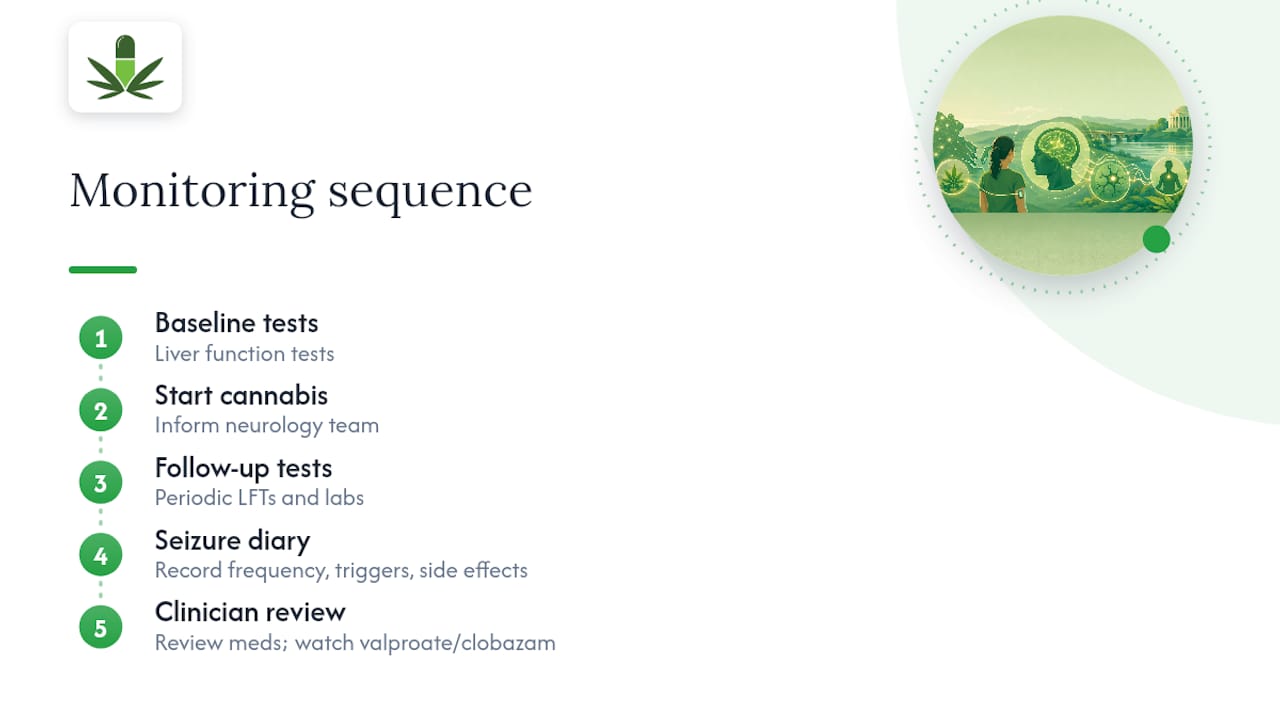
Caregivers play a direct role here too. Note any new drowsiness, appetite changes, or behavior shifts, and bring them up at the next appointment instead of waiting for something to escalate.
What this guide gets right that other advice misses
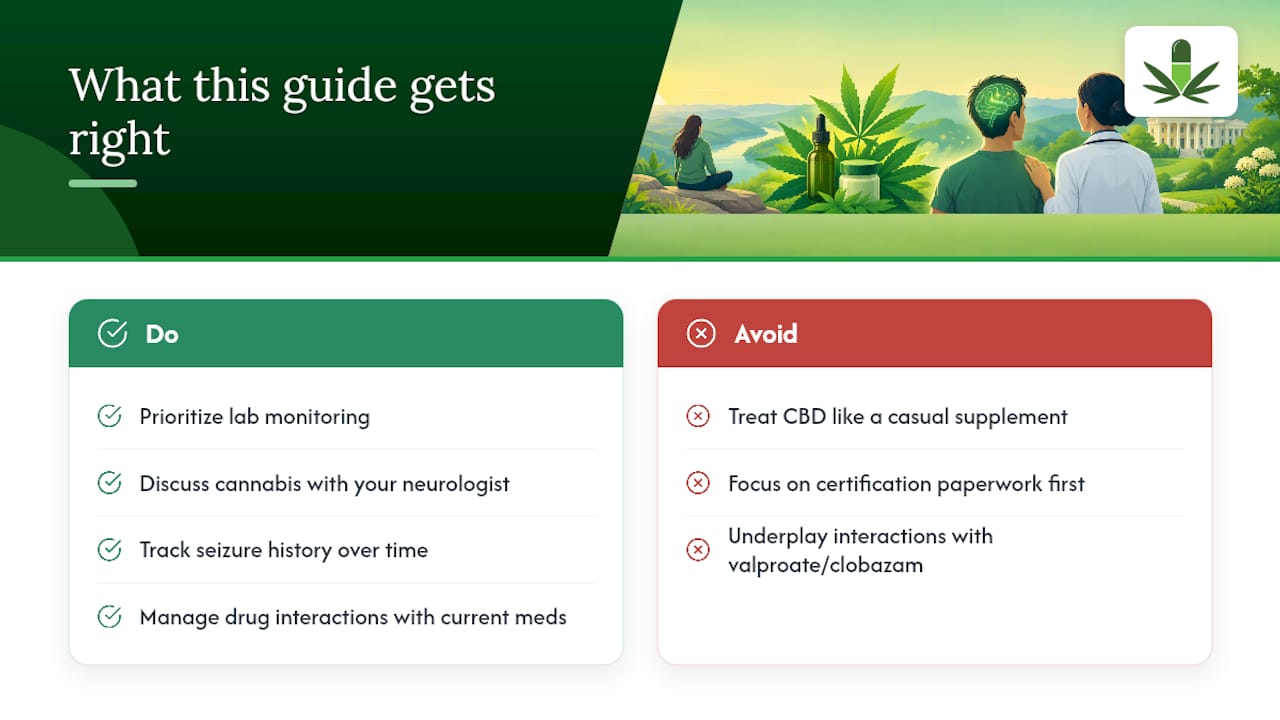
Most articles on this topic treat “does epilepsy qualify” as the whole question, when it’s really the easy part. The harder, more useful question is how you integrate cannabis into a treatment plan that already involves other medications, a neurologist, and a seizure history that needs tracking over time. That’s where the real risk and the real benefit both live.
The conventional advice tends to underplay drug interactions, treating CBD like a supplement rather than a compound that measurably raises clobazam levels and liver enzymes in combination with valproate. It’s not dangerous to use, but it’s not casual either. If you take one thing from this guide, prioritize the lab monitoring and the conversation with your neurologist over the certification paperwork itself. The paperwork is the easy part. Managing the interaction between cannabis and your existing regimen is the part that actually determines whether this helps you.
— Jonathan
Getting certified quickly through Virginia Medical Cannabis Certifications
Once you’ve decided cannabis is worth discussing with a practitioner, the certification itself doesn’t need to take weeks. Virginia Medical Cannabis Certifications offers same-day virtual evaluations built around getting patients a valid written certification without the wait typically associated with in-person specialist visits.

- New certifications require a fee, and the clinical evaluation typically takes about 10 minutes online.
- Renewals require a fee for returning patients who need to keep their certification current.
- The fee may be refunded if you’re not approved, reducing the financial risk in finding out whether you qualify.
For a patient managing epilepsy, that speed matters. A same-day evaluation means you can move from “I want to try this” to holding a valid certification without losing momentum, and without paying full price if the practitioner decides cannabis isn’t the right fit for your case. Visit our services page to book your evaluation and get started.
This article is general information, not a substitute for advice from a qualified doctor. Consult a qualified healthcare professional about your own circumstances before acting on anything here.
Sources
- Virginia Cannabis Control Authority — Patients
- CCA Portal Getting Started Guide — Virginia Cannabis Control Authority
- Epilepsy Foundation — Medical Marijuana
- Meta-analysis and randomized trials of cannabidiol efficacy in severe epilepsy — PMC
- Code of Virginia — § 4.1-1601 Certification for use of cannabis for treatment
FAQ
What conditions qualify for medical marijuana in Virginia?
Virginia law lets a licensed practitioner certify any condition they believe cannabis will likely benefit, rather than limiting approval to a fixed list. Epilepsy and seizure disorders are commonly certified conditions, alongside others like chronic pain and anxiety. Our guide to qualifying conditions breaks down how practitioners typically approach that decision.
Is medical marijuana good for people with epilepsy?
Clinical trials on pharmaceutical cannabidiol show it reduces seizure frequency in Lennox-Gastaut syndrome, Dravet syndrome, and some tuberous sclerosis complex cases, according to research on CBD in severe epilepsy. Dispensary products differ from the pharmaceutical version studied in trials, so benefit and safety should be discussed with your neurologist before starting.
Can you drive if you have epilepsy in Virginia?
Driving eligibility for people with epilepsy in Virginia depends on seizure control and DMV medical review requirements, not on whether you hold a cannabis certification. Cannabis itself can impair driving ability temporarily, so timing use around driving matters regardless of your seizure history. Check with the Virginia DMV directly for the medical review standards that apply to your situation.
What disqualifies you from getting a medical marijuana card?
There’s no fixed disqualifying list under Virginia law. A practitioner declines to certify when they judge that cannabis is unlikely to provide benefit or that the risks outweigh the potential help for your specific case. If that happens with Virginia Medical Cannabis Certifications, the evaluation fee is fully refunded.