
Yes. A Virginia practitioner may issue a written certification for menopause-related symptoms when, in their professional judgment, your diagnosed condition or symptoms may benefit from cannabis. The next move is simple: book an evaluation with an eligible Virginia practitioner and have your ID and medical history ready to discuss.
Table of Contents
- Virginia Eligibility and How the Law Treats Menopause-Related Symptoms
- What Clinicians Evaluate During Your Certification Appointment
- How to Prepare for Your Telehealth Evaluation
- What Happens After Your Certification Is Approved
- Does Marijuana Actually Help With Menopause Symptoms?
- Common Menopause Symptoms Patients Discuss With Certifying Practitioners
- Side Effects and Interactions to Discuss Before You Start
- Legal Limits and Possession Rules for Certified Patients
- Alternative Treatments Worth Discussing With Your Regular Care Team
- Strains, Dosages, and Methods: What to Discuss at the Dispensary
- A Clinician-First Way to Approach Your Visit
- Get Your Virginia Certification the Fast, Refundable Way
- FAQ
- Sources
Virginia Eligibility and How the Law Treats Menopause-Related Symptoms
Virginia does not list menopause as a named qualifying condition, and it does not need to. Under Virginia Cannabis Control Authority guidance, a practitioner may issue a written certification whenever they determine that a patient’s diagnosed condition or symptoms may benefit from cannabis use. That means hot flashes, sleep disruption, mood changes, or joint pain tied to menopause can all be part of the conversation, as long as a licensed practitioner reviews your case and agrees.
Who can actually certify you? Licensed physicians (MD or DO), physician assistants, and qualifying advanced practice registered nurses all have the authority to issue certifications in Virginia. Basic eligibility is straightforward: you need to be a Virginia resident, carry a valid government-issued ID, and be 18 or older, or have a parent or legal guardian involved if you are a minor. Once issued, a certification can remain valid for up to one year before you need to renew.
There is no checkbox on a form that says “menopause.” Instead, the practitioner is evaluating you as a whole person: your symptoms, your history, and whether cannabis makes clinical sense for your situation. That is why the appointment itself matters more than the label you walk in with.
What Clinicians Evaluate During Your Certification Appointment
Virginia regulations spell out exactly what a certifying practitioner has to do before signing off. According to 3VAC10-30-30, the practitioner must assess you, review your medical and prescription history, weigh the benefits against the risks, and build an actual treatment plan rather than just approving a request.
Practitioners are also required to access or confirm access to the Virginia Prescription Monitoring Program, so expect your current medications to come up. If you take something that could interact with cannabis, your clinician needs to know before, not after, you pick up your first product.
During a menopause-focused visit, this usually means talking through:
- Which symptoms bother you most, such as sleep loss, hot flashes, anxiety, or joint pain.
- Any medications or supplements you currently take for menopause or other conditions.
- Your relevant medical history, including past diagnoses that might affect how cannabis interacts with your body.
- How you would administer cannabis, and what the practitioner expects in terms of follow-up care.
The clinician is required to explain administration methods and risks before you leave the visit, and to remain available for follow-up. A rushed visit that skips this step is not meeting the standard the regulation sets.
How to Prepare for Your Telehealth Evaluation
A little preparation turns a 10-minute telehealth visit into a genuinely useful conversation. Bring a valid Virginia ID and be ready to confirm your address, since your legal name, date of birth, and address need to match across every step of the process, from your intake form to your CCA Portal account later on.
Write down your menopause symptoms before the call. Hot flashes, insomnia, mood swings, and joint pain are common, but vague descriptions make it harder for a practitioner to build a treatment plan. Specifics help: how often symptoms occur, how long they last, and what you have already tried.

Have your medication list ready, including anything over the counter, since the practitioner needs your prescription history to assess interactions. If you have a copy of a recent diagnosis or lab result related to menopause, keep it nearby, though it is not always required.
Finally, make sure your internet connection and device camera work before your appointment time. Telehealth visits move quickly, and a technical delay can push you to the back of the queue. If you are also managing your account details, our guidance on updating your address before you apply can help you avoid a portal mismatch later.
What Happens After Your Certification Is Approved
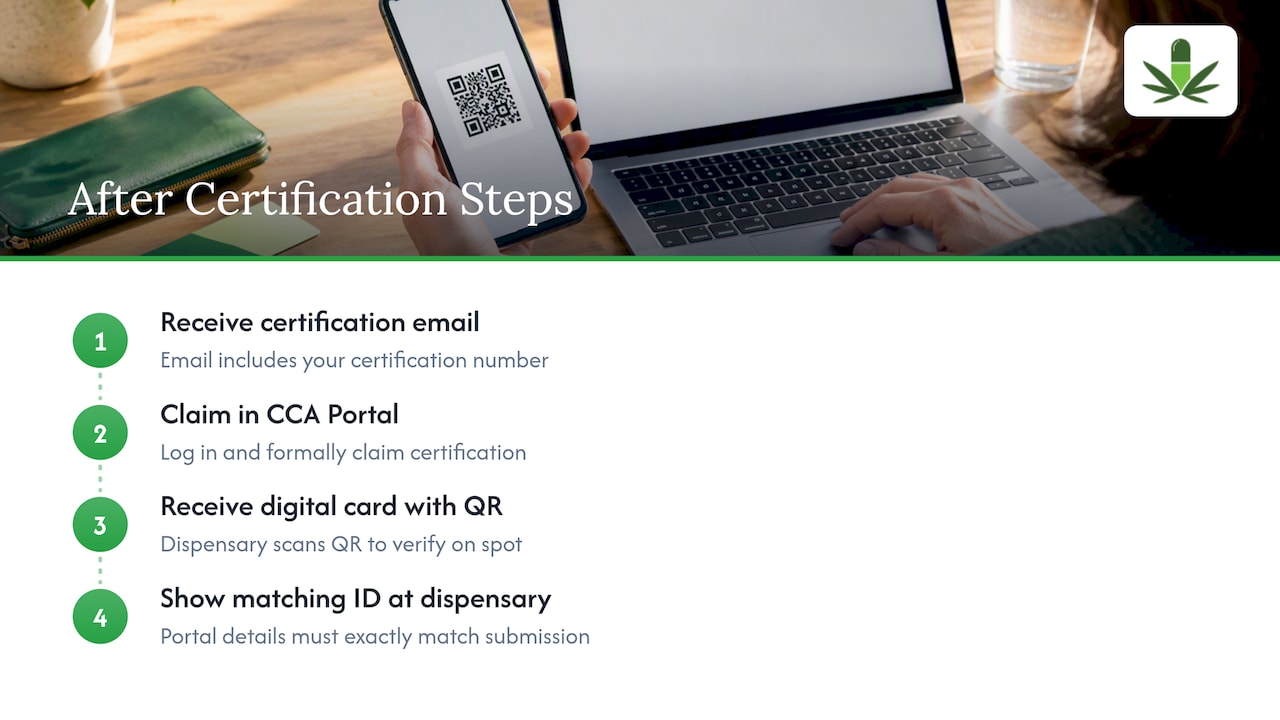
Approval is not the finish line. Once a practitioner issues your certification, you receive an email with a certification number, but you still need to log into the CCA Portal and formally claim it. This step gets skipped more often than you would think, and it is the single biggest reason patients get stuck at the dispensary counter.
When you claim your certification, the portal generates a digital card with a QR code. Dispensaries scan that code to verify your certification on the spot, so there is no physical card to lose or forget. The catch is that your portal account details, full legal name, date of birth, and address, need to match exactly what your practitioner submitted. A typo or an old address from a previous move is enough to cause a rejection.
Registration with the CCA is optional for most patients, but if you want to designate a registered agent to pick up your cannabis on your behalf, that requires a separate registration and a $25 fee, and one agent can serve no more than two patients, according to 3VAC10-30-50.
Once your digital card is active, you can locate a licensed dispensary through the CCA’s dispensary directory, since availability and product selection vary by region. Our own guide to Virginia dispensaries walks through what to expect at your first visit.
Does Marijuana Actually Help With Menopause Symptoms?
This is where we have to be honest about the limits of what is known. Virginia’s certification process does not require proof that cannabis is an effective menopause treatment. It requires a practitioner’s professional judgment that your symptoms may benefit, which is a different, more individualized standard.
Cannabis is not an approved or government-endorsed treatment for menopause symptoms specifically, and no Virginia regulation classifies it that way. What the certification pathway offers is legal access, decided case by case in a clinical visit, rather than a blanket medical endorsement. If your practitioner believes a trial makes sense for your sleep, mood, or pain symptoms, that judgment, documented in a treatment plan, is what makes the certification valid under state code.
Safety depends heavily on your individual health picture: current medications, other conditions, and how your body responds. This is exactly why the practitioner visit includes a prescription history review, not just a symptom checklist. Treat the visit as a real medical evaluation, and you are far more likely to get a plan that actually fits your situation.
Common Menopause Symptoms Patients Discuss With Certifying Practitioners
Patients pursuing certification for menopause-related reasons typically bring up a cluster of recurring symptoms during their evaluation. Sleep disruption tops the list for many, since hot flashes and night sweats make consistent rest difficult. Mood changes, including irritability and anxiety that feel out of proportion to daily stress, come up frequently as well.
Joint and muscle discomfort is another common thread, often described as a new ache that was not present before. Some patients also mention low mood or a general sense of mental fog that interferes with work or daily tasks.
None of these symptoms guarantees certification on their own. What matters is how you describe them, how long they have lasted, and whether your practitioner believes your specific presentation may benefit from cannabis use. A vague “I don’t feel like myself” is harder to evaluate than “I’ve had disrupted sleep most nights for the past four months, and it’s affecting my concentration at work.”
Side Effects and Interactions to Discuss Before You Start
Cannabis affects people differently, and menopause adds its own variables to the mix, including changes in metabolism and existing medication use. Common side effects reported with cannabis use include drowsiness, dry mouth, changes in appetite, and short-term effects on memory or concentration. These effects tend to vary by method of use and individual tolerance.
Interactions are the bigger concern for many menopause patients, particularly those on blood thinners, antidepressants, or hormone therapy. This is precisely why Virginia regulation requires practitioners to check the Prescription Monitoring Program and review your medication history before certifying you, per 3VAC10-30-30. A practitioner who skips this step is not doing their job correctly.
Pro Tip: Ask your certifying practitioner directly how a potential interaction with your current medications would be handled, and request that the answer be part of your documented treatment plan, not just a verbal reassurance.
If you experience unexpected side effects after starting cannabis, your certifying practitioner is required to remain available for follow-up. Use that resource rather than guessing or adjusting your use on your own.
Legal Limits and Possession Rules for Certified Patients
Once certified and registered through the CCA Portal, you can legally purchase cannabis products from a licensed Virginia dispensary. Possession limits and product types available are set by state regulation and enforced at the dispensary level, so your certified status and matching ID are what dispensaries check at the point of sale.
It helps to separate two different legal questions that often get blurred together. Virginia’s insurance law addresses whether health plans must cover menopause-related medical care, but it has no bearing on cannabis eligibility, according to the relevant insurance statute. Practitioner certification authority is a separate legal track, governed by its own statute, and the two do not overlap.
Staying within Virginia’s legal framework means keeping your certification current, renewing before it expires, and purchasing only from licensed dispensaries. For a broader look at how these rules fit together, our overview of Virginia marijuana laws covers the practical side in more detail.
Alternative Treatments Worth Discussing With Your Regular Care Team
Cannabis certification is one option among several for managing menopause symptoms, and a thoughtful practitioner will likely ask what else you have tried or considered. Hormone therapy remains a standard medical approach for many patients and is worth discussing with your primary care provider or gynecologist before or alongside a cannabis evaluation.
Lifestyle approaches, including sleep hygiene changes, exercise, and dietary adjustments, are commonly recommended first lines of symptom management. Some patients also explore non-cannabis topical or botanical options for related concerns, such as menopause-related hair changes, as part of a broader symptom-care routine alongside their regular medical treatment.
The strongest approach is coordination, not substitution. Mentioning your menopause care team during your cannabis certification visit, and vice versa, helps both providers build a treatment plan that actually accounts for everything you are taking and trying.
Strains, Dosages, and Methods: What to Discuss at the Dispensary
Once you are certified, the specific strain, dosage, and consumption method become conversations for your dispensary’s pharmacist and your certifying practitioner, not a one-size-fits-all formula. Dispensary staff are positioned to walk through product options based on your certification and your stated goals, whether that is better sleep or steadier mood.
Method matters as much as strain. Inhaled products act quickly but wear off sooner, while edibles take longer to kick in and last longer, which changes how you would time a dose around symptoms like nighttime hot flashes. If you are new to cannabis, starting low and adjusting slowly is a more sustainable approach than guessing at an effective dose on day one.
Administration questions, including how dosing and delivery methods compare for safety with regular use, are worth raising directly, and general safety comparisons between consumption methods can offer useful background before that conversation. Your certifying practitioner is required to explain administration and risks as part of your visit, so use that discussion to settle on a starting point rather than leaving the dispensary to make every decision alone.
A Clinician-First Way to Approach Your Visit
Walking into your evaluation with full honesty about your current menopause care and medications gets you a better outcome than trying to steer the conversation toward a specific product. Tell your practitioner what you are already taking, what has helped, and what hasn’t.
Before you leave the visit, ask directly: who handles follow-up if something feels off, and how often will check-ins happen? A practitioner who can answer clearly, and who documents a real treatment plan rather than a one-line approval, is doing the job the regulation asks of them.
A streamlined evaluation does not have to mean a shallow one. We built our process around a 10-minute online evaluation with same-day emailed certification specifically so that speed does not come at the cost of a clinician actually reviewing your case.
— Jonathan
Get Your Virginia Certification the Fast, Refundable Way
If menopause symptoms are affecting your sleep, mood, or daily comfort, waiting weeks for an appointment shouldn’t be part of the process. We built our evaluation to take about 10 minutes online, with a same-day emailed certification for patients who qualify, so you can move from conversation to dispensary without unnecessary delay.

Here’s what to expect when you book with us:
- A flat fee for new certifications and renewals, both one-time charges.
- A same-day emailed certification for approved patients, ready for the CCA Portal claim step.
- A real clinical conversation with a clinician, not a form you fill out alone.
Have your Virginia ID, address, and a short list of your menopause symptoms ready before your appointment. Check your eligibility and book your evaluation through our services page today.
This article is general information, not a substitute for advice from a qualified doctor. Consult a qualified healthcare professional about your own circumstances before acting on anything here.
FAQ
Can a practitioner certify me for menopause symptoms specifically?
Yes, if a Virginia practitioner determines that your diagnosed condition or symptoms may benefit from cannabis, they can issue a written certification. There is no separate “menopause” category required under Virginia’s certification standard.
How long does a Virginia medical cannabis certification last?
A certification issued by a qualified Virginia practitioner can remain valid for up to one year before renewal is required, according to CCA patient guidance. You will need a new evaluation to renew once it expires.
What happens after my certification is approved?
After approval, you receive an email with a certification number, but you still need to log into the CCA Portal to claim it and generate your digital card. Dispensaries scan the card’s QR code to confirm your certification before a purchase.
How much does a certification cost through your service?
New certifications cost $50 and renewals cost $40, both one-time fees, through our services page. If your evaluation determines you do not qualify, that fee is fully refunded.
Do I need to register with the CCA separately?
Registration is optional for most patients and is mainly relevant if you want to designate a registered agent to pick up cannabis on your behalf. That option involves a separate registration and a $25 fee, per Virginia administrative code.