
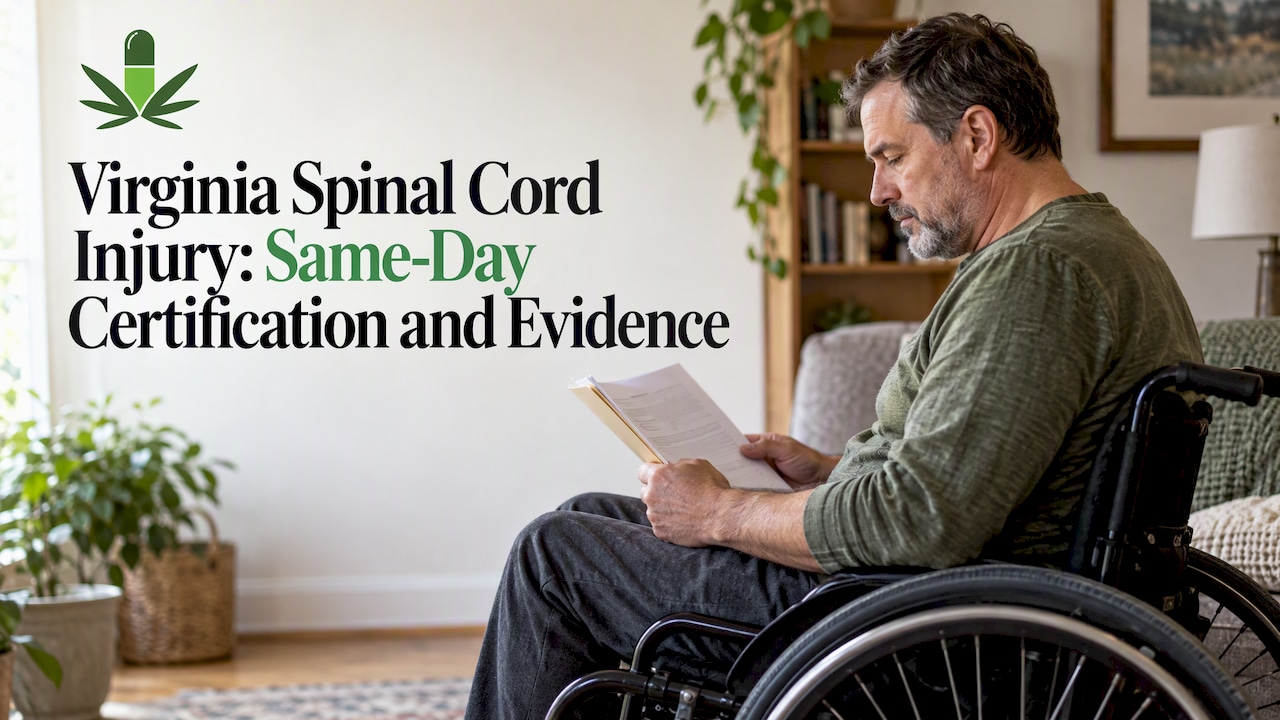
Yes. If a Virginia-licensed practitioner determines that medical cannabis may help with your spinal cord injury symptoms, you can receive a written certification that lets you shop at any licensed Virginia dispensary. Spinal cord injury isn’t on a special list, but chronic pain and spasticity, two of its most common effects, are exactly the kind of symptoms practitioners certify every week. Your next step is simple: book a clinical evaluation, in person or by telemedicine, and bring your medical history.
Table of Contents
- How Virginia decides who qualifies for medical cannabis
- What the research says about cannabis for pain and spasticity after SCI
- Preparing for your certification visit
- Choosing products and staying safe with spinal cord injury
- Making sense of the gap between access and evidence
- Getting certified through Virginia Medical Cannabis Certifications
- FAQ
- Sources
How Virginia decides who qualifies for medical cannabis
Virginia doesn’t work off a fixed list of approved diagnoses. Instead, the Virginia Cannabis Control Authority leaves the call to your practitioner’s clinical judgment: if they believe medical cannabis may benefit your condition, they can certify you. For spinal cord injury, that usually means certifying around the pain, spasticity, or sleep disruption that comes with it, not the injury label itself.
A few practical rules shape who can do this and how:
- Certifications can be issued by a licensed physician, physician assistant, or advanced practice registered nurse.
- You must be a Virginia resident, and you need to be at least 18 or have a parent or guardian involved if you’re a minor.
- Telemedicine visits are allowed, so you don’t have to find an in-person appointment.
- Virginia no longer requires annual state registration as of July 1, 2022, which cuts a step out of the old process.
Once issued, your written certification is what dispensary staff check, along with your state ID, before they let you purchase. Certifications are generally valid for up to a year, and you can add a registered agent at issuance if someone else needs to pick up your products for you.
What the research says about cannabis for pain and spasticity after SCI
The honest answer is: the evidence is mixed, and it’s thinner than most people expect. A systematic review of cannabinoid use in people with spinal cord injuries found that many patients report feeling better, particularly for pain and spasticity, but the controlled trials behind those reports are small, inconsistent, and not strong enough to call the benefit proven.
A 2020 systematic review of cannabinoids in spinal cord injury found frequent observational reports of symptom relief alongside a shortage of high-quality randomized trials, meaning the real-world experience outpaces the controlled science.
That gap matters for how you think about risk and benefit:
- Randomized trials in SCI populations have been small, and results for pain relief haven’t been consistent enough to call cannabinoids a reliable fix.
- Adverse events like dizziness, somnolence, and dysgeusia (a altered sense of taste) show up often enough in the literature to take seriously.
- Observational and preclinical data lean more positive for spasticity than for pain, but neither is settled science.
- Not every cannabis product is equal: the FDA distinguishes approved cannabinoid drugs from unapproved dispensary products, and that difference affects dosing consistency and safety oversight.
Epidiolex, for example, is FDA-approved for specific seizure disorders and has gone through the agency’s full safety and efficacy review. Most dispensary products haven’t, which means potency and composition can vary batch to batch. The clinical bottom line: some people with SCI do feel real relief from pain or spasticity, but the evidence supporting that outcome is still considered low quality, so ongoing monitoring with your care team isn’t optional, it’s the point.
Preparing for your certification visit
Walking into your evaluation prepared makes the whole process faster and gives your practitioner better information to work with.
- Gather your medical records, including any MRI or imaging reports that show the location and severity of your spinal cord injury.
- Bring your rehabilitation notes or physical therapy summaries if you have them; they help document how your symptoms affect daily function.
- List your current medications, including muscle relaxants, opioids, or anything else you’re taking for pain or spasticity.
- Bring a government-issued ID and proof of Virginia residency, such as a utility bill or lease.
- Expect the practitioner to review your history, discuss potential benefits and risks, and document a treatment plan, which may include authorization for botanical cannabis and registered agent details.
You can find certifying clinicians through the Virginia Cannabis Control Authority’s provider directory or through a reputable telehealth certification service. Costs and turnaround vary by provider, so it’s worth comparing what Virginia certifications typically cost before you book.
Pro Tip: Bring your imaging reports or a rehab consult note even if they’re a few years old. Objective documentation of your spinal cord lesion gives the certifying practitioner something concrete to work from, which speeds up the evaluation.
After certification, keep a copy (digital or printed) on hand for dispensary visits, and plan a follow-up with your practitioner to track how well the product is working and whether your treatment plan needs adjusting.
Choosing products and staying safe with spinal cord injury
Not all cannabis products behave the same way, and that matters more when you’re managing spasticity, neuropathic pain, or mobility limits from SCI.
- Inhaled products act fastest but wear off quickest; oral edibles take longer to kick in and last longer, which can complicate dosing if you’re new to cannabis.
- Sublingual sprays and tinctures sit in between, offering a bit more control over onset than edibles.
- Topicals won’t address systemic pain or spasticity but may help with localized discomfort without any cognitive effects.
- Start with the lowest reasonable dose and go slowly. CNS depression and sedation raise fall risk, which is a bigger concern when you already have mobility or balance challenges.
- Avoid driving or operating equipment while you’re still learning how a product affects you.
Cannabis can interact with opioids, benzodiazepines, and muscle relaxants, which are common prescriptions after spinal cord injury. Talk to your prescribing providers before combining them, since the sedative effects can stack up in ways that aren’t obvious until they happen.
Product consistency is part of the safety picture too. Dispensary products aren’t FDA-reviewed the way approved cannabinoid medications are, so potency can shift between batches. If you notice side effects or something feels off, tell your practitioner so it gets documented and addressed.
Pro Tip: Keep a simple symptom log for the first few weeks, noting dose, timing, and how you felt. It turns a vague “it helped” into something your practitioner can actually act on at your follow-up visit.
Making sense of the gap between access and evidence
Here’s the honest tension in this whole topic: Virginia makes it genuinely easy to get certified for spinal cord injury related symptoms, but the clinical evidence supporting cannabis for SCI pain and spasticity hasn’t caught up to that access. That’s not a reason to dismiss it. It’s a reason to treat certification as the start of a monitored trial, not a finished solution.
The patients who do best tend to treat cannabis as one piece of a larger plan, alongside physical therapy, medication management, and regular check-ins, rather than a standalone fix. Keep your primary care and rehab specialists in the loop even if they aren’t the ones certifying you. A documented treatment plan and honest follow-up conversations do more for your outcome than the product itself.
— Jonathan
Getting certified through Virginia Medical Cannabis Certifications
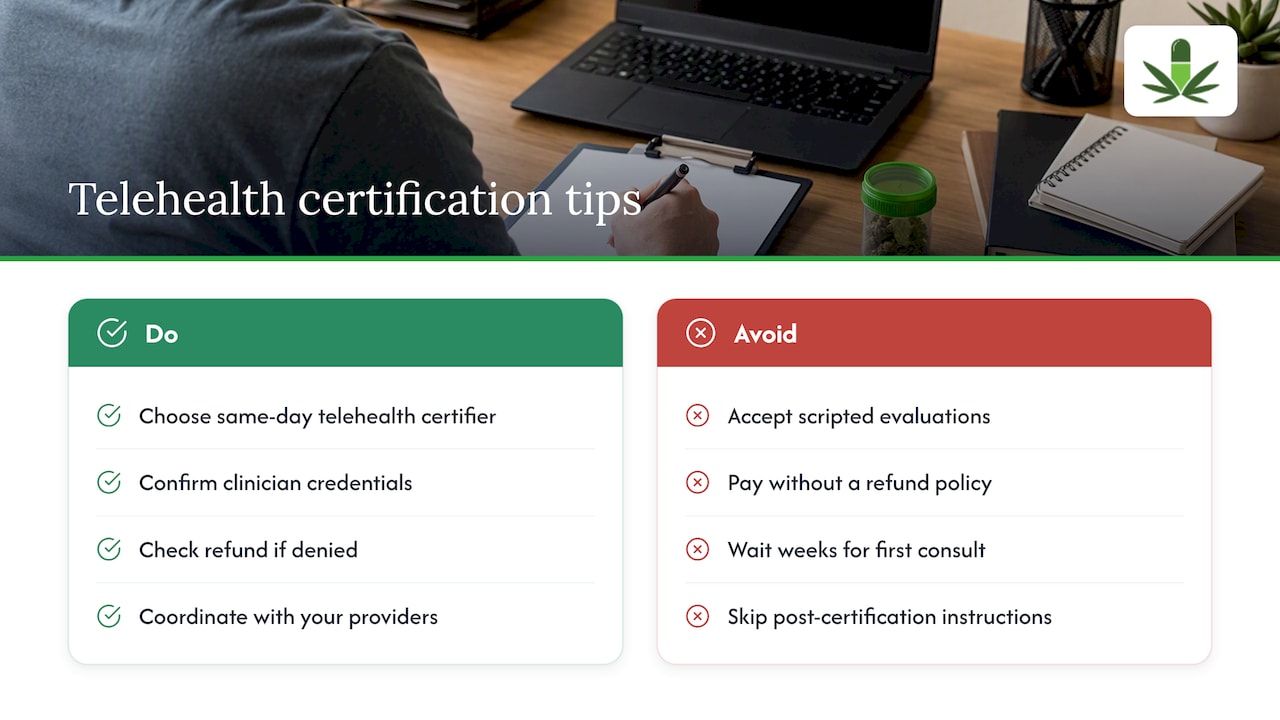
If you’d rather skip the search for an in-person appointment, we handle medical cannabis certifications entirely online. Evaluations take about 10 minutes, we offer same-day turnaround, and a licensed clinician reviews your case directly rather than running you through a generic script.

New certifications and renewals cost a fee, and if you don’t qualify, we refund the fee in full. That’s worth checking when you compare any telehealth certifier: look for clear clinician credentials, a straightforward refund policy, and explicit instructions for what happens after you’re certified.
For spinal cord injury specifically, same-day access matters. You shouldn’t have to wait weeks for an appointment just to start a conversation about pain or spasticity management, and our process is built so you don’t have to. That said, your certifying clinician still makes the clinical call, and we encourage ongoing coordination with your other providers for the best outcome. You can book a new certification or renewal whenever you’re ready.
This article is general information, not a substitute for advice from a qualified doctor. Consult a qualified healthcare professional about your own circumstances before acting on anything here.
FAQ
What is the new Virginia law on marijuana?
Virginia’s medical cannabis program no longer requires patients to renew an annual state registration, a change that took effect July 1, 2022, under Virginia Cannabis Control Authority rules. Practitioners still issue written certifications directly, and those remain valid for up to a year.
What disqualifies you from getting a medical marijuana card?
Virginia doesn’t publish a list of disqualifying conditions; eligibility comes down to whether a licensed practitioner judges that medical cannabis may help your specific symptoms. You’d typically be turned down only if the practitioner doesn’t see a clinical reason for it or if you don’t meet residency and ID requirements.
Is marijuana bad for the spine?
Current research hasn’t shown that cannabis itself harms spinal cord tissue, but a systematic review of cannabinoid use in spinal cord injury found that evidence for pain relief is inconsistent and that side effects like dizziness and sedation are common. For people with SCI, those side effects raise fall risk, so starting low and monitoring closely matters more than the spine concern itself.
What medical conditions qualify for a medical marijuana card in West Virginia?
This article covers Virginia’s program specifically, not West Virginia’s, since the two states run separate medical cannabis laws with different qualifying rules. If you live in Virginia, eligibility is based on your certifying practitioner’s clinical judgment rather than a fixed condition list.
Sources
- Patients & Caregivers — Virginia Cannabis Control Authority
- FDA and cannabis research and drug approval process — FDA