
Yes, palliative and hospice patients in Virginia can legally access medical cannabis once a registered practitioner issues a written certification, and in many hospice settings, authorized staff can store and administer cannabis oil as part of ongoing care. The practical first step is simple: schedule an evaluation with an eligible practitioner, in person or by telemedicine where allowed, to get that certification started and plan how dispensing or a registered agent will work for your situation.
Table of Contents
- Virginia Law and Recent Updates Affecting Hospitals, Hospices, and Palliative Care
- Who Can Certify You, and How Does the Process Work?
- How Hospice and Facility Staff Handle Storage and Administration
- Getting Products: Dispensaries, Delivery, and Supply Limits
- Documentation and Coordination for Palliative Care Providers
- Balancing Access and Clinical Stewardship in Virginia Palliative Care
- Getting a Same-Day Certification Through Virginia Medical Cannabis Certifications
- FAQ
- Sources
Virginia Law and Recent Updates Affecting Hospitals, Hospices, and Palliative Care
Virginia’s medical cannabis framework rests on practitioner judgment rather than a government checklist, with adjunctive supportive therapy options like hypnotherapy for cancer anxiety available to manage symptoms during palliative care. Under § 4.1-1601, a licensed practitioner decides whether a patient has a condition that may benefit from cannabis treatment, and there is no fixed list of qualifying diagnoses to match against. That flexibility matters for palliative and hospice patients, whose needs (pain, nausea, appetite loss, anxiety near the end of life) often don’t fit neatly into a rigid list.
Two other statutes shape how this plays out at the bedside. § 32.1-162.6:1 permits authorized hospice and hospice facility employees to store, dispense, or administer cannabis oil to a patient who holds a valid written certification. Alongside it, § 18.2-251.1:2 shields those same employees from prosecution when they’re acting within that authorization, so facility staff aren’t left guessing about legal exposure.
The Virginia Cannabis Control Authority (CCA) oversees how all of this works in practice, including the rollout of dispensaries across the state’s regions.
- Practitioners determine eligibility case by case, with no preset condition list.
- Hospice staff can legally handle cannabis oil for certified patients under state law.
- Facility employees acting within their authorization are protected from criminal prosecution.
Who Can Certify You, and How Does the Process Work?
Certification in Virginia starts with a qualified practitioner, not a pharmacy or a dispensary. Eligible practitioners include medical doctors, doctors of osteopathic medicine, physician assistants, and advanced practice registered nurses, and the CCA’s patient guidance confirms that these clinicians rely on their own professional judgment rather than a mandated symptom checklist. For palliative patients, that means a conversation about your diagnosis, your symptoms, and whether cannabis fits reasonably into your care plan.
Here’s roughly how the process unfolds:
- You confirm Virginia residency and bring a valid photo ID to your appointment, whether that happens in person or by telemedicine.
- A licensed practitioner reviews your medical history and issues a written certification through the CCA Portal if they determine cannabis may help.
- That certification can remain valid for up to one year, at the practitioner’s discretion, before renewal is needed.
- For minors or patients who can’t manage pickup themselves, a registered agent can be designated to receive products on their behalf.
Practitioners submit certifications directly through the CCA Portal, where their license is verified before any certification is issued. One detail worth knowing: a practitioner cannot issue your certification while physically present at a dispensary or processor, and processors aren’t allowed to promote specific certifying clinicians. That separation keeps the clinical decision independent from the business of selling cannabis.
How Hospice and Facility Staff Handle Storage and Administration
For hospice teams and facility staff, the law gives fairly specific permission to integrate cannabis oil into routine care once a patient is certified. Under § 32.1-162.6:1, authorized employees who normally handle medications can store, dispense, and administer cannabis oil for a patient holding a valid written certification, treating it as part of the broader medication routine rather than something handled outside normal channels.
In practice, that means:
- Cannabis oil gets logged in medication records the same way other prescribed treatments are tracked.
- Only staff already authorized to handle medications take on this responsibility, not any available employee.
- A registered agent can be designated when a patient needs help with pickup or can’t manage logistics independently.
At the dispensary end, pharmacists verify the certification and patient identity before the first dispensing, which gives facilities a built-in check before cannabis oil ever reaches a patient’s bedside. Coordinating that first verification early, before symptoms escalate, tends to save families a stressful scramble later.
Pro Tip: Loop in your hospice’s medication-management team as soon as certification is issued, not after the first dispensary trip, so storage and administration protocols are ready when the product arrives.
Getting Products: Dispensaries, Delivery, and Supply Limits
Virginia divides the state into five Health Service Areas (HSAs), each served by a licensed pharmaceutical processor that operates dispensaries. The CCA has continued expanding this network, including the opening of a new dispensary in HSA 1 in 2026, part of an ongoing regional rollout. Patients aren’t limited to their home HSA, so checking the CCA’s processor and dispensary listings is the practical way to find the closest option.
Supply limits and logistics to keep in mind:
- Dispensing pharmacists can authorize up to a 90-day supply at a time, based on their own clinical judgment.
- Botanical cannabis is capped at four ounces within any 30-day period.
- Patients should bring valid ID and their certification confirmation to every dispensary visit.
- Homebound palliative patients can arrange delivery or designate a registered agent to handle pickup.
For patients managing symptoms from home, scheduling that first pharmacist verification in advance, and confirming whether delivery is available in your HSA, cuts down on avoidable delays.
Documentation and Coordination for Palliative Care Providers
Clinicians certifying palliative patients should document the clinical reasoning behind the certification, not just the diagnosis. Noting the specific symptoms cannabis is intended to address (breakthrough pain, nausea refractory to standard antiemetics, appetite stimulation) gives the chart a clear rationale and supports continuity if another provider picks up the case later.
It also helps to document any route or form discussed with the patient, since dispensing limits (the 90-day supply ceiling and four-ounce botanical cap per 30 days) can shape what’s realistic to recommend. Coordination with the dispensing pharmacist matters here too: confirming the written certification is active, noting a registered agent when one is involved, and making sure the handoff to facility staff is clear before the product arrives.
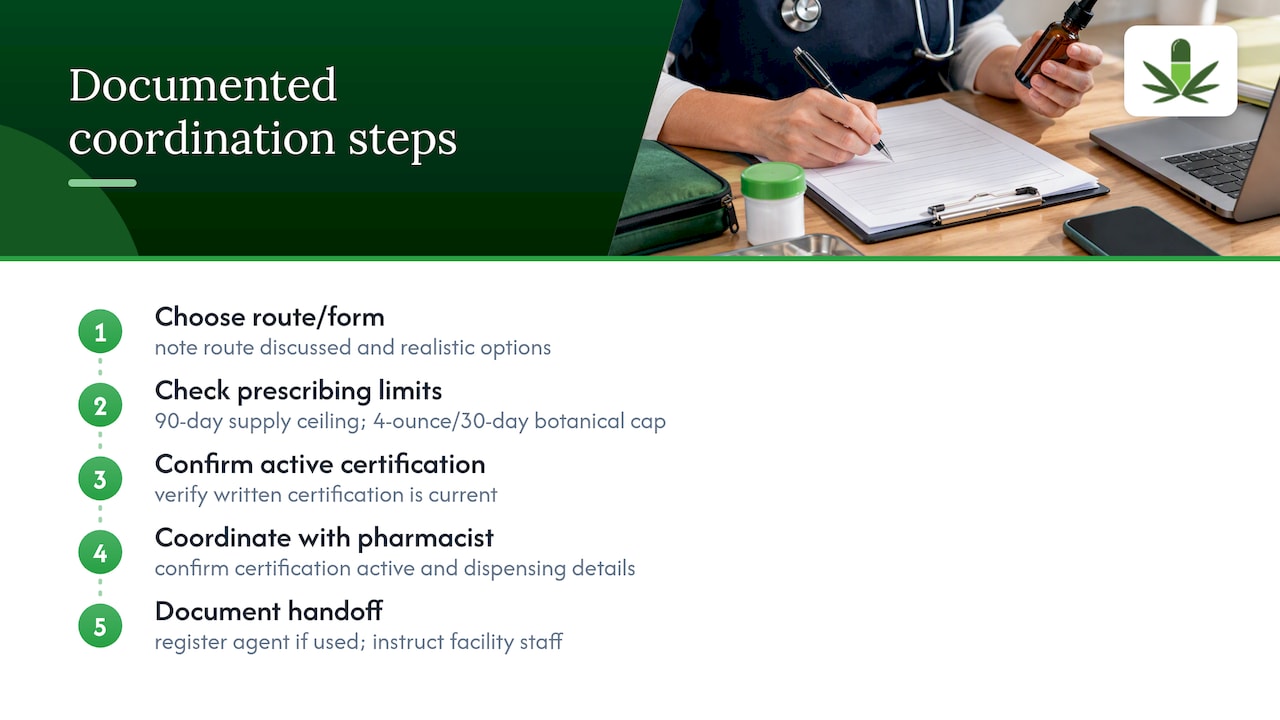
Pro Tip: A short chart note along the lines of “cannabis certification issued for symptom management; registered agent designated for pickup; hospice staff to administer per facility protocol” keeps everyone on the same page without overcomplicating the record.
Balancing Access and Clinical Stewardship in Virginia Palliative Care
Working alongside Virginia patients and clinicians through Virginia Medical Cannabis Certifications, I’ve come to see timely certification as a quality-of-life issue, not a formality. A patient waiting weeks for paperwork while symptoms worsen is a real cost, and clear documentation from the start makes every later step, from pharmacist verification to hospice administration, go smoother. Practitioners and facilities that lean on CCA resources and plan registered agent or delivery logistics early tend to avoid the scramble that otherwise falls on families during an already hard time.
— Jonathan
Getting a Same-Day Certification Through Virginia Medical Cannabis Certifications
We built our process around exactly the kind of timeline palliative patients and their families don’t have to spare. A new certification costs $50 with a fully refundable fee if you don’t qualify, and the clinical evaluation itself takes about 10 minutes online. Renewals run $40 and follow the same same-day structure.

For palliative patients, that speed matters: a telemedicine evaluation means you don’t need to leave home or a care facility to get certified, and we can help you plan ahead if a registered agent will be handling pickup or delivery on your behalf.
- Same-day telehealth evaluations, completed online in about 10 minutes.
- $50 for new certifications, $40 for renewals, both fully refundable if you don’t qualify.
- Support for registered agent arrangements when a patient can’t manage pickup independently.
If you’re ready to start, book your evaluation for a new certification or head to our renewal page if your certification is coming up for expiration. You can also review our refund and liability terms before you book, so there are no surprises.
This article is general information, not a substitute for advice from a qualified doctor. Consult a qualified healthcare professional about your own circumstances before acting on anything here.
FAQ
What is the new law on marijuana in Virginia?
Virginia’s medical cannabis law allows licensed practitioners, including MDs, DOs, physician assistants, and APRNs, to issue written certifications based on clinical judgment rather than a fixed list of qualifying conditions, as outlined by the Virginia Cannabis Control Authority. Separate statutes also permit authorized hospice and hospital staff to store, dispense, and administer cannabis oil to certified patients under § 32.1-162.6:1.
What disqualifies you from getting a medical marijuana card?
Virginia doesn’t publish a specific disqualification list; eligibility comes down to a practitioner’s professional judgment about whether your condition may benefit from cannabis, along with meeting residency, age, and ID requirements through the CCA’s patient guidance. If a practitioner determines cannabis isn’t appropriate for your situation, they simply won’t issue a certification.
What state has the toughest marijuana laws?
This varies widely by state and changes over time as laws are updated, so there’s no single authoritative answer we can point to here. What we can say with confidence is that Virginia has established a clear, practitioner-driven medical cannabis pathway, with statutory protections for hospice and facility staff built into the law.
Can you smoke marijuana in your backyard in Virginia?
Public consumption of cannabis is illegal in Virginia regardless of medical certification, and the law generally limits consumption to private residences, per Virginia Code Title 4.1. A backyard on your own private property typically falls under “private residence,” but anywhere visible or accessible to the public carries legal risk.
Sources
- Patients & Caregivers — Virginia Cannabis Control Authority
- § 32.1-162.6:1. Possession or administration of cannabis oil (Virginia Code)