

Yes, the smell of weed can trigger a headache or migraine in some people, especially if you are sensitive to strong odors, prone to migraines, or exposed in a poorly ventilated space. If you are feeling symptoms right now, take these steps immediately:
- Move to fresh air or an open window.
- Drink a full glass of water.
- Remove yourself from the source of the smell if possible.
- Sit in a quiet, dim room and rest.
The short version: Cannabis odor contains terpenes and volatile compounds that can activate sensory nerves and trigger headaches in sensitive individuals. Smoke exposure adds particulate irritants on top of that. Avoidance and ventilation are your best tools.
Table of Contents
- Can the smell of weed give you a headache? Here’s why it happens
- Who is most likely to get a headache from cannabis smell?
- What does a weed-related headache feel like, and how long does it last?
- Fast relief: how to get rid of a weed headache now
- How to prevent headaches from cannabis odor at home and in shared spaces
- Myths worth clearing up, and what clinicians actually say
- When should you see a doctor about these headaches?
- What the research says about odor-triggered headaches
- Key Takeaways
- A perspective worth sharing
- Further reading and authoritative sources
Can the smell of weed give you a headache? Here’s why it happens
The connection between cannabis odor and headaches comes down to a few overlapping pathways, not a single cause.
Terpenes and volatile organic compounds are the aromatic molecules that give cannabis its distinctive smell. Compounds like myrcene, limonene, and pinene are potent at close range, and some terpenes have been linked to headache reports in sensitive individuals. The same terpene that relaxes one person can overstimulate another’s sensory nerves.

Smoke and combustion byproducts are a separate problem. When cannabis is burned, it releases fine particulate matter and chemical irritants that inflame the airways and nasal passages. UCLA Health lists headache among the recognized side effects of inhaling secondhand marijuana smoke, alongside nausea, eye irritation, and fatigue.
Olfactory and trigeminal nerve activation is the third pathway. Your trigeminal nerve runs through your face and sinuses and is closely tied to migraine physiology. A strong odor, cannabis or otherwise, can stimulate this nerve and set off a migraine cascade in people who are already sensitized. Research on odor-triggered migraine attacks shows that odor sensitivity varies by age, sex, and migraine type.
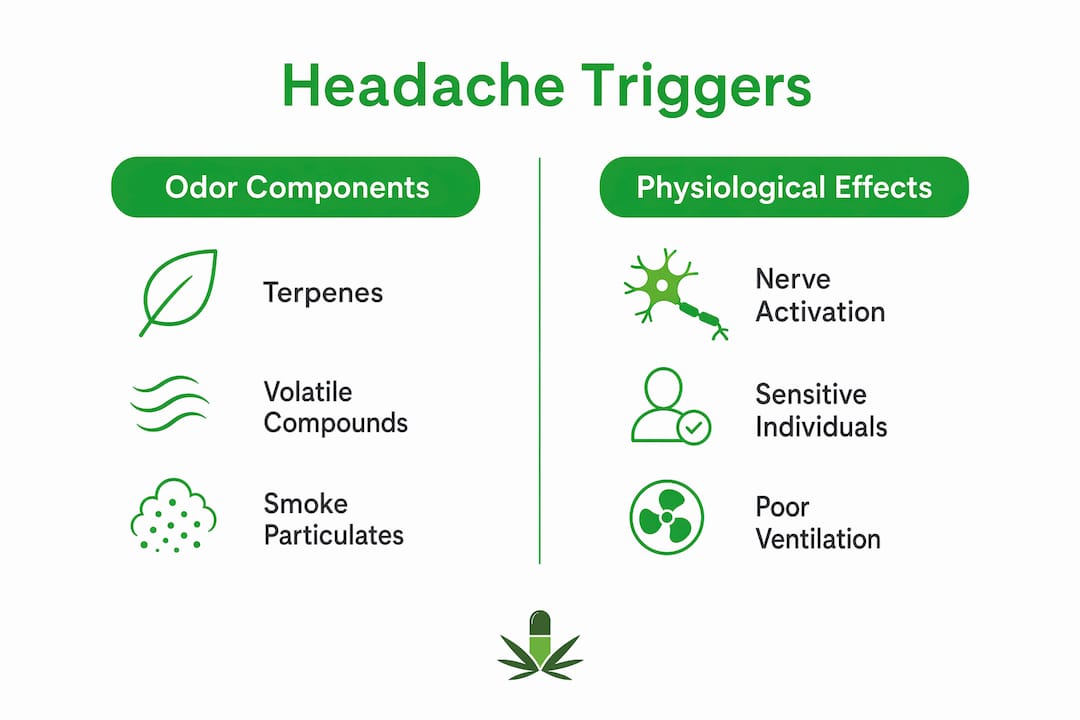
Context amplifies everything. An enclosed room with poor airflow concentrates both terpenes and smoke particulates fast. Indoor smoking and poor ventilation create lingering exposure that non-smokers cannot easily escape.
| Mechanism | What triggers it | Who feels it most |
|---|---|---|
| Terpene irritation | Aromatic compounds in cannabis odor | Odor-sensitive individuals |
| Smoke particulates | Combustion byproducts from burning cannabis | Asthma, sinus, or airway conditions |
| Trigeminal/olfactory nerve | Strong smell activating facial nerve pathways | Migraine sufferers |
| Contextual amplifiers | Enclosed space, high concentration, long exposure | Anyone in a poorly ventilated area |
Pro Tip: If you notice headaches specifically in enclosed spaces with cannabis smoke, open a window or turn on an exhaust fan before exposure begins. Reactive ventilation after the fact is far less effective.
Who is most likely to get a headache from cannabis smell?
Some people are genuinely more vulnerable than others. Knowing your risk profile helps you take prevention seriously before symptoms start.
- Migraine sufferers: If you already experience migraines, you are more likely to have a sensitized trigeminal nerve. Odor is one of the most commonly reported migraine triggers.
- People with multiple chemical sensitivity (MCS): This condition involves heightened reactions to everyday chemicals and odors, and cannabis terpenes fall squarely in that category.
- Those with asthma or allergic rhinitis: Airway hyperreactivity means your respiratory system responds more aggressively to inhaled irritants, including smoke particulates.
- People with anxiety or strong aversive associations: Anxiety can amplify pain perception, and a strong negative association with cannabis smell can trigger a stress-related headache even before any physiological irritant takes effect. Research on THC and anxiety highlights how psychological responses to cannabis compounds can vary significantly between individuals.
- Chronic sinus conditions: Inflamed or congested sinuses are more reactive to airborne irritants, making headaches more likely with any strong odor exposure.
What does a weed-related headache feel like, and how long does it last?
A scent-triggered headache from cannabis odor tends to feel like pressure or throbbing, often centered around the forehead, temples, or behind the eyes. Medical News Today notes that headache, dry mouth, and lightheadedness are among the reported side effects of secondhand marijuana smoke exposure.
Symptom checklist:
- Pressure or throbbing pain in the forehead or temples
- Light or sound sensitivity
- Nasal irritation or congestion
- Mild nausea
- Eye irritation or watering
- Fatigue or brain fog
Scent-triggered migraines can start within minutes of exposure or build gradually over one to two hours. A straightforward odor-triggered headache often resolves within a few hours once you remove yourself from the source. A full migraine attack can last anywhere from 4 to 72 hours, particularly if exposure continues, you are dehydrated, or sleep is disrupted.
Fast relief: how to get rid of a weed headache now
Act quickly. The sooner you reduce exposure and address symptoms, the shorter the episode tends to be.
- Get fresh air immediately. Leave the space or open every available window. Fresh air is the single most effective first step.
- Hydrate. Drink 8–16 ounces of water right away. Dehydration worsens headache pain and prolongs recovery.
- Move to a dark, quiet room. Light and noise amplify pain during a headache or migraine. Give your nervous system a break.
- Apply a cold or warm compress. A cold pack on the forehead or a warm compress on the neck works for different headache types. Try cold first for throbbing pain.
- Try slow, controlled breathing. Inhale for four counts, hold for four, exhale for four. This calms the nervous system and can reduce pain intensity.
- Consider an OTC pain reliever. Acetaminophen or ibuprofen taken at the first sign of a headache is more effective than waiting. Follow label dosing. Avoid ibuprofen if you have stomach issues, and avoid both if you have contraindications.
Do not: drink alcohol, return to the exposure environment, or skip hydration. All three extend headache duration. If you experience sudden severe head pain, vision changes, confusion, or weakness, seek emergency care immediately.
How to prevent headaches from cannabis odor at home and in shared spaces
Prevention beats treatment every time. These strategies reduce your exposure before a headache starts.

Ventilation is your first line of defense. Open windows on opposite sides of a room to create cross-ventilation. Run bathroom or kitchen exhaust fans continuously when cannabis is being used indoors. Practical ventilation and air filtration are the highest-value interventions for people sensitive to cannabis odor.
Air purifiers help, but the filter type matters. A HEPA filter captures fine smoke particulates effectively. Activated carbon filters target odor molecules and volatile organic compounds. A hybrid unit with both HEPA and activated carbon layers is the most useful option for cannabis odor specifically.
Masks offer partial protection. An N95 respirator filters fine particulates well but provides limited protection against gaseous odor compounds. A surgical mask offers minimal odor filtration. Masks are most useful when you cannot leave a space temporarily.
Communication and boundaries are practical tools in shared housing or social settings. Asking for outdoor-only use, designated smoking areas, or scheduled use times when you can be elsewhere are all reasonable requests. Frame it as a health need, not a judgment.
Pro Tip: If you live with someone who uses cannabis indoors, negotiate a cannabis-free zone in the bedroom and common areas. Even a partial boundary significantly reduces your cumulative daily exposure.
Myths worth clearing up, and what clinicians actually say
Myth: Any whiff of cannabis will make you sick. A brief, casual exposure to faint cannabis odor outdoors is very unlikely to cause physiological harm for most people. Healthline explains that brief exposure rarely causes a contact high or serious symptoms. The risk profile changes with repeated or high-concentration indoor exposure.
Myth: All cannabis smells are the same risk. Terpene profiles vary by strain. Some terpenes may actually have mild analgesic properties for certain people, while the same compounds trigger headaches in others. Concentration and individual sensitivity determine the outcome, not the smell alone.
Myth: If it doesn’t get you high, it can’t hurt you. ChoicePoint Health notes that headache, dry mouth, nausea, and tiredness are all possible effects from smelling weed, entirely separate from any psychoactive effect.
- Clinicians generally advise focusing on avoiding high-concentration enclosed environments rather than worrying about brief outdoor exposure.
- If you live or work in a space with frequent cannabis use, the cumulative exposure is the concern, not any single incident.
Pro Tip: If you cannot avoid frequent exposure at home or work, an air purifier running continuously in your primary living space reduces baseline irritant load significantly over time.
When should you see a doctor about these headaches?
Most scent-triggered headaches resolve on their own. Some symptoms require prompt medical attention.
Seek emergency care immediately if you experience:
- A sudden, severe headache that feels like the worst of your life (thunderclap headache)
- Vision loss, double vision, or visual disturbances
- Confusion, slurred speech, or weakness on one side of the body
- Persistent vomiting you cannot control
See your primary care provider or urgent care if:
- Your headaches are becoming more frequent or more severe over time
- You have a new headache pattern that is different from your usual experience
- OTC medications are no longer providing relief
A neurologist or headache clinic is the right next step if migraines are recurrent and disrupting your daily life. When you see a clinician, tell them: how often headaches occur, what triggers them, how long they last, and what you have already tried. That information makes the evaluation faster and more useful.
What the research says about odor-triggered headaches
The evidence on secondhand cannabis smoke and headaches is consistent across major health sources. UCLA Health, Medical News Today, and ChoicePoint Health all list headache among the recognized transient effects of secondhand marijuana smoke exposure. The mechanism most supported by evidence involves smoke particulates and mucosal irritation rather than odor alone at low concentrations.
A published classification study on odors associated with migraine attacks confirms that odors can trigger migraines and that individual variability is significant. Age, sex, and migraine subtype all influence which odors are most likely to provoke an attack.
The honest caveat: direct experimental data on low-concentration cannabis odor causing headaches in controlled settings is limited. Most evidence comes from self-reported symptoms and secondhand smoke studies. High-concentration or smoke-based exposure has a clearer evidence base than the faint smell of cannabis from a distance.
If your headaches are recurrent and you are a Virginia resident exploring whether medical cannabis could help with an underlying condition, Virginia Medical Cannabis Certifications offers same-day online certifications for $50, with a full refund if you do not qualify.
This article is general health information, not medical advice. Confirm any treatment decisions with a qualified healthcare provider.
Key Takeaways
The smell of weed can trigger headaches in sensitive individuals through terpene irritation, smoke particulates, and olfactory nerve activation, with avoidance and ventilation being the most effective responses.
| Point | Details |
|---|---|
| Yes, it can cause headaches | Cannabis odor triggers headaches via terpenes, smoke particulates, and trigeminal nerve activation in sensitive people. |
| Highest risk groups | Migraine sufferers, people with MCS, asthma, allergic rhinitis, or anxiety are most vulnerable. |
| Immediate relief steps | Get fresh air, hydrate, rest in a dark quiet room, and take OTC pain relief at the first sign of symptoms. |
| Best prevention | Cross-ventilation, HEPA plus activated carbon air purifiers, and clear boundaries in shared spaces reduce exposure most effectively. |
| When to seek care | Sudden severe headache, neurological symptoms, or a changing headache pattern all warrant prompt medical evaluation. |
A perspective worth sharing
There is a tendency in health writing to treat cannabis odor as either completely harmless or categorically dangerous, and neither framing serves you well. The real picture is more nuanced. A brief outdoor whiff is genuinely low-risk for most people. But if you are migraine-prone, chemically sensitive, or regularly spending time in enclosed spaces where cannabis is being smoked, that is a meaningfully different situation, and dismissing your symptoms as “just a smell” does not help you manage them.
What I find underappreciated in most guides on this topic is the role of cumulative exposure. A single exposure might not trigger a headache. But daily low-level exposure in a shared apartment, combined with stress, dehydration, and disrupted sleep, creates a much higher baseline risk. The practical answer is not to panic about a single encounter but to take your environment seriously if this is a recurring problem.
If you are a Virginia resident dealing with recurrent headaches and considering whether medical cannabis might actually help an underlying condition like chronic pain or anxiety, that conversation is worth having with a clinician. You can explore cannabis-related headache topics and related clinical content through Virginia Medical Cannabis Certifications, where same-day evaluations are available for $50 with a full refund guarantee if you do not qualify.
Further reading and authoritative sources
A note on sources: The following resources represent the strongest available clinical and research evidence on cannabis odor, secondhand smoke, and headache triggers. Use them to go deeper on any topic covered above.
- UCLA Health: Secondhand marijuana smoke risks — Clinical overview of symptoms including headache, nausea, and eye irritation from secondhand exposure.
- Healthline: Can you get high from smelling weed? — Balanced explainer on contact high likelihood and exposure thresholds.
- Medical News Today: Secondhand marijuana smoke side effects — Summary of reported symptoms and risk context.
- PMC: Classification of odors associated with migraine attacks — Peer-reviewed research on odor-triggered migraines and individual variability.
- Virginia Medical Cannabis Certifications — For Virginia residents seeking a same-day online clinical evaluation and medical cannabis certification.
Recommended
- Why Do Dabs Give Me Headaches? Causes and Fixes – Virginia Medical Cannabis Certifications
- THCA Headaches: Causes, Relief, and Safe Use – Virginia Medical Cannabis Certifications
- Sativa Headache Relief: What You Need to Know – Virginia Medical Cannabis Certifications
- Can Edibles Cause Migraines? What You Need to Know – Virginia Medical Cannabis Certifications