
Most traditional oil-based edibles start working in 30 to 90 minutes, peak around 1 to 3 hours, and can keep affecting you for 4 to 12 hours or longer. Fast-acting formats like nanoemulsion drinks can kick in within 15 to 30 minutes. The one rule that matters more than any of these numbers: wait at least 2 hours, ideally 3, before taking more.
TL;DR:
- Effects onset varies from 15 minutes with nanoemulsion drinks to up to 90 minutes or longer with baked goods, requiring careful timing for redosing.
- Liver metabolism and food intake significantly influence onset time and potency, especially for slow metabolizers or those eating high-fat meals prior to consumption.
- Peak effects typically occur within one to three hours, but impairment can persist beyond the point where users feel sober, increasing the risk for activities like driving.
- Beginners should start with 2.5 to 5 mg doses, wait at least two hours before redosing, and avoid planning activities that require full alertness during effects.
- Consulting a healthcare professional through same-day virtual evaluations can clarify individual timing, interactions, and safe dosing considerations for managing health conditions.
Table of Contents
- Edible Onset Time by Product Type
- Why Onset Time Varies So Much From Person to Person
- What to Expect at Peak and How Long Effects Last
- How to Dose Edibles Safely
- What to Do If Someone Takes Too Much
- When Clinical Guidance Makes Timing Questions Easier
- Three Rules I Give Every First-Time Edible User
- Get Clinical Guidance Before Your Next Edible
- Sources
Edible Onset Time by Product Type
Your gummy and your friend’s seltzer are not playing by the same clock. Formulation changes everything about how fast THC reaches your bloodstream, and mixing up the timelines is the single most common reason people take a second dose too soon.
Fast-acting products built with nanoemulsion technology or absorbed through the mouth (oromucosal drops) skip most of the digestive wait. These typically deliver noticeable effects in 15 to 30 minutes because the THC particles are broken down small enough to pass into circulation faster, some through the lining of the mouth rather than the gut.
Traditional gummies, chocolates, and baked goods work differently. They have to survive your stomach and get processed by your liver before you feel anything, which is why the standard window is 30 to 90 minutes, and sometimes closer to 3 hours if you have just eaten a big meal.
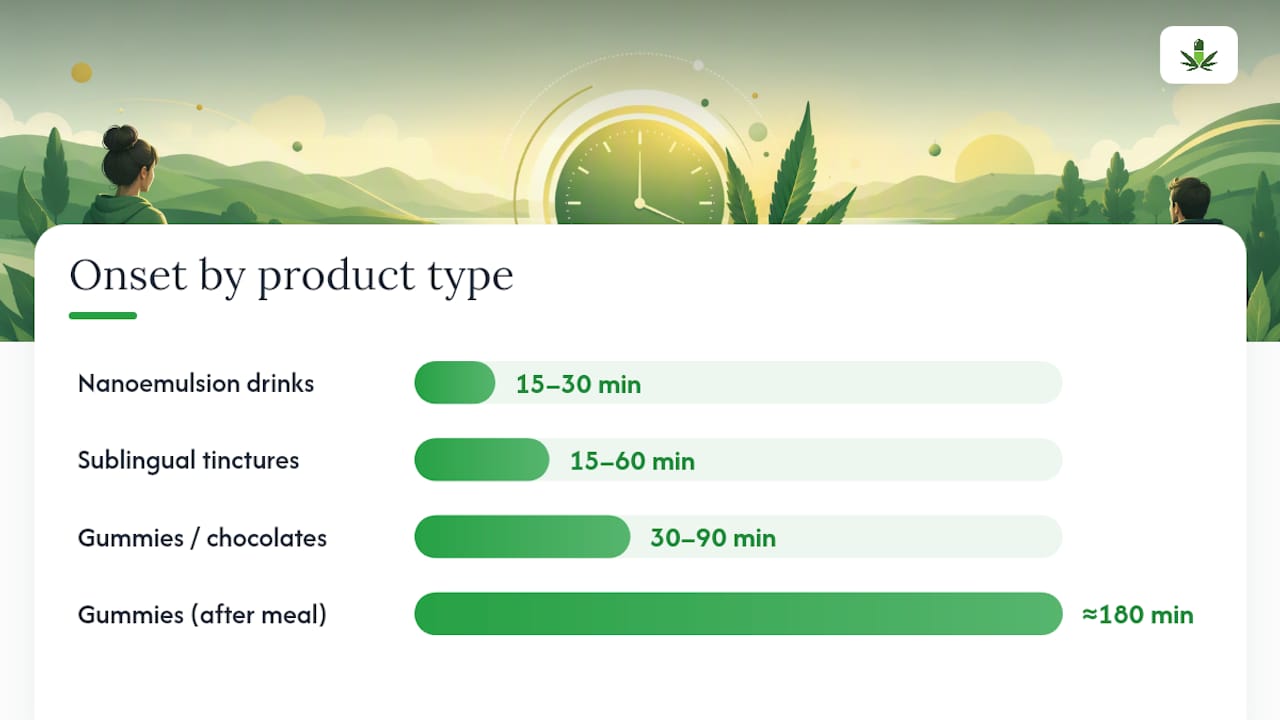
Sublinguals and chewables designed to dissolve under the tongue land somewhere in the middle, usually 15 to 60 minutes, depending on the formulation and how long you actually hold the product before swallowing.
Here is the general breakdown by format:
- Nanoemulsion drinks and oromucosal drops: onset 15–30 minutes, peak 30–90 minutes, duration 2–4 hours
- Sublingual tinctures and chewables: onset 15–60 minutes, peak 1–2 hours, duration 4–6 hours
- Gummies, chocolates, baked goods: onset 30–90 minutes, peak 1–3 hours, duration 4–12 hours
If you are new to tinctures specifically, our tincture dosing guide walks through how hold time and measurement affect these numbers.
Why Onset Time Varies So Much From Person to Person
The biggest reason edibles feel unpredictable comes down to what happens in your liver, not your stomach. When you swallow THC, your liver converts a portion of it into 11-hydroxy-THC, a metabolite that crosses into the brain efficiently and can hit harder than the THC itself. This first-pass metabolism is also why an edible dose can feel noticeably stronger than the same amount of THC smoked or vaped, and why the effects take longer to build but tend to run deeper once they arrive.
Food is the next major variable. Eating a high-fat meal before or with your edible increases total THC exposure and pushes back the time it takes to reach peak blood concentration for both THC and 11-hydroxy-THC, according to research on food and cannabinoid pharmacokinetics. An empty stomach can speed things up, but it also makes your response harder to predict, since absorption becomes less consistent.
Genetics play a real role too. Around 10% of people of European ancestry carry a CYP2C9*3 gene variant that slows THC metabolism. If that is you, onset can stretch to 3 or 4 hours, and when the effects finally arrive, the peak can be more intense than expected. There is no easy way to know your status without genetic testing, which almost nobody gets before eating a gummy.
Medications matter as well. Anything that affects liver enzymes in the CYP family, including some antibiotics, antifungals, and antidepressants, can change how quickly THC gets metabolized and how strong the effects feel. Verified pharmacokinetic models built in 2025 now let researchers estimate these drug interaction risks with more precision than older methods allowed.
Age, body composition, and how often you use cannabis all shift the picture further. None of these factors act alone. They stack, which is exactly why the same 10 mg gummy can feel completely different two weekends in a row.
What to Expect at Peak and How Long Effects Last
Peak intensity for most edibles arrives 1 to 3 hours after you eat them. If you are a slower metabolizer, that peak can arrive later and land harder than you planned for. Total subjective effects commonly last 4 to 12 hours, though some pharmacokinetic markers stay elevated even longer after the high itself has faded.
Here is the part people miss: feeling “back to normal” and having no more THC in your system are not the same thing. Blood-plasma THC can remain measurable well after you feel sober, which matters directly for anyone considering driving or operating machinery. Impairment risk does not end when the subjective high does. For a deeper breakdown of the full duration curve, our guide on how long edibles last covers what happens hour by hour after the peak.
How to Dose Edibles Safely
Getting the timing right starts with getting the dose right. Follow these steps in order:
- Start low. Beginners should try 2.5 to 5 mg of THC as a first dose. Anything above 10 mg is considered a moderate dose for most new users, and doses over 20 mg commonly produce strong, sometimes overwhelming, effects, especially the first time.
- Read the label carefully. Check whether the mg figure listed is per serving or per package. Many packages contain multiple servings, and splitting a single gummy is often necessary to hit a true low dose.
- Wait before redosing. Give it a full 2 hours minimum, 3 hours if you took a traditional oil-based edible on a full stomach. Onset can legitimately take that long, and taking a second dose during the wait is the number one cause of accidental overconsumption.
- Match the format to your goal. Fast-acting products let you titrate your dose more precisely since you feel effects sooner. Traditional gummies and baked goods suit people who want longer, steadier relief and do not mind a longer wait.
- Track your results. Log the product, dose, whether you ate beforehand, and how you felt for at least three sessions before adjusting anything.
Our edible dosing guide for beginners and our list of low-dose edibles are both useful starting points if you are still narrowing down a first product.
Pro Tip: Set a timer the moment you eat the edible instead of relying on memory. Most redosing mistakes happen because people lose track of exactly when they started, not because they misjudge how they feel.
What to Do If Someone Takes Too Much
Overconsumption from edibles is common precisely because the delayed onset tricks people into thinking the first dose did not work. If you or someone else has taken too much, stay with them, move to a calm and familiar space, and offer water. Avoid caffeine or other stimulants, which tend to worsen anxiety and heart rate rather than help.

Most cases resolve with time, rest, and reassurance. But certain signs mean it is time to call for emergency care: severe chest pain, trouble breathing, loss of consciousness, uncontrollable vomiting, or any sign of severe psychiatric distress or self-harm risk. Emergency departments typically manage these cases with supportive care and observation rather than aggressive intervention, since the underlying issue is almost always a temporary, uncomfortable, but non-life-threatening intoxication.
When Clinical Guidance Makes Timing Questions Easier
General timing charts help, but they cannot account for your medications, your health history, or a condition like anxiety or chronic pain that changes how you should approach dosing. That is where a clinician consultation fills the gap.
Same-day virtual clinical evaluations for medical cannabis certification are available, completed online in about 10 minutes, often with a flat fee and a refund policy if not approved. A quick consult with a clinician can clarify how your medications, dosage needs, and specific condition should factor into your edible timing decisions, something a generic dosing chart cannot do. Jonathan’s perspective below draws on this same clinical grounding, and our dosing guide offers further reading if you want more detail before your appointment.
Three Rules I Give Every First-Time Edible User
If you remember nothing else, remember this. Start with a low milligram dose, something in the 2.5 to 5 mg range. Wait through the full onset window, a minimum of 2 hours, before even considering more. And plan your day around it: no driving, arrange to rest, and talk to a clinician first if you take medications or manage a health condition.
— Jonathan
Get Clinical Guidance Before Your Next Edible
Faster, more affordable paths to medical cannabis certification answers are available compared to specialist appointment waitlists, especially regarding dosing, interactions, or fitting cannabis safely with existing conditions. Some providers offer same-day virtual evaluations that take about 10 minutes online, with refund policies if not approved.

If you are managing chronic pain, anxiety, PTSD, or another qualifying condition and want a clinician’s input on how edibles fit your situation, not just a generic chart, book your same-day evaluation and get certified from home. You can also review how the approval process and refund guarantee work before you schedule, so you know exactly what to expect from start to finish.
This article is general information, not a substitute for advice from a qualified doctor. Consult a qualified healthcare professional about your own circumstances before acting on anything here.
Sources
- Effects of food on cannabinoid pharmacokinetics
- Physiologically based pharmacokinetic models for CBD and THC (PMC)
- Review: pharmacokinetics and clinical effects of oral THC