
Yes: if a licensed Virginia practitioner determines that medical cannabis may help your multiple sclerosis symptoms, you qualify for a written certification. The evaluation can happen over telemedicine, and there are services that offer same-day online visits with a fee and a full refund if you’re not approved. Book the evaluation, get your certification, and you can visit a licensed dispensary the same day.
Table of Contents
- Does MS Qualify for Medical Marijuana in Virginia?
- How Do You Get Certified for Medical Marijuana in Virginia?
- What Documentation and Residency Proof Does Virginia Require?
- How Do You Register With the Virginia Board of Pharmacy?
- Where Can You Buy Medical Marijuana in Virginia After Certification?
- What Legal Protections Do Certified MS Patients Have?
- Are There Financial Assistance Options for Certification and Treatment?
- Why Speed Matters When You’re Living With MS
- Get Certified Today With Virginia Medical Cannabis Certifications
- Sources
- FAQ
Does MS Qualify for Medical Marijuana in Virginia?
Virginia doesn’t run a checklist system where MS either makes the cut or doesn’t. Instead, state law puts the decision in the hands of your practitioner, who evaluates whether cannabis may reasonably help your specific symptoms. That’s actually good news for MS patients: spasticity, nerve pain, chronic fatigue, and sleep disruption are exactly the kinds of symptoms practitioners are trained to weigh, and MS is a condition commonly certified under this framework.
Walking into your evaluation prepared makes the conversation faster and more productive. Bring what you can gather:
- Recent neurology notes describing your MS diagnosis and disease course
- MRI reports or summaries, especially if they document active lesions or progression
- A symptom log tracking pain, spasticity, fatigue, or sleep issues over the past few weeks
- A current medication list, including anything that hasn’t worked well
- Any referral letters from your neurologist or primary care provider
You don’t need every item on that list to qualify. What matters most is being able to describe, clearly, how your symptoms affect daily function: can you sleep through the night, walk without significant pain, manage muscle spasms without other medication? Practitioners are listening for functional impact, not just a diagnosis code.
How Do You Get Certified for Medical Marijuana in Virginia?
The path from “I think this could help” to holding a valid certification is shorter than most people expect. Here’s how it plays out.
- Book an evaluation with a licensed practitioner. Virginia allows physicians, physician assistants, and nurse practitioners to issue certifications, and the state permits real-time telemedicine visits as long as the practitioner uses interactive audiovisual technology. You’ll need your ID and a summary of your MS diagnosis and symptoms on hand.
- Complete the evaluation. Expect a focused 10 to 20 minute conversation. Administrative rules require the practitioner to assess your condition, discuss risks and benefits, and build a treatment plan rather than simply hand you a signature.
- Receive your written certification. Once approved, your certification is issued digitally through the CCA Portal, often with a QR code that dispensaries scan to confirm it’s valid. Practitioners typically also provide a printed or emailed copy.
- Add a registered agent if you need one. If mobility is a challenge, especially during an MS flare, you can designate someone to pick up your medication at the dispensary. This has to be listed on your certification, and the agent may need to complete their own registration step.
Pro Tip: Make sure the name and ID you use during your evaluation match exactly what’s on file, down to spelling and middle initials. A mismatch is the most common reason dispensaries delay a first purchase.
Some certifications are typically delivered the same day, which matters when a symptom flare makes waiting a week or two feel unmanageable.
What Documentation and Residency Proof Does Virginia Require?
Virginia’s medical cannabis program requires proof that you actually live in the state, along with confirmation of your identity and age. To qualify, you must be a Virginia resident, hold a valid government-issued ID, and be at least 18, or have a guardian provide consent if you’re a minor.
In practice, a driver’s license or state ID card covers both the identity and residency requirement in one document. If your ID reflects an out-of-state address because you recently moved, a current utility bill or lease agreement in your name can usually fill that gap. Bring whichever backup document is easiest to produce; practitioners are generally flexible about the exact form as long as it clearly ties your name to a Virginia address.
For MS specifically, documentation goes beyond identity. Your practitioner will want enough medical history to support a certification decision, so having your diagnosis confirmed by a neurologist, even informally through notes or an after-visit summary, speeds things along. You don’t need a lawyer-grade paper trail. You need enough for the practitioner to see the full picture of how MS is affecting you.
One detail that trips people up: certifications are tied to the person, not shared across a household. If both you and a family member have qualifying conditions, each of you completes a separate evaluation and holds a separate certification.
How Do You Register With the Virginia Board of Pharmacy?
Here’s a piece of good news that surprises a lot of new patients: Virginia removed the separate patient registration step that used to sit between certification and dispensary access. As of a 2023 regulatory update, the process runs through the practitioner and the CCA Portal rather than a standalone registry application you have to file yourself.
In practical terms, once your practitioner issues your written certification, it lives in the Cannabis Control Authority’s system and can be accessed through your CCA Portal account. There’s no separate card to mail away for and wait on, no extra registry fee, and no second form to submit. Your certification itself functions as your proof of eligibility.
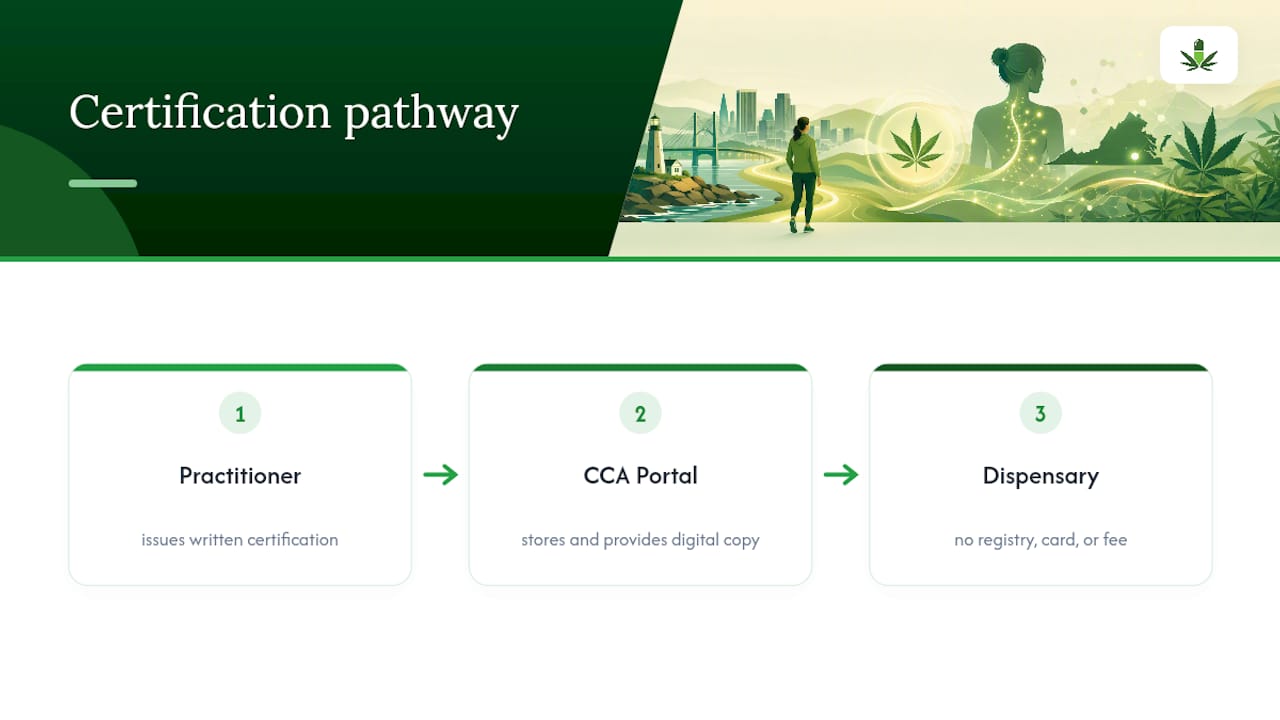
That said, it’s worth setting up your CCA Portal account soon after certification rather than waiting until you’re at the dispensary counter. It gives you a digital copy of your certification you can pull up on your phone, which is faster than digging through email if the pharmacist needs to verify it. If you ever need to renew, extend, or check your certification’s expiration date, the portal is also where that information lives.
Where Can You Buy Medical Marijuana in Virginia After Certification?
Your certification is only useful at one type of location: a licensed cannabis dispensing facility, sometimes called a pharmaceutical processor. Virginia currently has a limited number of these dispensaries operating regionally, so it’s worth checking which one is closest to you before your first visit, particularly if travel is difficult due to MS-related mobility issues.
At the dispensary, staff will scan your certification’s QR code or verify it through the CCA Portal before your first purchase. Bring the same government ID you used during your evaluation. Some dispensaries add you to their internal patient system on that first visit, which can add a few extra minutes compared to later trips.
Product selection varies by location, but most dispensaries carry flower, tinctures, capsules, and edibles, with staff available to help you choose a form that fits your symptoms and lifestyle. For MS patients dealing with tremors or fine motor difficulty, capsules or pre-measured tinctures are often easier to manage than flower that requires grinding or rolling.
If getting to a dispensary in person isn’t realistic during a flare, this is exactly where a registered agent becomes valuable. Confirm with your practitioner during the evaluation whether you want someone added to your certification, since retrofitting that request later can mean an extra step with the dispensary or the CCA Portal.
What Legal Protections Do Certified MS Patients Have?
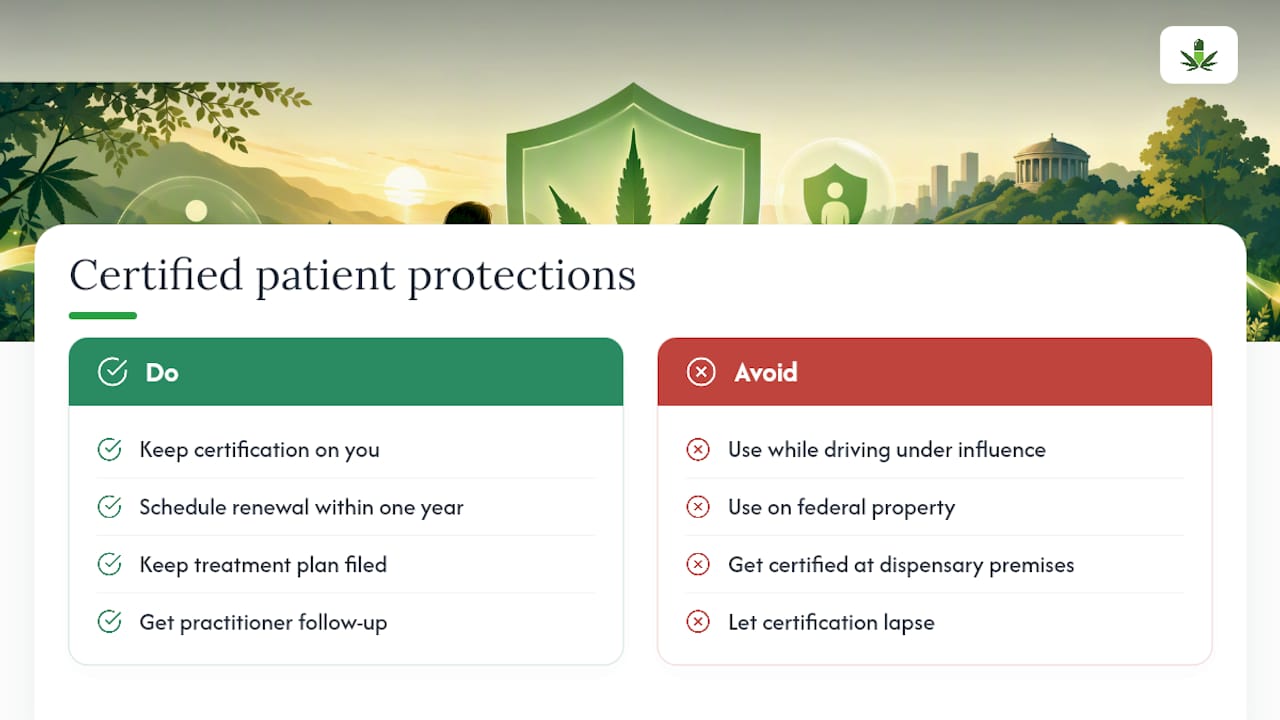
Once you’re certified, Virginia law backs your ability to use and possess medical cannabis without the criminal exposure that applies to unregistered use. Your written certification is your legal proof, and the practitioner who issues it is required to maintain your medical records and remain available for follow-up care, not simply sign off once and disappear.
Certifications are valid for up to one year, which means your legal protection has a clear expiration date. Mark your renewal date early, since letting a certification lapse means losing dispensary access until you complete a new evaluation.
There are limits worth knowing. Virginia law prohibits practitioners from issuing certifications while physically on the premises of a dispensary or processor, which keeps the medical evaluation separate from the sales side of the business. Certified status also doesn’t extend to activities like driving under the influence or using cannabis in violation of federal property rules, such as on federal land or in federal housing, since state legalization doesn’t override federal law in those specific contexts.
For MS patients specifically, having a documented treatment plan on file adds a layer of protection if questions ever come up about your cannabis use in a medical or workplace context. It shows your use is tied to a diagnosed condition and overseen by a licensed provider, not incidental.
Are There Financial Assistance Options for Certification and Treatment?
Cost is a real concern for MS patients already managing ongoing treatment expenses, and it’s fair to ask what help exists. Virginia’s medical cannabis program doesn’t currently offer state-funded subsidies for certification fees or product costs, and most health insurance plans, including Medicare and Medicaid, don’t cover cannabis products or evaluation fees because cannabis remains federally restricted.
That leaves the certification fee itself as the main cost lever patients can control. Fees vary by provider, and choosing a service with transparent, flat pricing matters more than it might seem, since some clinics tack on hidden charges for follow-up questions or certificate reissue. Some providers charge a set fee for new patients and renewals, with a refund if you’re not approved, which removes the financial risk of applying without knowing in advance whether you’ll qualify.
Veterans have access to a discount through a coupon code, which helps offset costs for a group that includes a meaningful share of MS patients given service-related neurological conditions. Beyond certification fees, dispensary product costs are the larger ongoing expense, and those aren’t currently offset by insurance or state assistance programs. Comparing product pricing across the dispensary nearest you is worth doing once you’re certified, since costs for equivalent products can vary between locations.
Why Speed Matters When You’re Living With MS
Speed in this process isn’t about convenience for its own sake. When spasticity or nerve pain flares, waiting two or three weeks for an appointment means living with symptoms that a same-day certification could start addressing immediately. That’s the practical case for a fast evaluation model.
But speed only helps if it doesn’t cut corners on the medical relationship behind it. A certification should come with a real treatment plan and a practitioner who remains available if your MS symptoms change, not a one-time transaction. The two goals, fast and thorough, aren’t actually in conflict when the evaluation is built around real clinical judgment rather than a rubber stamp.
— Jonathan
Get Certified Today With Virginia Medical Cannabis Certifications
Some services offer a faster, lower-risk path to certification than the traditional route of scheduling around a specialist’s calendar and waiting weeks for an opening. Online evaluations can take about 10 minutes and may include a fee and refund policy.

Booking is straightforward: you complete the visit from home using your phone or computer, describe your MS symptoms and history, and a licensed Virginia practitioner reviews your case in real time. Approved patients typically receive their certification the same day, delivered digitally so you can head to a dispensary right away instead of waiting on paperwork in the mail. If mobility is a concern, mention it during your evaluation so a registered agent can be added to your certification.
Ready to start? Book your evaluation and see the approval criteria and refund guarantee in full before you begin.
This article is general information, not a substitute for advice from a qualified doctor. Consult a qualified healthcare professional about your own circumstances before acting on anything here.
Sources
- Patients & Caregivers — Virginia Cannabis Control Authority
- § 4.1-1601. Certification for use of cannabis for treatment — Code of Virginia
- 3VAC10-30-30. Requirements for practitioner issuing a certification — Virginia Administrative Code
FAQ
Does Multiple Sclerosis Qualify for Medical Marijuana in Virginia?
MS can qualify when a licensed Virginia practitioner determines that cannabis may help your symptoms, since state law relies on practitioner judgment rather than a fixed condition list.
Can You Get Certified for Medical Marijuana in Virginia Through Telemedicine?
Yes, Virginia law permits practitioners to issue certifications through telemedicine as long as they use real-time audiovisual technology, and evaluations cannot happen on dispensary or processor premises.
How Long Is a Virginia Medical Cannabis Certification Valid?
A written certification is valid for up to one year from the date your practitioner issues it, after which you’ll need a renewal evaluation.
What Documents Do You Need for a Medical Marijuana Evaluation in Virginia?
Bring a valid government-issued ID showing Virginia residency, along with any neurology notes, MRI results, or a symptom log documenting how MS affects your daily function.
How Much Does Medical Marijuana Certification Cost in Virginia?
Virginia Medical Cannabis Certifications charges a set fee for new patients and renewals, with a full refund if you’re not approved.