CBDA is the plant’s raw, acidic form and, for several acute physical symptoms, shows stronger preclinical potency and higher oral absorption than CBD. If you’re dealing with acute nausea or targeted inflammation, cold-processed CBDA products may offer a more direct pharmacological hit. For daily stress, sleep, and general wellness, CBD remains the better-studied, more stable, and more widely available option.
- CBDA for acute symptoms: Preclinical data show CBDA suppressed toxin-induced vomiting much more potently than CBD in animal models, linked to stronger 5-HT1A serotonin receptor affinity.
- CBD for established clinical use: CBD’s pharmaceutical form, Epidiolex, is FDA-approved for certain epilepsy syndromes, giving it a clinical trial record CBDA simply doesn’t have yet.
- Quick product tip: Choose cold-processed raw extracts or tinctures labeled with CBDA on the certificate of analysis (COA) when you want the acid-form pharmacology. Choose conventional CBD oils, gummies, or capsules when you want shelf stability and a broader product range.
Table of Contents
- What exactly is CBDA?
- What is CBD and why does it dominate the market?
- How CBDA converts to CBD, and why it matters for your purchase
- How CBDA and CBD act differently in your body
- What recent research shows about potency and absorption
- Practical guidance: buying, dosing, storing, and combining
- Safety, drug tests, and the legal picture in Virginia
- Which compound fits your goal?
- Key Takeaways
- A clinician’s perspective on advising patients
- Authoritative sources and further reading
What exactly is CBDA?
Cannabidiolic acid (CBDA) is the acidic precursor cannabinoid that the living hemp plant actually produces. The plant doesn’t make CBD directly. It synthesizes CBDA first, storing it in the glandular trichomes of the flower. Structurally, CBDA carries a carboxyl group (-COOH) attached to the cannabinoid core, and that single addition changes how the molecule interacts with receptors and enzymes compared to CBD.
You’ll find intact CBDA in raw or cold-extracted tinctures, freshly pressed hemp juice, certain full-spectrum raw oils, and some minimally processed concentrates. The practical test: check the COA. If the lab report lists “CBDA” as a separate line item alongside “CBD,” the product preserved the acid form. If only CBD appears, the CBDA has already converted.
What is CBD and why does it dominate the market?
Cannabidiol (CBD) is the neutral, decarboxylated form produced when CBDA loses its carboxyl group through heat or processing. Commercially, that conversion happens during drying, heated extraction, or distillation. The result is a chemically stable molecule that tolerates room-temperature storage, survives manufacturing, and ships well.
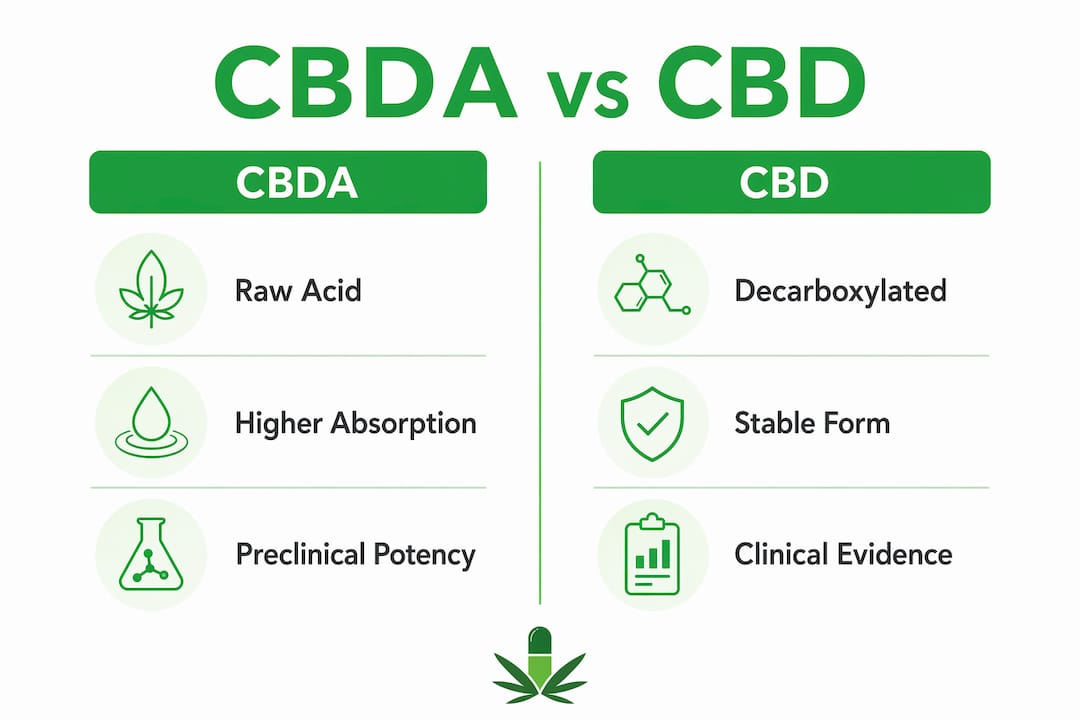
That stability is the main reason CBD dominates the market. Oils, gummies, capsules, topicals, and pharmaceutical formulations all rely on CBD because it behaves predictably across the supply chain. CBDA, by contrast, requires careful cold handling at every stage, which raises production costs and limits product variety.
How CBDA converts to CBD, and why it matters for your purchase
The conversion is called decarboxylation: heat drives off the carboxyl group as carbon dioxide, leaving neutral CBD behind. It’s a one-way reaction. Once CBDA becomes CBD, you can’t reverse it.
What triggers conversion:
- Smoking or vaping (immediate, near-complete conversion)
- Heated solvent extraction or distillation
- Standard CO2 extraction run at elevated temperatures
- Prolonged exposure to light, oxygen, or warmth during storage
What to look for when buying CBDA products:
- A COA that lists CBDA as a distinct, quantified compound
- Claims of cold-press or cold-ethanol extraction
- Storage instructions specifying refrigeration or a cool, dark environment
- A recent batch date (CBDA degrades over time even when stored correctly)
Pro Tip: Ask the brand for a COA dated within the last 90 days. A COA from six months ago tells you what was in the product then, not now.
Cold processing preserves the carboxyl group and the terpenes that heat would otherwise volatilize. Traditional heat-based extraction or distillation converts CBDA to CBD regardless of the brand’s marketing language, so the COA is your only reliable confirmation.
How CBDA and CBD act differently in your body
The carboxyl group isn’t just a structural footnote. It fundamentally changes which proteins CBDA binds to and how your body processes it.
Key mechanism differences:
- 5-HT1A serotonin receptors: CBDA shows much higher affinity here than CBD, which explains its stronger anti-nausea and potential antidepressant signals in preclinical work.
- COX-2 enzyme inhibition: CBDA selectively inhibits COX-2 with roughly 9-fold greater selectivity over COX-1, similar in principle to the NSAID celecoxib. CBD modulates inflammation through broader, less selective pathways.
- CB1/CB2 endocannabinoid receptors: Neither CBDA nor CBD binds strongly here. Both work largely outside the classic THC receptor pathway.
- Metabolism: CBDA is primarily glucuronidated rather than undergoing the extensive first-pass hepatic metabolism CBD faces. That difference helps explain why CBDA reaches higher peak plasma concentrations after oral dosing.
The biosynthetic pathway runs: CBGA (cannabigerolic acid) → CBDA (in the plant) → CBD (after heat). Understanding that sequence clarifies why the two compounds behave differently despite being chemically close.
What recent research shows about potency and absorption
| Dimension | CBDA | CBD | Evidence level |
|---|---|---|---|
| Oral absorption (Cmax/AUC) | Higher in animal PK studies | Lower baseline | Animal PK, limited human data |
| Anti-nausea potency | Up to 100× stronger in rodent models | Moderate effect | Preclinical (animal) |
| COX-2 selectivity | ~9-fold over COX-1 | Non-selective modulation | In vitro |
| Human clinical trials | None published | Epidiolex (FDA-approved) | Clinical (CBD only) |
A 12-hour pharmacokinetic study in beagles found CBDA isolates produced higher Cmax and AUC than CBD isolates, with no adverse events at tested doses. That cross-species signal is consistent with broader pharmacokinetic assessments showing CBDA as a higher-absorption option, though large-scale human trials are still absent.
The honest summary: CBDA’s preclinical potency signals are striking, but every data point above is animal or in vitro. CBD’s clinical record, anchored by Epidiolex, is the only cannabinoid evidence base with robust human trial data.
Practical guidance: buying, dosing, storing, and combining
Buying checklist:
- Confirm CBDA appears as a separate line on the COA
- Verify cold-press or cold-ethanol extraction on the product page
- Check storage instructions (refrigerate or keep below 65°F)
- Note the batch date and expiration
Dosing: No formally published CBDA-specific dosing guidelines exist. Because CBDA’s higher oral absorption means you may get more pharmacological effect per milligram, starting lower than a typical CBD dose is sensible. A start-low, titrate-slowly approach applies to both compounds. Track your response before increasing.
Storage: Keep CBDA products sealed, refrigerated, and away from light. Unlike CBD distillates, CBDA-rich concentrates tend to stay liquid at high concentrations rather than crystallizing, which can make dosing easier but also means the product looks different from what you may expect.
Combining CBDA and CBD: Research on cannabinoid interactions supports the idea that CBDA and CBD are complementary, not competing. A combined product may produce an entourage effect where multiple cannabinoids modulate receptors and transporter proteins together. If you’re new to either compound, a 1:1 CBDA:CBD product is a reasonable starting point for exploring synergy. For a broader look at how other cannabinoid pairs compare, the CBC vs CBG breakdown covers similar ground.
Safety, drug tests, and the legal picture in Virginia
Safety: CBD and CBDA share a similar side-effect profile: mild gastrointestinal symptoms, drowsiness, reduced appetite, and, at high doses, elevated liver enzymes. Because CBDA converts to CBD in the body and is better absorbed, you may encounter CBD-class side effects at lower doses than you’d expect from CBD alone. Drug interactions are a real concern. Both compounds interact with CYP3A4, the enzyme responsible for metabolizing roughly 60% of pharmaceutical drugs. If you take anticonvulsants, blood thinners, or other medications, talk to a clinician before starting. Virginia patients with gastrointestinal conditions should also review CBD’s GI interaction profile before use.

Drug tests: CBD and CBDA themselves are non-intoxicating and not the target of standard drug screens. The risk comes from trace THC in hemp-derived products. Mislabeled or poorly tested products can contain more THC than the label states. Always buy from brands with current, third-party COAs that confirm THC below 0.3%.
Legal status: Under the 2018 Farm Bill, hemp-derived cannabinoids with THC below 0.3% are federally legal. Virginia follows federal hemp law and also has a regulated medical cannabis program. Hemp-derived CBD and CBDA products are broadly available in Virginia without a medical card. However, if you’re considering higher-potency cannabis products or want clinician guidance on cannabinoid choices, a Virginia medical cannabis certification opens access to the state’s licensed dispensary system. For context on how acidic cannabinoids like CBDA compare to their neutral counterparts more broadly, the THCA vs THC primer is a useful reference.
This article is general information, not medical advice. Confirm current Virginia regulations and your personal eligibility with a qualified clinician.
Which compound fits your goal?
| Symptom or goal | Better first choice | Evidence level | One-line recommendation |
|---|---|---|---|
| Acute nausea | CBDA | Preclinical (animal) | Choose cold-processed CBDA; potency signal is strong but human trials are pending |
| Targeted inflammation | CBDA | In vitro / preclinical | COX-2 selectivity is notable; no human trial data yet |
| Chronic pain | CBD or combined | Preclinical / limited clinical | CBD has more real-world use data; consider a 1:1 product |
| Anxiety | CBD | Preclinical / limited clinical | CBD’s 5-HT1A and endocannabinoid modulation are better studied in humans |
| Sleep | CBD | Limited clinical | CBD is the practical choice; consult a clinician for dosing |
| Daily wellness | CBD | Clinical (Epidiolex anchor) | CBD’s stability and product variety make it the default starting point |
When symptoms overlap, a combined CBDA+CBD product is worth considering. If you’re managing a diagnosed condition or taking other medications, clinician input before choosing is the right call.
Key Takeaways
CBDA offers stronger preclinical potency for nausea and inflammation, but CBD holds the only robust human clinical evidence base, making your symptom and evidence-strength tolerance the deciding factor.
| Point | Details |
|---|---|
| CBDA vs CBD core difference | CBDA is the raw acidic precursor; CBD is the stable, decarboxylated form produced by heat. |
| Potency and absorption | CBDA shows up to 100× stronger anti-nausea effect and higher oral absorption in preclinical models. |
| Evidence gap | CBD has FDA-approved clinical data (Epidiolex); CBDA has no published human clinical trials yet. |
| Storage and COA | Verify CBDA on the COA, store cold and sealed, and check the batch date before buying. |
| Drug-test and legal note | Trace THC in products, not CBDA or CBD itself, creates drug-test risk; always confirm THC below 0.3% on the COA. |
A clinician’s perspective on advising patients
Preclinical potency numbers for CBDA are genuinely impressive. A 100-fold anti-nausea advantage over CBD in animal models is not a number you dismiss. But my approach with patients is to hold that data at arm’s length until human trials confirm it. Preclinical signals have a long history of not translating cleanly to clinical outcomes, and CBDA has no published human trial data to date.
What that means practically: I treat CBDA as a promising adjunct, not a replacement for CBD in most cases. For patients with acute nausea or localized inflammation who haven’t responded well to CBD alone, a cold-processed CBDA or combined 1:1 product is a reasonable next step, starting at a lower dose than they’d use for CBD given the absorption difference. I ask patients to document their response over two to four weeks before adjusting.
Medication interactions deserve real attention. CYP3A4 involvement means cannabinoids can affect how other drugs are processed, and that conversation needs to happen before someone starts, not after a problem appears.
For Virginia patients who want that clinician conversation quickly, Virginia Medical Cannabis Certifications offers same-day online evaluations for $50, with a full refund if you don’t qualify. Getting certified means you can access licensed dispensaries where product quality and THC content are verified, which removes a lot of the guesswork around COAs and mislabeling.
Authoritative sources and further reading
- Bolognini et al. — CBDA anti-nausea preclinical data (PubMed) — Animal study showing CBDA’s potency advantage over CBD in suppressing toxin-induced vomiting via 5-HT1A receptors. Preclinical.
- Takeda et al. — CBDA COX-2 selectivity (PubMed) — In vitro data on CBDA’s roughly 9-fold COX-2 over COX-1 selectivity. In vitro.
- Decarboxylation mechanisms and cannabinoid stability (PubMed) — Explains the chemical process converting CBDA to CBD and factors affecting stability. Review.
- Cannabinoid entourage interactions (PubMed) — Reviews how CBDA and CBD may work together through receptor and transporter modulation. Review.
- Frontiers — 12-hour PK study of CBDA and CBD isolates in beagles — Comparative pharmacokinetic data showing higher Cmax and AUC for CBDA. Animal PK.
- CBDA vs. CBD: Clinical Breakthroughs overview (CBHD News) — 2026 commentary summarizing the current evidence landscape and CBDA’s emerging role. Commentary/overview.
- Medical News Today — What is CBDA and how is it different from CBD? — Accessible clinical overview covering mechanisms, uses, and safety. General review.
Recommended
- CBC vs CBG: Key Differences and Benefits Explained – Virginia Medical Cannabis Certifications
- CBD and Gastritis: What Virginia Patients Need to Know – Virginia Medical Cannabis Certifications
- THCA Headaches: Causes, Relief, and Safe Use – Virginia Medical Cannabis Certifications
- Sativa Headache Relief: What You Need to Know – Virginia Medical Cannabis Certifications