
Yes, chronic pain can qualify you for a medical cannabis certification in Virginia, as long as a licensed practitioner determines cannabis is an appropriate treatment for your condition. Your next move is simple: book a legitimate telemedicine evaluation with a Virginia-licensed provider. If you’re approved, that practitioner uploads your certification straight to the state’s CCA portal, and there’s no plastic card to wait for.
Table of Contents
- Which Virginia Telemedicine Providers Certify Chronic Pain Patients?
- How Do You Get a Medical Cannabis Certification in Virginia?
- Does Chronic Pain Actually Qualify for a Virginia Card?
- What Happens at the Dispensary After Certification?
- Is Marijuana Safe for Chronic Pain, and What Else Should You Consider?
- Why the Evaluation Itself Is the Safeguard
- A Clinician-Rooted Tip Worth Following
- Get Certified Today With Virginia Medical Cannabis Certifications
- Where This Information Comes From
- Sources
- FAQ
Which Virginia Telemedicine Providers Certify Chronic Pain Patients?
Several telemedicine clinics across the state handle chronic pain certifications, and they differ more in service details than in the basic process. Here’s what separates them.
Virginia Marijuana Card has built the largest patient base among the group, with a stated focus on same-day approval and a high volume of patient visits statewide. CannabisMD TeleMed FFX VA MARIJUANA CARD DRS LLC serves Fairfax and Northern Virginia specifically, and includes follow-up care at no added cost, a detail worth asking about wherever you go. CannabisMD TeleMed Arlington VA Marijuana Card VA Marijuana Doctor operates under the same follow-up model but focuses on Arlington-area patients. Virginia Cannabis Cards – Medical Marijuana Card Doctor Telehealth – Arlington carries BBB A+ accreditation and offers a veteran discount, which matters if you’re a service member managing service-connected pain. Medical Marijuana Card Leesburg-ReThink-Rx leans on board-certified clinicians and serves Loudoun County patients who want that credential front and center. Quick Med Cards | Medical Marijuana Doctors of Virginia moves fast, supports renewals, and offers 24/7 dispensary verification for patients who need round-the-clock access confirmation.
If you’re comparing on cost and turnaround alone, Virginia Medical Cannabis Certifications keeps things simple: a flat $50 for new patients, $40 for renewals, and a full refund if your evaluation doesn’t result in approval. For chronic pain patients who just want a fast, low-risk way to find out if they qualify, that combination is hard to beat.
How Do You Get a Medical Cannabis Certification in Virginia?
The path from “I think I qualify” to “I’m at the dispensary” runs through five steps, and none of them require a trip to a state office.
- Choose a licensed telemedicine provider. Virginia law requires real-time audiovisual technology for telemedicine evaluations, so a phone call alone won’t cut it. Pick a provider licensed to practice in Virginia.
- Book your video visit. Most appointments run short, often around 10 to 15 minutes, since the practitioner is focused on function and history rather than a full physical exam.
- Discuss your pain history openly. Expect questions about how long you’ve had the pain, what treatments you’ve already tried, how it affects your daily function, and what medications you currently take.
- Wait for the practitioner’s decision. If they determine cannabis is appropriate, they submit an Electronic Patient Certification directly through the CCA portal. Nothing gets mailed to your house.
- Head to a dispensary. Once your certification appears in the CCA system, you can typically visit a dispensary the same day, bringing a government photo ID.
Fees vary by provider, but you’re generally paying a single practitioner fee. There’s no separate state licensing fee tacked on for the certification itself.
Pro Tip: Test your camera and internet connection before your appointment. A dropped video call during a real-time evaluation can force you to reschedule, and that costs you a day of access.
Does Chronic Pain Actually Qualify for a Virginia Card?
Virginia doesn’t publish a rigid list of approved diagnoses. Instead, the law puts the decision in the hands of the practitioner, who applies professional judgment to determine whether cannabis is an appropriate option for your specific condition. That’s a meaningfully different standard than a checkbox list, and it means chronic pain qualifies often, not automatically.
In practice, clinicians commonly approve patients dealing with:
- Degenerative spine disease and chronic back pain
- Neuropathic pain from diabetes, nerve damage, or other causes
- Long-term post-surgical pain that hasn’t resolved with standard treatment
- Chronic pain tied to arthritis or autoimmune conditions like Crohn’s disease
- Pain from conditions such as a herniated disc that limits daily movement
You don’t need a certified diagnosis document to start the conversation, but bringing what you have helps. Medical records, imaging summaries, specialist notes, or even a simple treatment log showing what you’ve already tried gives the practitioner concrete evidence to work with, which tends to make the evaluation faster and more thorough.
What Happens at the Dispensary After Certification?
Dispensaries don’t take your word for it. When you arrive, staff verify your certification directly through the CCA portal and check it against your photo ID. At your first visit, the pharmacist or a pharmacy technician keeps a copy of your written certification on file for two years, part of the state’s recordkeeping requirement for licensed dispensaries.
Supply limits are set in state law, not left to store policy:
- No more than a limited amount of botanical cannabis per 30-day period as set by state law
- A supply limit for cannabis oil products covering approximately three months, with the exact amount determined by the pharmacist based on formulation
If you plan to use a registered agent or caregiver to pick up your product, that person needs to be properly designated in advance. Delivery is available through some dispensaries, but the same ID and certification checks apply at the door.
Is Marijuana Safe for Chronic Pain, and What Else Should You Consider?
Cannabis isn’t risk-free just because it’s legal with a certification. The Virginia Cannabis Control Authority points patients toward responsible consumption resources, and for good reason: driving under the influence carries the same legal exposure as alcohol, and some employers still test for cannabis regardless of your certification status.
Talk to your practitioner about:
- How cannabis might interact with medications you’re already taking, especially opioids, sedatives, or blood thinners
- Whether reducing opioid use alongside cannabis needs closer monitoring
- Non-cannabis options worth trying alongside or instead of cannabis, including physical therapy, cognitive behavioral therapy for pain, or a full medication review
- Which cannabinoid ratios might suit your pain type better than others
Follow-up visits matter here. Chronic pain shifts over time, and your treatment plan should shift with it.
Why the Evaluation Itself Is the Safeguard
Virginia’s law draws a hard line: practitioners cannot issue certifications on dispensary premises, keeping the clinical decision separate from the sale. That separation, combined with the professional-judgment standard, is what makes the certification meaningful rather than a rubber stamp.
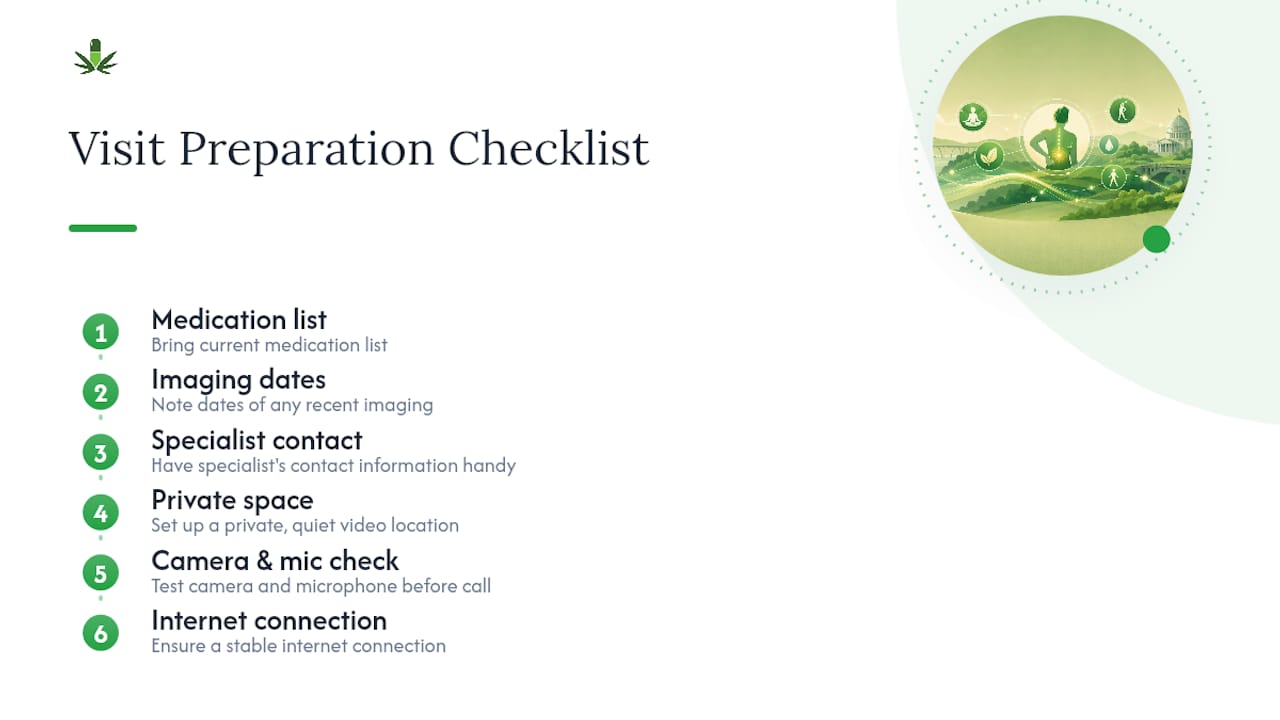
Before your visit, gather your current medication list, note the dates of any recent imaging, and have a specialist’s contact information handy. Set up in a private, quiet space for the video call. Services offering 10-minute evaluations, same-day upload to the CCA portal, and a refund if you’re not approved reflect how far this process has moved from paperwork toward accessibility.
A Clinician-Rooted Tip Worth Following
Organize your pain history into one page before your telemedicine visit: onset, what you’ve tried, and how it limits your day. Practitioners move faster and ask sharper follow-up questions when they aren’t hunting for basics. That single habit shapes not just your approval odds, but the quality of care you get afterward. Start there, then book your evaluation.
— Jonathan
Get Certified Today With Virginia Medical Cannabis Certifications
One service provides quick movement from inquiry to certification, with a clinical evaluation completed online in about 10 minutes and approvals submitted to the state’s portal the same day, enabling patients to access dispensaries quickly. They offer a refund if the patient does not qualify.

Some providers offer a veteran discount, and evaluations are conducted by licensed clinicians who review patient history during the telemedicine visits. If you’re a Virginia resident living with chronic pain and you want to know where you stand without risking a wasted fee, start your new certification now.
Where This Information Comes From
This guide draws directly from Virginia’s official cannabis program pages and state code, not third-party summaries.
- Patients & Caregivers guidance, Virginia Cannabis Control Authority
- Code of Virginia, Chapter 16, medical cannabis provisions
- CCA Portal Getting Started Guide for certification submission details
- Session law on dispensing rules covering supply limits and recordkeeping
This article is general information, not a substitute for advice from a qualified doctor. Consult a qualified healthcare professional about your own circumstances before acting on anything here.
Sources
- Patients & Caregivers – Virginia Cannabis Control Authority
- Code of Virginia — Medical cannabis provisions (chapter 16)
- CCA Portal Getting Started Guide — Virginia Cannabis Control Authority
- Session law: medical cannabis program transition and dispensing rules — Virginia
FAQ
Is Marijuana Prescribed for Chronic Pain in Virginia?
Practitioners don’t technically “prescribe” cannabis since it remains federally restricted, but they can issue a written certification when they judge it appropriate for your chronic pain, which functions the same way for dispensary access.
Does Chronic Pain Qualify for Medical Marijuana in Virginia?
Chronic pain qualifies when a licensed practitioner determines cannabis is an appropriate treatment for your specific case, since Virginia relies on practitioner judgment rather than a fixed list of approved diagnoses.
What Are Some Healthy Alternatives to Marijuana for Chronic Pain?
Physical therapy, cognitive behavioral therapy for pain management, and a full medication review with your practitioner are worth discussing alongside or instead of cannabis, especially if you’re also managing opioid use.
What Kind of Marijuana Is Best for Chronic Pain?
The right cannabinoid balance depends on your pain type and tolerance, and a practitioner can help you weigh options like CBD-heavy formulations against THC-forward products during your evaluation.
How Much Does a Medical Cannabis Certification Cost in Virginia?
Pricing for medical cannabis certifications varies by provider across the state, and some offer refunds if patients are not approved.