
Yes, a Virginia practitioner can certify PTSD for medical cannabis when an evaluation shows the potential benefits outweigh the risks for you. Virginia does not require a fixed diagnosis list, so your practitioner uses professional judgment. If you qualify, you leave with a written certification and photo ID, which is your legal proof to buy at any Virginia cannabis pharmacy. The next move is booking a telemedicine evaluation with a Virginia-registered practitioner.
Table of Contents
- Does PTSD Qualify for Medical Marijuana in Virginia?
- How Much Cannabis Can You Buy, and in What Forms?
- What Does the Research Actually Say About Cannabis and PTSD?
- What Happens During Your Evaluation and First Dispensary Visit?
- Are You Protected at Work and at Home as a Certified Patient?
- What Will Certification and Cannabis Actually Cost You?
- How Do You Renew Your Certification Before It Expires?
- What Legal Risks Should You Still Watch For?
- Why Fast, Personal Certification Matters for PTSD Care
- Get Certified Today With Virginia Medical Cannabis Certifications
- Sources
- FAQ
Does PTSD Qualify for Medical Marijuana in Virginia?
PTSD can absolutely factor into a Virginia medical cannabis certification, but the state does not work off an approved checklist anymore. Virginia shifted to a practitioner-recommendation standard, meaning your clinician decides case by case whether cannabis makes clinical sense for you. PTSD is one of the conditions practitioners commonly consider under this approach, alongside chronic pain, anxiety, and a range of other diagnoses.
That discretion comes with real obligations attached. Under 3VAC10-30-30, a Virginia practitioner issuing a certification must:
- Evaluate your medical and prescription history before making any recommendation
- Form a documented opinion that the potential benefits outweigh the health risks specific to you
- Keep records of the assessment and the reasoning behind the certification
- Remain available for follow-up care, not just a one-time signature
- Confirm through telemedicine is allowed, so the evaluation doesn’t require an in-person office visit
The Virginia Cannabis Control Authority reinforces this: practitioners must actually assess your history and use clinical judgment rather than rubber-stamping requests. That protects you, too. A practitioner who skips the assessment isn’t doing you a favor, they’re putting your certification and your safety at risk.
How Much Cannabis Can You Buy, and in What Forms?
Virginia certifications don’t come with unlimited access. Your practitioner sets a supply period, and under Virginia Code Title 4.1, Chapter 16, that period tops out at a 90-day supply at a time. Pharmacists at licensed dispensing facilities verify your certification and ID before that first fill, and they retain a copy on file going forward.
Product forms lean toward controlled, measurable options: oils, tinctures, capsules, topicals, and vaporization products dominate Virginia pharmacy shelves. Smokable botanical cannabis is available too, but it comes with its own quantity caps under state pharmaceutical processor rules, distinct from concentrated products.
Your practitioner and the dispensing pharmacist work together on dosing guidance, especially at your first visit. If you’re new to cannabis therapy, expect the pharmacist to walk you through starting doses rather than just handing you a bag and sending you off. Regulatory updates moving through 2025 and 2026 have also touched program fees and processor licensing, which is worth knowing if you’re tracking how the retail landscape keeps evolving. None of that changes your 90-day limit, but it does affect how many dispensing locations exist near you and how quickly new ones open.
What Does the Research Actually Say About Cannabis and PTSD?
The honest answer: promising signals, not proof. Some patients report meaningful relief from hyperarousal, sleep disruption, and intrusive symptoms with cannabis use, and that lived experience is real. But PTSD treatment research on cannabis remains limited in scope, and no product form or strain has cleared the bar of a definitively proven treatment.
Risks deserve equal attention. Cannabis can worsen anxiety in some people, interact with other medications, and create dependence patterns that complicate rather than resolve trauma symptoms. That’s exactly why Virginia’s practitioner-recommendation model puts a real clinical evaluation between you and a certification, instead of an automatic yes.
Harm minimization matters here more than brand names or strain hype. Clinicians generally advise starting low and going slow, favoring non-combustible forms like tinctures or capsules over smoking, and keeping your mental health provider in the loop rather than treating cannabis as a standalone fix. If you’re weighing specific product types for PTSD symptoms, reviewing clinical considerations before you buy helps you ask sharper questions at your evaluation. Cannabis therapy works best as one piece of a broader PTSD treatment plan, not a replacement for therapy or psychiatric care.
What Happens During Your Evaluation and First Dispensary Visit?
Expect the evaluation itself to move fast. Most Virginia telemedicine appointments run around 10 minutes and cover your PTSD diagnosis history, current medications, prior treatment attempts, and how symptoms affect your daily life. Bring any existing mental health records if you have them, though a formal diagnosis paper trail isn’t always mandatory since the practitioner is forming their own clinical opinion.
You’ll typically sign a consent or liability waiver acknowledging you understand the risks and responsibilities of cannabis therapy. This isn’t a formality to skim past. It documents that your practitioner explained the risks, which protects both of you if questions ever come up later.
Once approved, your written certification arrives, often by email, and that document plus a valid photo ID is what you present at the pharmacy counter. First-time visits take longer than repeat ones because pharmacists verify your certification and log a copy for their records.
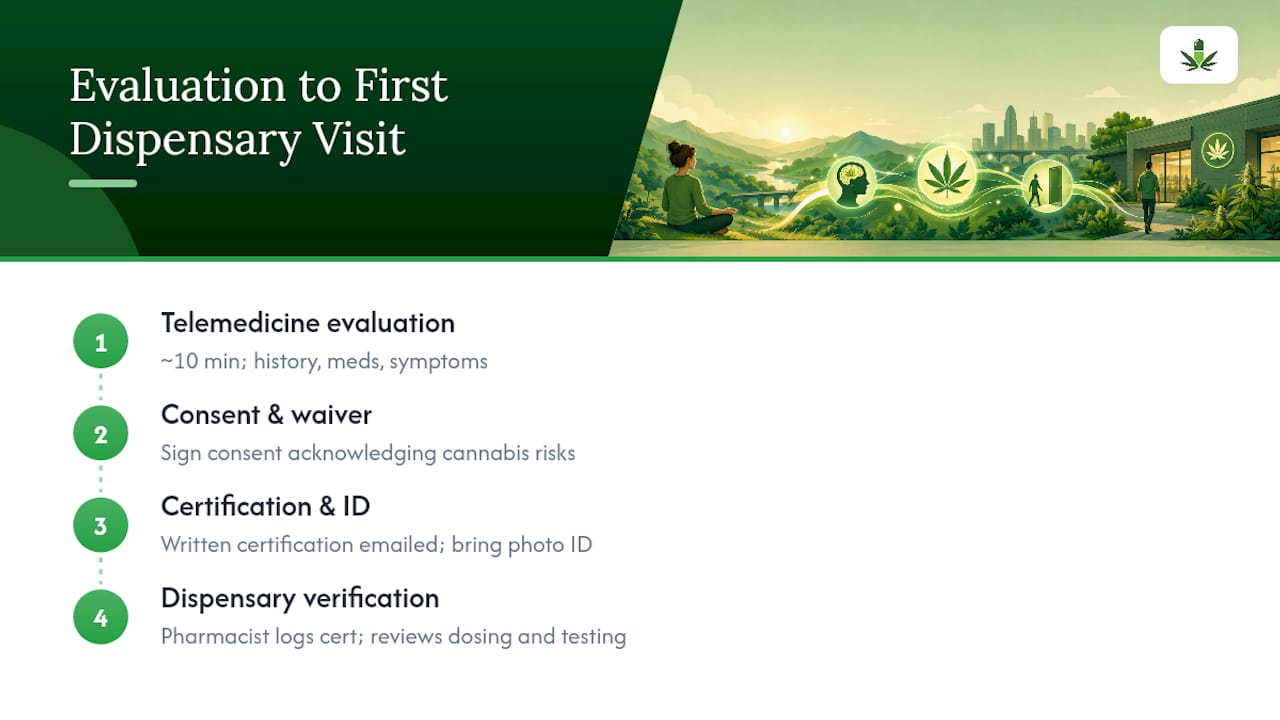
Shopping safely means asking questions rather than grabbing whatever’s on the counter display. Ask about milligram content per dose, onset time for edibles versus vaporized products, and whether a product has been third-party tested. A good pharmacist will walk you through options based on the practitioner’s dosing guidance, not just what’s popular that week.
Are You Protected at Work and at Home as a Certified Patient?
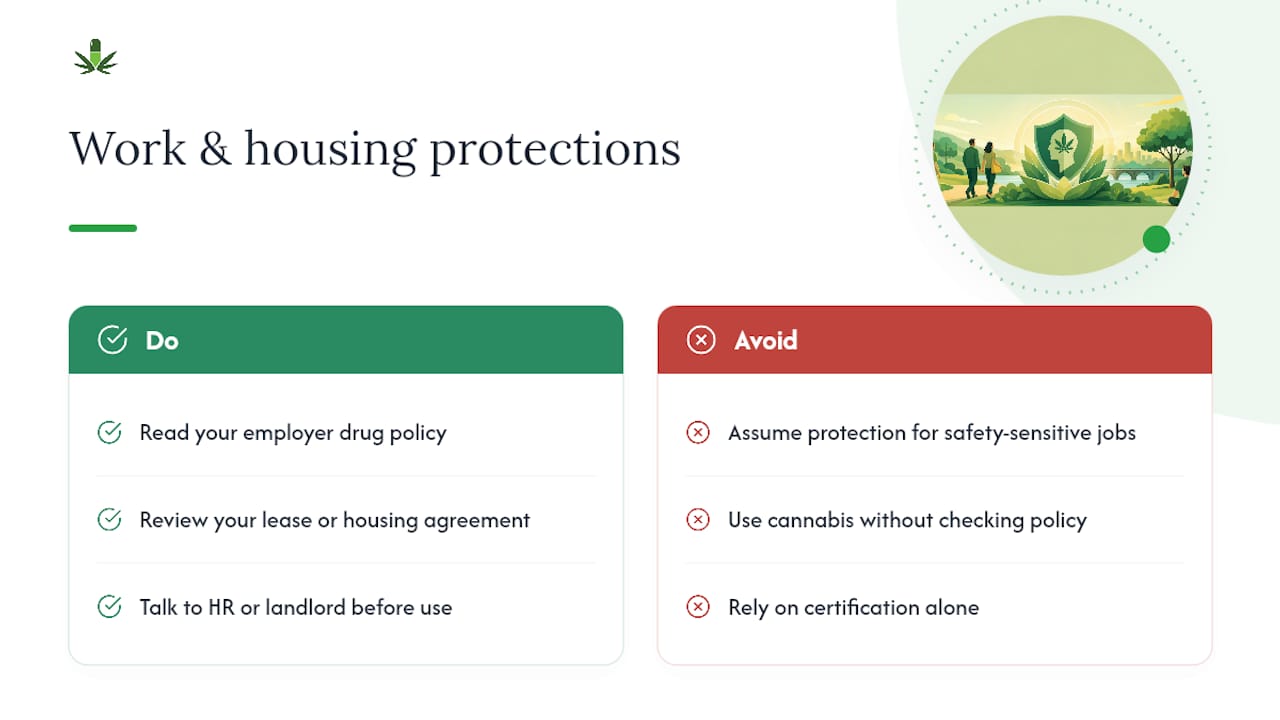
Certification doesn’t erase every risk, but Virginia law does offer some real protection. Employers generally cannot take adverse action against you solely for holding a valid written certification and using cannabis in accordance with it, though this protection has limits. Safety-sensitive positions, federal contractors, and jobs governed by federal drug-testing rules often fall outside these protections entirely.
Housing carries similar nuance. Private landlords retain broad discretion over lease terms, and federally subsidized housing programs generally prohibit cannabis use regardless of your state certification, since cannabis remains federally illegal. Before you assume any protection applies to your specific job or lease, read your employer’s actual policy and your housing agreement rather than relying on general assumptions.
If you’re a veteran navigating PTSD alongside legal or crisis-related complications, veteran-focused treatment and legal support programs exist specifically to help with that intersection, separate from your cannabis certification process entirely.
None of this replaces reading your specific employer’s drug policy or a housing agreement’s actual language. When protections are unclear, a quick conversation with HR or your landlord before you start using cannabis saves you a much harder conversation later.
What Will Certification and Cannabis Actually Cost You?
Certification costs in Virginia vary by provider, but expect to pay a flat consultation fee rather than insurance billing, since federal cannabis restrictions mean health insurance typically doesn’t cover certification visits or dispensary purchases. Some providers charge more for extended evaluations; others keep it simple with one flat rate regardless of how long your appointment runs.
Beyond certification, dispensary pricing depends heavily on product form and potency. Tinctures and capsules tend to price out differently than vaporization cartridges or flower, and costs add up faster than many new patients expect, especially in the first few months while you’re still finding the right dose and product combination.
Renewal fees usually run lower than your initial certification cost, since the practitioner already has your history on file and the follow-up visit is typically shorter. Budgeting for both the certification and the ongoing cost of product matters just as much as the legal eligibility question, especially if you’re managing PTSD alongside other financial pressures.
How Do You Renew Your Certification Before It Expires?
Virginia certifications don’t last forever. Practitioners set the certification period, and renewal requires another evaluation, though typically a shorter one than your initial visit since your practitioner already has a documented history and treatment response on file.
Start your renewal before your current certification lapses, not after. A gap between an expired certification and a new one means a gap in your ability to purchase legally, which is the last thing you want if cannabis has become part of a working PTSD management routine. Most practitioners recommend scheduling renewal a few weeks ahead of the expiration date to leave room for scheduling and any follow-up questions.
Your renewal visit is also the right moment to flag anything that’s changed: new medications, symptom shifts, or side effects you’ve noticed since your last certification. That ongoing follow-up is part of what 3VAC10-30-30 actually requires of practitioners, not an optional extra. Treat renewal as a real checkup on how cannabis is working for you, not just a paperwork chore.
What Legal Risks Should You Still Watch For?
Certification protects your right to purchase and possess cannabis under Virginia’s medical program, but it doesn’t erase every legal boundary. Public consumption remains restricted statewide. Using cannabis in public spaces, parks, or anywhere alcohol consumption would also be prohibited can still result in citations, certification or not.
Driving under the influence carries the same legal exposure as any impairing substance, regardless of your medical status. Certification is not a defense against an impaired-driving charge.
Travel is where things get genuinely complicated. Cannabis remains illegal under federal law, which means crossing state lines with product, even into a neighboring state with its own medical program, can create legal exposure. Flying with cannabis products is federally prohibited outright, since airports and airspace fall under federal jurisdiction regardless of what’s legal on the ground in Virginia. If you’re planning travel, the safest assumption is that your Virginia certification protects you inside Virginia and nowhere else.
Why Fast, Personal Certification Matters for PTSD Care
Waiting weeks for an appointment while symptoms flare doesn’t serve anyone. Same-day access matters clinically, not just conveniently, because delayed care often means delayed relief for people already managing sleep disruption and hypervigilance. A provider built its process around that reality: a quick online evaluation, a fee fully refunded if you don’t qualify, and same-day certification delivery. Coordination with your existing mental health provider stays part of the picture, with follow-up availability built in, not an afterthought.
— Jonathan
Get Certified Today With Virginia Medical Cannabis Certifications
You’ve read the requirements. You know what an evaluation covers and what your certification unlocks at the pharmacy counter. The next move is simple: Virginia Medical Cannabis Certifications offers a same-day medical cannabis certification built specifically to get PTSD patients from evaluation to dispensary access without the multi-week wait typical of traditional clinics.

The process runs online, takes about 10 minutes, and costs a flat fee for new patients, with a refund if not approved. Renewal fees are lower than initial certification fees. There’s no waiting room, no driving across the state, and no risk of paying for an evaluation that goes nowhere. Once approved, your written certification arrives the same day by email, ready to present with your photo ID at any Virginia cannabis pharmacy. Keep your mental health provider looped in throughout, since cannabis works best alongside your existing PTSD treatment, not in place of it. Ready to see if you qualify? Book your evaluation and find out today.
Sources
Verify eligibility and dispensing rules directly through the Virginia Cannabis Control Authority patient resources, which cover certification and pharmacy access, and 3VAC10-30-30, the regulation governing practitioner duties.
This article is general information, not a substitute for advice from a qualified doctor. Consult a qualified healthcare professional about your own circumstances before acting on anything here.
- Virginia Cannabis Control Authority — medical cannabis providers
- Virginia Administrative Code — 3VAC10-30-30 Requirements for practitioner issuing a certification
FAQ
Can PTSD Qualify for Medical Cannabis in Virginia?
Yes. Virginia uses a practitioner-recommendation standard rather than a fixed condition list, and PTSD is commonly considered when a practitioner determines the potential benefits outweigh the risks for that patient.
How Fast Can I Get Certified in Virginia?
Virginia Medical Cannabis Certifications offers same-day certification through a roughly 10-minute online evaluation, with written certification typically emailed the same day if you qualify.
What Does a Virginia Medical Cannabis Certification Cost?
New patient evaluations through Virginia Medical Cannabis Certifications cost $50, fully refunded if you aren’t approved, and renewal certifications cost $40.
Do I Need a Separate State Registration Card to Buy Cannabis?
No. Your written certification plus a valid photo ID is your legal proof to purchase at any Virginia cannabis pharmacy, with no separate state card required.
How Much Cannabis Can a Certified Patient Purchase?
Practitioners set a supply period that tops out at a 90-day supply at a time, with pharmacists verifying your certification and ID before each initial fill.