
Cannabis use changes anesthetic requirements, raises cardiovascular and airway risks, and requires individualized perioperative planning for every patient who uses it. Whether you use cannabis occasionally or daily, your surgical team needs to know before they put you under. The APSF 2025 update recommends universal preoperative screening and individualized anesthetic planning because cannabis can alter drug requirements, cardiovascular physiology, and postoperative pain in ways that are hard to predict without that information.
Here is what matters most right away:
- Tell your surgical team about all cannabis use, including edibles, vaping, concentrates, and topicals, before any procedure.
- Stop using cannabis at least 72 hours before elective surgery, per the American College of Surgeons recommendation.
- Elective procedures should be postponed if you are acutely intoxicated at the time of your appointment.
- Expect higher anesthetic and opioid needs if you are a habitual user, and plan accordingly with your team.
- Withdrawal symptoms can appear postoperatively in chronic users and may be mistaken for pain or infection.
Pro Tip: Document cannabis use in the preoperative note with the same specificity you would use for alcohol or opioids: type, route, frequency, last use, and estimated dose. Vague notes like “patient uses marijuana” leave the anesthesia team without the detail they need to plan safely.
Table of Contents
- How do THC and CBD actually affect your body during anesthesia?
- What should you do before surgery if you use cannabis?
- What happens in the operating room when a patient uses cannabis?
- What should you watch for after surgery if you use cannabis?
- Why is acute intoxication the biggest risk factor on surgery day?
- How do you manage cannabis withdrawal in the perioperative period?
- What should patients tell their surgical team, and what should clinicians ask?
- What does the evidence actually say, and where are the gaps?
- The bottom line for patients and clinicians
- Key Takeaways
- What the evidence means in practice
- Useful sources for clinicians and patients
How do THC and CBD actually affect your body during anesthesia?
Cannabis contains dozens of active compounds, but two drive most perioperative concerns: delta-9-tetrahydrocannabinol (THC), the primary psychoactive component, and cannabidiol (CBD), which is non-intoxicating but pharmacologically active. Routes of use matter too. Smoking and vaping produce rapid onset and peak effects within minutes. Edibles delay onset by 1–2 hours but extend duration significantly, which affects how long effects linger before surgery. Concentrates deliver far higher THC doses than traditional flower.

At the receptor level, THC binds primarily to CB1 receptors in the brain and spinal cord, modulating GABAergic and glutamatergic (NMDA) pathways. This is exactly where many anesthetic agents work. Recent 2025 research documents consistent associations between chronic cannabis use and increased requirements for GABAergic anesthetics like propofol and midazolam, along with possible stability improvements with NMDA antagonists in select cases. CBD adds another layer: it inhibits several CYP450 enzymes, particularly CYP2C9 and CYP3A4, which metabolize many drugs used perioperatively, including some opioids and benzodiazepines.
For a deeper look at how individual cannabinoids differ, the CBC vs CBG vs CBD guide from Virginia Medical Cannabis Certifications breaks down their distinct pharmacologic profiles.
The table below summarizes how acute versus chronic use changes perioperative risk in practical terms.
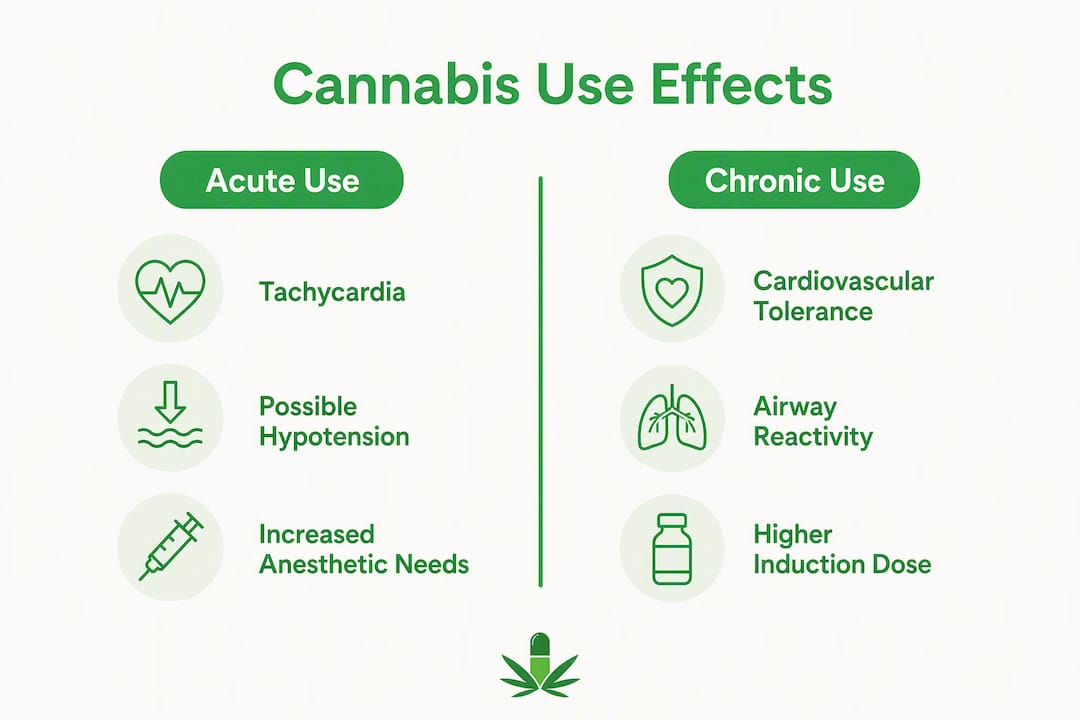
| Effect | Acute Use | Chronic Use |
|---|---|---|
| Cardiovascular | Tachycardia, possible hypotension | Tolerance to tachycardia; paradoxical bradycardia possible |
| Airway | Bronchodilation (short-term) | Hyperreactivity, chronic bronchitis-like symptoms |
| CNS/Sedation | Additive sedation with anesthetics | Tolerance; higher anesthetic doses often needed |
| Hemodynamics | Labile, unpredictable | More stable but altered baseline |
| Pain sensitivity | Variable | Often increased postoperative pain scores |
| Drug metabolism | CYP inhibition possible | Persistent CYP effects; altered opioid metabolism |
Chronic cannabis smoking can produce airway hyperreactivity and symptoms that closely resemble chronic bronchitis, raising the risk of bronchospasm during intubation and complicating airway management. Anesthesiologists often approach these patients similarly to chronic tobacco smokers when assessing airway risk.
What should you do before surgery if you use cannabis?
Preoperative screening for cannabis use should be universal, not reserved for patients who volunteer the information. Patients often withhold use because of stigma or legal concerns, so open, nonjudgmental language from the clinical team makes accurate disclosure far more likely. Accurate disclosure is clinically essential, not optional.
Preoperative screening checklist
Clinicians should capture all of the following before any procedure:
- Type and formulation: flower, concentrate, edible, tincture, topical, or CBD-only product
- Route of administration: smoked, vaped, ingested, sublingual, or topical
- Frequency of use: daily, weekly, occasional, or episodic
- Last use: date and approximate time
- Estimated dose: THC percentage or mg per dose when known
- History of heavy or regular use: years of use and any escalation pattern
- Concurrent sedative, opioid, or alcohol use: additive CNS depression risk
- Cardiovascular history: arrhythmia, hypertension, coronary artery disease
- Pulmonary history: asthma, COPD, or chronic cough in smokers/vapers
- Cannabis use disorder history: prior treatment, withdrawal episodes
When to postpone surgery
Elective procedures should be postponed if the patient shows signs of acute intoxication at the time of the appointment. Clinical signs include tachycardia, conjunctival injection, impaired cognition, anxiety, or paranoia. A patient who cannot give valid informed consent because of acute intoxication should not proceed to an elective procedure, for the same reason an intoxicated patient would not sign a surgical consent form.
The American College of Surgeons recommends stopping all cannabis products at least 72 hours before elective surgery. This window reflects the time needed for acute hemodynamic and CNS effects to resolve, though it does not eliminate all pharmacologic effects in heavy chronic users. The evidence supporting exactly 72 hours is based on expert consensus rather than large randomized trials, so clinicians should treat it as a practical minimum, not a guarantee of full clearance.
Pro Tip: When a patient discloses cannabis use close to surgery, ask specifically about edibles. Their delayed onset and longer duration mean a patient who “stopped smoking yesterday” may still have significant active THC on board if they consumed an edible the same day.
What happens in the operating room when a patient uses cannabis?
The most clinically significant intraoperative finding is that habitual cannabis users often need higher doses of induction and maintenance agents. A clinical trial found cannabis smokers required significantly higher induction doses of propofol than non-users, and a systematic review and meta-analysis confirmed the association between cannabinoid use and higher propofol requirements, though the review notes causality and mechanisms are not fully established. The practical implication: titrate to effect rather than relying on standard weight-based dosing, and have additional agents ready.

Airway management deserves extra attention in patients who smoke or vape cannabis. Chronic inhalational use produces airway hyperreactivity that can trigger bronchospasm during laryngoscopy or intubation. Consider pre-treating with an inhaled bronchodilator in high-risk patients, and have a lower threshold for using a supraglottic airway or regional technique when clinically appropriate.
The monitoring table below outlines key intraoperative parameters and the triggers that warrant intervention.
| Parameter | Why It Matters | Intervention Trigger |
|---|---|---|
| Heart rate and blood pressure | Hemodynamic lability is common | HR elevated or BP drop from baseline |
| BIS / processed EEG | Tolerance may shift depth of anesthesia | BIS elevated with clinical signs of light anesthesia |
| EtCO2 | Respiratory depression risk | EtCO2 >50 mmHg or rising trend |
| Peak airway pressure | Bronchospasm detection | Sudden rise from baseline |
| SpO2 | Oxygenation in airway-reactive patients | SpO2 below normal range |
Drug interaction cautions are real. Cannabis inhibits CYP2C9 and CYP3A4, which can slow the metabolism of fentanyl, alfentanil, and some benzodiazepines, potentially prolonging their effects. Sympathomimetics like ephedrine may produce exaggerated responses in acutely intoxicated patients because of additive cardiovascular stimulation. Beta-blockers can blunt the tachycardia that would otherwise signal light anesthesia, masking an important clinical sign.
Pro Tip: For chronic cannabis users who require higher GABAergic doses, consider adding a low-dose NMDA antagonist such as ketamine as an adjunct. Recent literature notes possible hemodynamic stability improvements in select cases, and ketamine’s opioid-sparing properties are an added benefit in patients who already trend toward higher postoperative opioid needs.
What should you watch for after surgery if you use cannabis?
Postoperative pain management is where cannabis use creates the most consistent clinical challenge. Despite the common perception of cannabis as an analgesic, reviews show that cannabis use is associated with higher postoperative pain intensity scores and increased opioid requirements in many surgical cohorts. Plan for this before the patient leaves the OR, not after they are already in pain in the recovery room.
Monitoring priorities in the post-anesthesia care unit (PACU) for cannabis users include:
- Withdrawal symptoms: irritability, nausea, diaphoresis, anxiety, and insomnia can appear within hours of the last use in daily users and may be mistaken for surgical pain or infection.
- PONV (postoperative nausea and vomiting): cannabis use, particularly heavy use, is associated with cannabinoid hyperemesis syndrome in some patients; standard antiemetics may be less effective.
- Delirium and emergence agitation: acute intoxication at the time of surgery raises the risk of violent or confused emergence from anesthesia.
- Respiratory complications: patients with inhalational use history need closer monitoring for bronchospasm and oxygen desaturation.
For multimodal analgesia, lean toward non-opioid adjuncts: NSAIDs, acetaminophen, regional nerve blocks, and low-dose ketamine infusions. This approach reduces total opioid exposure in a population already prone to higher opioid consumption. For patients with chronic pain conditions who use cannabis therapeutically, the cannabis pain management discussion at Virginia Medical Cannabis Certifications provides useful context on realistic analgesic expectations.
Discharge counseling should cover:
- Resume cannabis use only after discussing timing with your surgeon.
- Avoid combining cannabis with prescribed opioids or benzodiazepines at home.
- Watch for signs of wound complications; cannabis may affect immune response and tissue healing.
- Call your care team if you experience severe nausea, vomiting, or agitation that does not resolve.
Why is acute intoxication the biggest risk factor on surgery day?
Acute cannabis intoxication on the day of surgery is the single highest-risk scenario in perioperative cannabis management. Clinical reviews document that intoxication can produce sudden tachycardia, hemodynamic lability, and unpredictable sedative requirements that make safe anesthetic management significantly harder. In rare but serious cases, it can trigger violent emergence agitation as the patient wakes from anesthesia.
There is also a consent issue. Acute intoxication impairs memory and perception in ways that parallel alcohol intoxication. A patient who cannot reliably process and retain information about surgical risks cannot give valid informed consent for an elective procedure. This is not a technicality; it is a genuine patient safety concern.
The 72-hour recommendation from the American College of Surgeons exists because most acute hemodynamic and CNS effects resolve within that window. That said, heavy daily users may carry residual pharmacologic effects beyond 72 hours, and THC metabolites remain detectable in urine for weeks. The 72-hour mark is a practical, evidence-informed minimum, not a biological reset.
Pro Tip: If a patient arrives for an elective procedure and you suspect acute intoxication but they deny recent use, check heart rate, pupil reactivity, and cognitive orientation. Tachycardia above 100 bpm combined with conjunctival injection and slowed processing is a reasonable clinical basis to postpone and reschedule.
How do you manage cannabis withdrawal in the perioperative period?
Cannabis withdrawal syndrome is real and clinically relevant, though it is often underrecognized in surgical settings. Symptoms typically begin within 24–48 hours of the last use in daily or near-daily users and peak around days 2–3. They include irritability, anxiety, sleep disturbance, decreased appetite, nausea, and diaphoresis. In the postoperative context, these symptoms can look like surgical pain, infection, or opioid withdrawal, which leads to unnecessary workup and treatment.
Chronic users also present with the airway hyperreactivity and altered anesthetic tolerance described earlier. When a chronic user’s postoperative course is unexpectedly difficult, consider withdrawal as part of the differential before escalating opioids or ordering additional imaging.
Here are the immediate management steps for perioperative cannabis withdrawal:
- Confirm the diagnosis. Review the preoperative cannabis history. Onset of irritability, nausea, and insomnia within 24–48 hours of last use in a daily user is consistent with withdrawal.
- Treat symptoms supportively. Antiemetics for nausea, sleep aids for insomnia, and anxiolytics (used cautiously given CNS depression risk) for severe anxiety.
- Avoid opioid escalation as a first response. Withdrawal-related discomfort is not opioid-responsive; escalating opioids adds risk without addressing the cause.
- Consult addiction medicine or pain management if symptoms are severe, if the patient has a documented cannabis use disorder, or if the clinical picture is unclear.
- Document the withdrawal assessment in the chart so the entire care team is aligned on the diagnosis and plan.
Pro Tip: Ask patients during preoperative screening whether they have ever tried to cut back on cannabis and experienced discomfort. A yes answer is a strong predictor of withdrawal risk postoperatively and should prompt a more detailed plan before surgery.
What should patients tell their surgical team, and what should clinicians ask?
Nondisclosure is the most preventable risk in perioperative cannabis management. Patients often stay quiet because they worry about judgment or legal consequences. The clinical team’s job is to make disclosure feel safe and routine.
What patients should say
You do not need a formal script. A simple, direct statement works:
- “I use cannabis regularly. My last use was [date/time]. I usually use [edibles/flower/vape], about [frequency].”
- “I take CBD products daily. I’m not sure of the dose.”
- “I used cannabis yesterday. I wasn’t sure if I needed to stop before surgery.”
Honesty about timing, dose, and route gives your anesthesia team the information they need to keep you safe. There is no wrong answer, only incomplete ones.
What clinicians should document
A complete preoperative cannabis note should include:
- Type and formulation (flower, concentrate, edible, CBD product)
- Route (smoked, vaped, ingested, sublingual, topical)
- Frequency (daily, weekly, occasional)
- Last use (date and approximate time)
- Estimated dose or THC concentration when known
- Withdrawal risk assessment (daily use for >3 months = higher risk)
- Concurrent substance use (alcohol, opioids, benzodiazepines)
- Counseling provided: stop 72 hours before surgery, disclose to all providers
Sample documentation template
What does the evidence actually say, and where are the gaps?
The evidence base for perioperative cannabis guidance is growing but uneven. Here is an honest map of what is strong, what is moderate, and where gaps remain.
Strong evidence:
- Habitual users require higher doses of propofol and other GABAergic agents. Multiple clinical studies and a systematic review and meta-analysis support this finding, though the exact mechanism is not fully established.
- Chronic inhalational use causes airway hyperreactivity comparable to tobacco smoking.
- Acute intoxication creates hemodynamic instability and consent impairment that justify postponing elective procedures.
Moderate evidence:
- Cannabis use is associated with higher postoperative pain scores and increased opioid requirements in surgical cohorts, per PMC review data.
- CYP-mediated drug interactions are pharmacologically plausible and documented in vitro, but clinical magnitude varies.
Limited or emerging evidence:
- The exact 72-hour cessation window is expert consensus, not a randomized trial finding.
- NMDA antagonist adjuncts in cannabis-tolerant patients are supported by case reports and mechanistic reasoning, not large trials.
- Long-term surgical outcomes (wound healing, infection rates, mortality) in cannabis users need more prospective data.
“As cannabis use increases across the United States, anesthesia providers must be prepared to address its perioperative implications. Universal preoperative screening, individualized anesthetic planning, and open patient communication are the cornerstones of safe care.”
— APSF 2025 Perioperative Cannabis Update
The ASRA Pain Medicine consensus guidelines address nine key perioperative questions and provide the most structured clinical framework currently available. The APSF 2025 update and the ACS patient guidance complement it with screening and patient-facing recommendations. Together, these three sources form the practical foundation for perioperative cannabis policy at most institutions.
The bottom line for patients and clinicians
Cannabis and anesthesia interact in ways that are predictable enough to plan for and serious enough to take seriously. The core message has not changed since the first clinical reviews appeared: tell your team, stop before surgery, and expect your anesthetic plan to be adjusted.
Three actions every patient and clinician should take:
- Disclose fully and early. Route, frequency, last use, and formulation all matter. Partial disclosure leads to incomplete planning.
- Stop cannabis at least 72 hours before any elective procedure and postpone if you arrive intoxicated.
- Plan for individualized anesthetic management. Higher induction doses, multimodal analgesia, and withdrawal monitoring are not edge cases; they are standard considerations for regular cannabis users.
Open communication between patients and their surgical teams is what makes safe perioperative care possible. If you are a Virginia patient who uses cannabis medically and wants to make sure your care is coordinated and documented, Virginia Medical Cannabis Certifications offers same-day online certifications for $50, with a full refund if you do not qualify.
This article provides general health information, not medical or legal advice. Confirm current guidelines and your individual perioperative plan with your anesthesiologist, surgeon, or a qualified healthcare provider.
Key Takeaways
Cannabis use consistently alters anesthetic drug requirements, raises airway and cardiovascular risks, and requires individualized perioperative planning with full patient disclosure and a minimum 72-hour cessation window before elective surgery.
| Point | Details |
|---|---|
| Stop 72 hours before surgery | The American College of Surgeons recommends stopping all cannabis products at least 72 hours before elective procedures. |
| Expect higher anesthetic doses | Habitual users typically need higher propofol and GABAergic agent doses; titrate to effect rather than standard weight-based dosing. |
| Disclose route and timing | Type, route, frequency, and last use all affect anesthetic planning; edibles have delayed onset and longer duration than smoked cannabis. |
| Watch for withdrawal postoperatively | Daily users can develop irritability, nausea, and insomnia within 24–48 hours of last use, which may mimic surgical pain or infection. |
| Postpone if acutely intoxicated | Acute intoxication impairs consent, destabilizes hemodynamics, and raises emergence agitation risk; elective surgery should not proceed. |
What the evidence means in practice
The clinical literature on cannabis and anesthesia is more consistent than many providers realize, and the practical recommendations that follow from it are straightforward. What gets lost in translation is the gap between what the evidence says and what actually happens in preoperative interviews.
Most nondisclosure is not deception. Patients genuinely do not know that cannabis use matters to anesthesia, or they assume their provider will judge them. The clinical team’s tone in the preoperative interview determines how much information they actually get. A nonjudgmental, matter-of-fact question (“Do you use cannabis in any form?”) yields far better data than a question buried in a checklist or asked in a way that signals disapproval.
The 72-hour recommendation is useful as a communication anchor, but it should not create false confidence. A patient who uses high-potency concentrates daily for years is not pharmacologically equivalent to a patient who had one edible four days ago, even if both technically cleared the 72-hour window. Chronic use changes baseline physiology in ways that persist longer than the acute effects. Anesthesia teams who treat the 72-hour mark as a binary pass/fail miss the more important question: how does this patient’s pattern of use change my plan for induction, maintenance, and postoperative pain?
The postoperative opioid picture is the finding that surprises most patients. Cannabis users who expect their use to reduce postoperative pain often find the opposite. Setting that expectation before surgery, not after the patient is already in the recovery room asking why their pain is worse than expected, is one of the most practical things a preoperative conversation can accomplish.
Useful sources for clinicians and patients
The sources below are the primary references underpinning this article. Each is worth reading directly if you want the original evidence or need to cite primary literature.
| Source | What it covers |
|---|---|
| APSF 2025 Perioperative Cannabis Update | Society-level guidance on universal screening, individualized planning, and cardiovascular and pain implications; the most current U.S. anesthesia society statement |
| ASRA Pain Medicine Consensus Guidelines | Evidence-based answers to nine perioperative questions; the most structured clinical framework for cannabis and cannabinoid management |
| ACS Patient Guidance: Marijuana and Surgery | Patient-facing recommendation to stop all cannabis products 72 hours before surgery; useful for patient handouts |
| PMC Review: Perioperative Considerations in Cannabis Users | Comprehensive review covering intoxication risks, postoperative pain, opioid requirements, and withdrawal |
| Systematic Review: Cannabinoids and Propofol Dosage | Meta-analysis of propofol dose requirements in cannabis users; key reference for intraoperative planning |
| Anesthesia & Analgesia 2025: Cannabinoids and General Anesthetics | Mechanistic review of cannabinoid-anesthetic interactions including NMDA pathway effects |
| PMC Review: Cannabis Smoking and Airway Effects | Evidence on airway hyperreactivity and chronic bronchitis-like changes from cannabis smoking |
| ASAHQ Made for This Moment: Cannabis and Surgery | Patient communication guidance and nonjudgmental screening language recommendations |
Recommended
- Can Weed Cause Nightmares? What You Need to Know – Virginia Medical Cannabis Certifications
- Can Weed Help Sleep Apnea? What You Need to Know – Virginia Medical Cannabis Certifications
- Can THC Cause Low Blood Sugar? What You Need to Know – Virginia Medical Cannabis Certifications
- Indica vs Sativa for Cancer: What Patients Need to Know – Virginia Medical Cannabis Certifications