If you live in Virginia and have carpal tunnel pain, you can ask a licensed practitioner whether medical cannabis makes sense for you. Virginia regulations allow a practitioner to certify cannabis for any diagnosed condition when they conclude the likely benefits outweigh the risks. The honest catch is that nobody has shown yet that cannabis treats carpal tunnel syndrome itself. This guide covers what the science says, what can make your symptoms worse, and exactly how certification works in Virginia, so you can decide with clear information.
Table of Contents
- The short answer on cannabis and carpal tunnel
- What the research says about cannabis and nerve pain
- What can make carpal tunnel symptoms worse
- Non-drug care still matters
- Does carpal tunnel qualify in Virginia?
- How to get certified in Virginia
- Our perspective
- Get certified online in about 10 minutes
- Questions to ask during your evaluation
- Frequently asked questions
- Sources
The short answer on cannabis and carpal tunnel
Carpal tunnel syndrome (CTS) is a nerve problem in the wrist, so people often group it with neuropathic pain. That is where the cannabis research is most relevant, and also where it is most mixed.
Here is where things stand:
- No finished trial has shown that cannabis helps carpal tunnel syndrome. A University of Virginia phase-2 trial of a topical CBD treatment for CTS is listed as not yet recruiting, with completion scheduled for January 2027. It plans to enroll 20 people, so it is a small first step.
- For nerve pain in general, the evidence is limited. A 2026 Cochrane review found no clear, high-quality evidence that cannabis-based medicines (THC, CBD, or balanced products) relieve chronic neuropathic pain better than placebo.
- Some patients still report that cannabis helps them. Virginia practitioners surveyed by the state say so too, as covered below.
That does not mean you should rule it out. It means you should go in with realistic expectations and a plan that does not rely on cannabis alone.
What the research says about cannabis and nerve pain
CTS is caused by pressure on the median nerve as it passes through the wrist. No study of cannabis has been built around that exact problem yet, so we look at the closest evidence: chronic pain and neuropathic pain.
Federal health agencies
As of April 2024, the CDC says there is limited evidence that cannabis works to treat most types of acute or chronic pain. The same page notes that some studies suggest cannabis may help neuropathic pain, but more research is needed to know whether it works better than other ways of managing it.
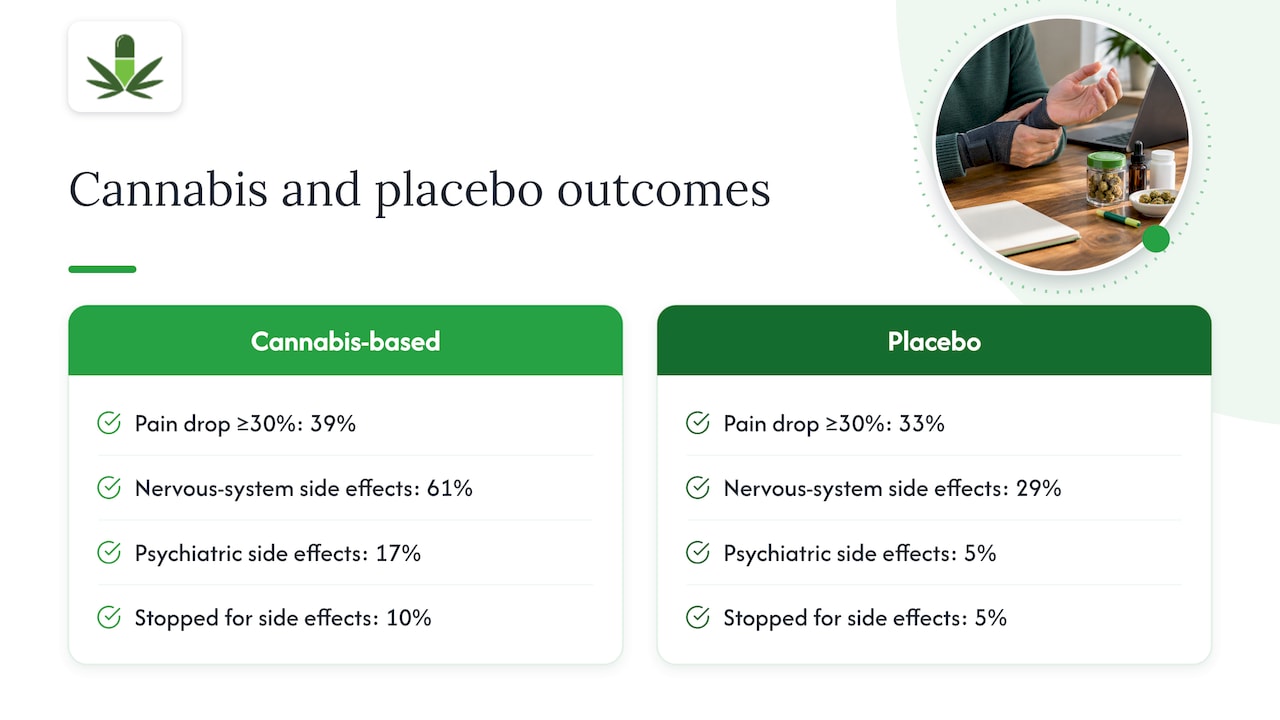
The Indian Health Service published a formulary brief on medical cannabis with specific numbers for neuropathic pain. In the trials it summarizes, 39% of people on cannabis-based treatment had at least a 30% drop in pain, compared with 33% on placebo. That is a small difference. Nervous-system side effects occurred in 61% versus 29%, psychiatric side effects in 17% versus 5%, and 10% versus 5% stopped because of side effects.
Medical society reviews
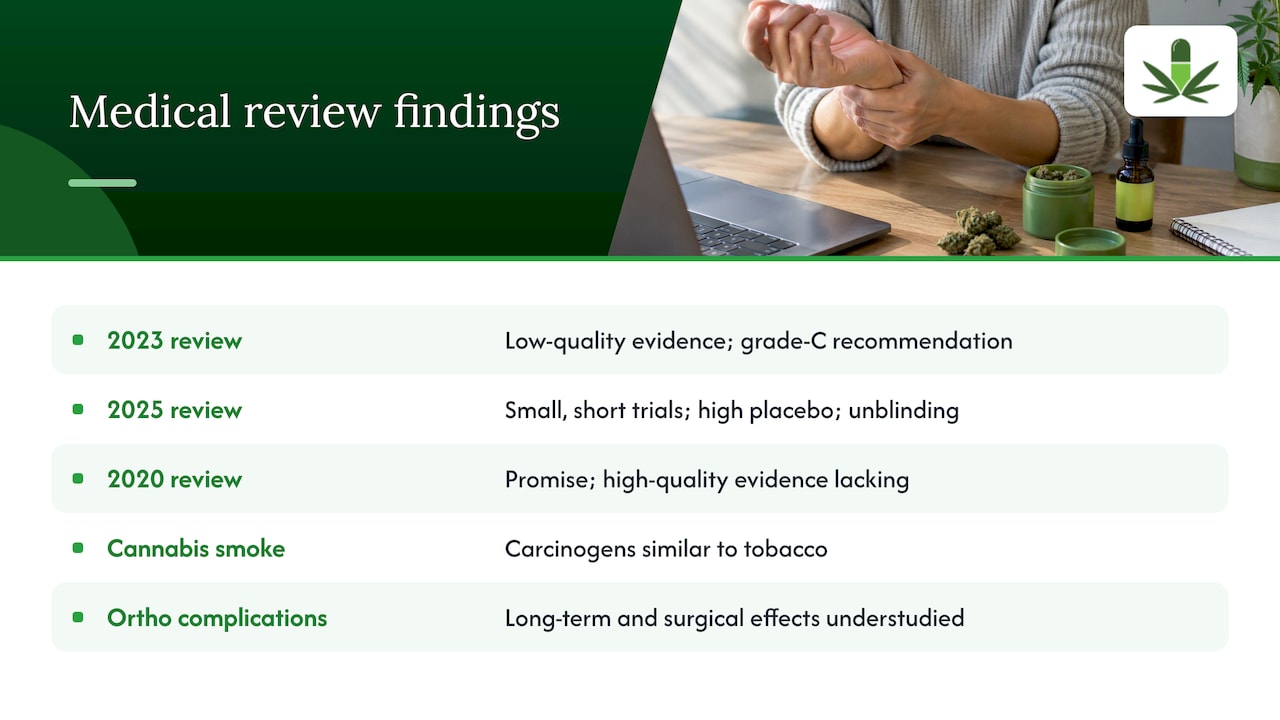
The American Society of Pain and Neuroscience’s 2023 review describes the evidence for cannabis in neuropathic pain as low quality and gives it a grade-C recommendation. It also says safety and efficacy data are lacking for chronic nonmalignant pain.
A 2025 systematic review points to reasons the results are hard to read: small studies, short durations, high placebo response, and trials where participants can tell which treatment they got.
For hand and wrist problems specifically, a 2020 review of cannabinoid use in musculoskeletal illness says cannabinoids have theoretical promise for modulating pain, but high-quality data is lacking. It also notes that cannabis smoke contains carcinogens similar to those in tobacco, and that long-term and surgery-related complications have not been well studied in orthopaedic patients.
What Virginia practitioners report
In a Virginia Cannabis Control Authority survey published June 24, 2025, 94% of surveyed practitioners rated cannabis somewhat or very helpful for pain. In the same survey, 56% said it may pose mental or physical health risks. Both numbers are worth holding at once: clinicians see value, and they see risk.
Can smoking marijuana make nerve pain worse?
The sources above do not show that smoking cannabis causes carpal tunnel syndrome. They do show that smoke carries its own health concerns, and that side effects such as dizziness, sedation, and mood changes were common in nerve pain trials. If you are weighing options, ask your practitioner about non-smoked forms and about how cannabis may interact with your other medicines.
What can make carpal tunnel symptoms worse
Before you add anything new, it helps to know what is driving your symptoms. The U.S. Department of Veterans Affairs says symptoms commonly worsen during driving, reading, typing, or holding a phone. They can include tingling, numbness, shooting pain, stiffness, cramping, weakness, and clumsiness.
Mayo Clinic lists a number of factors linked with carpal tunnel risk or worsening nerve damage. It notes these are not necessarily proven direct causes:
- Wrist fracture or dislocation
- Arthritis and other inflammatory conditions
- Diabetes
- Obesity
- Fluid retention
- Thyroid or kidney disease
- Repeated wrist flexion
- Vibrating tools and assembly-line work
- Cold working conditions
If any of those apply to you, mention them during your evaluation. A practitioner who knows your full picture can give you better advice than one who only hears “wrist pain.”
Non-drug care still matters
The American Academy of Orthopaedic Surgeons says research shows little difference among nonsurgical carpal tunnel treatments, and most help only a little or for a short time. That is useful context. It means no single option, cannabis included, is a sure fix, and combining approaches is common.
For an overview of established conservative care, this physiotherapy guide to carpal tunnel syndrome explains what exercise-based treatment involves and how it compares with newer pain approaches. Many patients use cannabis as one part of a plan alongside wrist positioning, activity changes, and a physician’s guidance.
See a doctor promptly if you notice ongoing numbness, weakness in your grip, or dropping things. Nerve damage can become harder to reverse over time, and no certification should delay a proper diagnosis.
Does carpal tunnel qualify in Virginia?
Virginia does not work from a short fixed list the way many states do. Under state regulations, a practitioner can certify cannabis products for any diagnosed condition or disease when they conclude the potential benefits likely outweigh the risks. The practitioner must also:
- Complete an assessment
- Create a treatment plan
- Explain the risks and benefits
- Be available for follow-up
- Review the prescription monitoring program
So the question is not whether “carpal tunnel” appears on a list. The question is whether your practitioner, after reviewing your history, believes cannabis is a reasonable choice for you. Chronic pain from CTS, especially when other treatments have given limited relief, is the kind of situation patients bring to these visits. The decision is always the practitioner’s. You can also look at our qualifying condition guide before you book.
How to get certified in Virginia
The Virginia Cannabis Control Authority explains that a resident must consult a licensed practitioner, who issues a written certification if they agree cannabis may help. That certification is what lets you buy from a licensed dispensary.
Who is eligible
According to the same CCA page, you must:
- Be a permanent or temporary resident of Virginia
- Be at least 18, or have a parent or legal guardian’s consent
- Have a valid government-issued ID
- Have a condition or disease that may benefit from cannabis products
Do you need a card?
No. Virginia does not require a registration card. Your written certification is the main document, and you present it with a valid government ID at a licensed dispensary. Out-of-state cards are not accepted, and public consumption is illegal. If you need help getting your medicine, a practitioner can include an agent on your certification, so the agent does not need to register with the CCA. Otherwise the agent registers, with an initial fee and an annual renewal fee of $25.
How long it lasts
A written certification is valid for one year unless the practitioner sets an earlier expiration. Plan to renew each year if cannabis is working for you. Our step-by-step walkthrough shows what the process looks like from start to finish.
Our perspective
We talk with people every week who have wrist and hand pain and are tired of it. Many have tried braces, rest, and over-the-counter medicine. They are not looking for a miracle. They want a practitioner to listen and tell them honestly whether cannabis is a reasonable thing to try.
That is how we run our evaluations. A practicing Virginia clinician reviews your history, your current treatment, and your goals in a short online visit that takes about 10 minutes. We do not promise that cannabis will fix carpal tunnel syndrome, because the research does not say that. What we do is make the certification step simple, fast, and low-risk for you. The fee is refunded in full if you do not qualify.
Our advice is to keep your doctor in the loop. Bring up your wrist symptoms, your other medicines, and any work habits that aggravate the problem. If cannabis is part of your plan, it works best next to everything else you are already doing for your hands.
— Jonathan
Get certified online in about 10 minutes
If you have decided to talk with a practitioner, we make it easy. A new certification is $50 and a renewal is $40. You complete the evaluation online, usually the same day. If you are not approved, you get a full refund. Veterans receive a discount through a coupon code.
Ready to start? You can book a new or renewal certification or see how we handle same-day access to dispensaries. Renewing patients can go straight to our renewal page.
Questions to ask during your evaluation
A good visit goes both ways. These questions help you get something useful out of it:
- Is my wrist pain from carpal tunnel, or could it be another nerve or joint problem that needs testing?
- Which product forms are options for me, and do I need to avoid smoking?
- How might cannabis interact with my current medicines?
- How will I know after a few weeks whether it is helping?
- What should I do about driving or operating tools, given my work?
Write down your answers. If the research moves on, you will know what to revisit at your annual renewal.
Frequently asked questions
Can medical marijuana cure carpal tunnel syndrome?
No. Nothing in the current research shows that cannabis cures carpal tunnel syndrome. At best, some people find it eases pain, though large reviews have not found clear evidence for nerve pain overall. A University of Virginia trial of topical CBD for CTS is still ahead, with completion listed for January 2027.
Can smoking marijuana cause nerve pain?
The sources we reviewed do not link smoking cannabis to carpal tunnel or nerve pain directly. They do note that cannabis smoke contains carcinogens similar to tobacco and that nerve pain trials saw frequent nervous-system side effects. Ask your practitioner about non-smoked options.
Do I need a medical card to buy cannabis in Virginia?
You do not need a registration card. You need your written certification from a licensed practitioner and a valid government ID at a licensed dispensary. Out-of-state cards are not accepted.
How much does it cost to get certified with you?
A new certification is $50 and a renewal is $40. If you do not qualify after your evaluation, the fee is fully refunded.
What can make carpal tunnel worse?
Typing, driving, reading, and holding a phone commonly aggravate symptoms, according to the VA. Mayo Clinic also lists repeated wrist flexion, vibrating tools, diabetes, thyroid disease, arthritis, and fluid retention among associated factors.
Sources
- Topical Cannabidiol for Treating Carpal Tunnel Syndrome (ClinicalTrials.gov)
- Cochrane: no clear evidence cannabis-based medicines relieve chronic nerve pain
- CDC: Cannabis and Chronic Pain
- Indian Health Service: Formulary Brief, Medical Cannabis
- American Society of Pain and Neuroscience: Medical Cannabis review
- Are Cannabis-Based Medicines a Useful Treatment for chronic pain? (systematic review)
- Cannabinoid Use in Musculoskeletal Illness: a Review
- Virginia Cannabis Control Authority: Practitioner Survey
- VA: Understanding Carpal Tunnel Syndrome
- Mayo Clinic: Carpal tunnel syndrome, symptoms and causes
- AAOS: Management of Carpal Tunnel Syndrome, plain language summary
- Virginia Cannabis Control Authority: Patients and Caregivers
- Virginia Cannabis Control Authority: FAQ
- Virginia Administrative Code, 3VAC10-30
- Physiotherapy for carpal tunnel syndrome: 2026 guide
Recommended
- Marijuana for Back Pain in Virginia: Small Relief, Local Providers
- Getting Arthritis Marijuana Certification in Virginia Fast
- Virginia Telemedicine Options and One-Page Prep for Chronic Pain
- CBD vs CBN vs CBG for Pain Relief: What to Try First
In Virginia? Get your medical cannabis card online today.
$50 new certification ($40 renewal), same-day telehealth visit with a licensed provider. No office visit needed.