
Medical cannabis can meaningfully ease endometriosis pain, sleep problems, and anxiety for some patients, but it does not treat the underlying disease and works best alongside gynecologic care. Virginia residents can pursue this legally with a written certification from a licensed practitioner. If you want a fast, documented path forward, book an evaluation with a Virginia-registered provider or a verified online certification service today.
Table of Contents
- What Endometriosis Is and Why Symptom Management Matters
- What Does the Research Say About Cannabis and Endometriosis Pain?
- Which Endometriosis Symptoms Respond Best to Cannabis?
- Does Endometriosis Qualify for Medical Cannabis in Virginia?
- How Do You Get Medical Cannabis in Virginia?
- What Product Forms Are Available for Pelvic Pain?
- What Should You Ask Your Clinician Before Starting?
- Our Perspective: Making Certification Fast and Straightforward
- Get Certified Without the Wait
- Sources
- FAQ
What Endometriosis Is and Why Symptom Management Matters
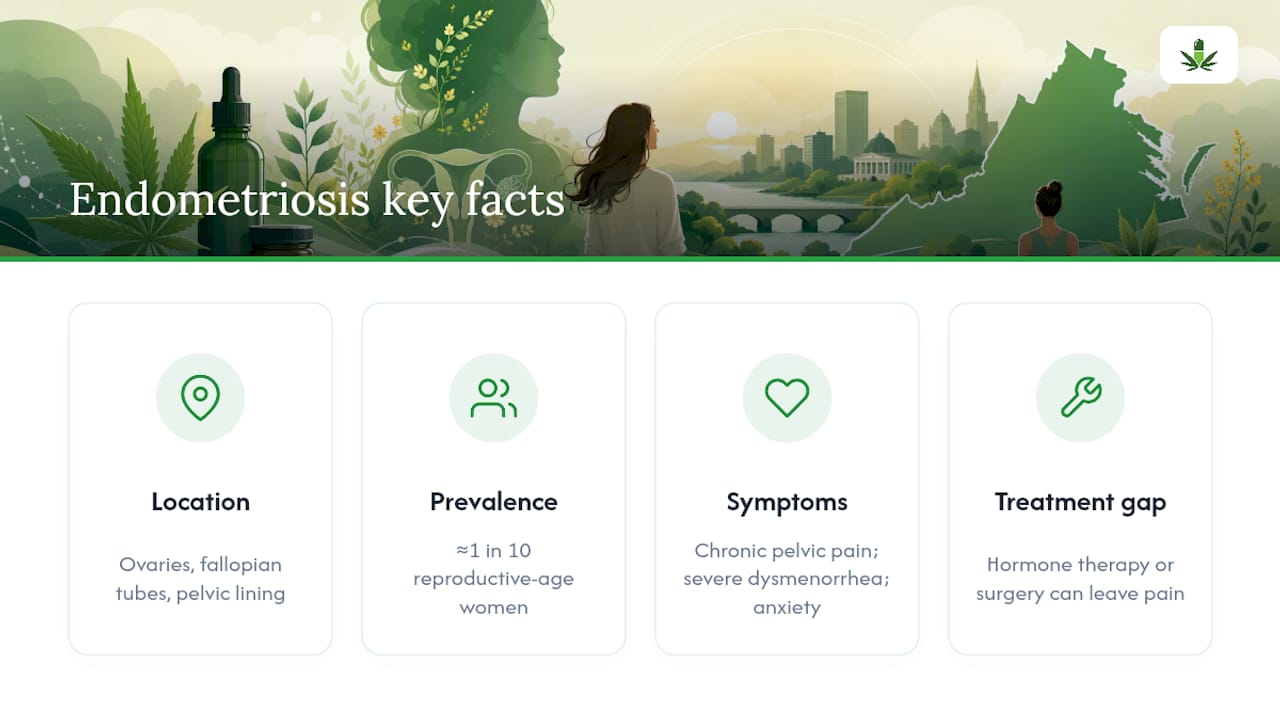
Endometriosis happens when tissue similar to the uterine lining grows outside the uterus, often on the ovaries, fallopian tubes, or pelvic lining. It affects roughly 1 in 10 women of reproductive age, though many go undiagnosed for years because symptoms get dismissed as “bad periods.”
The symptoms driving people toward alternatives like cannabis are specific: chronic pelvic pain that outlasts a normal cycle, dysmenorrhea severe enough to disrupt work or sleep, and the anxiety that builds when pain becomes unpredictable. Hormonal therapy and surgery remain the standard first-line treatments, but they don’t resolve everything. Many patients still deal with breakthrough pain, medication side effects, or symptoms that return after surgical excision. That gap is exactly where symptom-focused options, including medical cannabis, tend to enter the conversation.
What Does the Research Say About Cannabis and Endometriosis Pain?
The evidence is promising but still early stage, built almost entirely on observational data rather than randomized trials.
A 2026 prospective cohort study found that participants using CBD-based therapy for endometriosis reported average pelvic pain scores drop from 5.4 to 3.7, and worst pain fall from 7.6 to 5.3 after three months. That’s a meaningful shift on a standard 10-point pain scale, though the study’s authors are careful to note the small sample size limits how far those numbers generalize.
A separate mixed-methods study tracked patients over 12 weeks after they were newly prescribed medicinal cannabis and found decreased pelvic pain alongside improved quality-of-life measures, while calling for larger randomized trials before drawing firm conclusions. Longer-term registry data tell a similar story: patients followed for up to 24 months through the UK Medical Cannabis Registry showed sustained improvements in pain, sleep, and anxiety, and a subset reduced their opioid use over that period.
None of this is randomized, placebo-controlled proof. News coverage summarizing these findings stresses that larger, controlled studies are still needed before cannabis becomes a standard-of-care recommendation. What the data does show consistently:
- Pain score reductions similar to those reported in some cohorts, though results vary by product formulation and dose
- Quality-of-life gains reported across multiple independent studies, not just one
- Some patients lowering opioid dosages under clinician supervision
- Common adverse events including dry mouth, drowsiness, and mild dizziness, generally described as mild to moderate
The takeaway isn’t that cannabis is unproven. It’s that the proof we have comes from real patients tracked over months, not from double-blind trials, so it should inform your decision rather than replace a conversation with your gynecologist.
Which Endometriosis Symptoms Respond Best to Cannabis?
Pain severity, sleep quality, and anxiety show the strongest patient-reported improvement across the available studies. That’s a narrower claim than “cannabis treats endometriosis,” and it’s the more honest one.
Side effects and interactions deserve equal attention. Cannabis can interact with blood thinners, certain antidepressants, and sedatives, so any clinician recommending it should review your full medication list first. There’s also a behavioral piece worth naming directly: chronic pain conditions like endometriosis often carry a psychological weight, and cannabis used purely to numb distress, without addressing sleep, stress, or mental health, tends to produce diminishing returns over time.
- THC-heavy products carry a higher risk of anxiety or dizziness at high doses, especially for first-time users
- CBD-dominant products tend to produce fewer psychoactive effects but slower, less pronounced pain relief
- Combining cannabis with opioids or benzodiazepines requires medical oversight
- Tracking your response for two to four weeks tells you more than any single dose ever will
Pro Tip: Start with the lowest available THC dose, even if a dispensary staffer suggests something stronger. You can always titrate up. You can’t easily undo a rough first experience with an edible that hits harder than expected two hours later.
Does Endometriosis Qualify for Medical Cannabis in Virginia?
Virginia does not run a fixed list of qualifying conditions the way some states do. Instead, state law puts the decision in the hands of licensed practitioners, who can certify any condition they believe is likely to benefit from cannabis based on their own clinical judgment. Endometriosis qualifies when a practitioner documents that judgment.
Here’s who can actually issue that certification:
- A licensed physician (MD or DO)
- A licensed physician assistant
- An advanced practice registered nurse, jointly licensed to prescribe
Each of these practitioner types must be registered and active in the Virginia Cannabis Control Authority’s CCA Portal, the system used to issue electronic certifications. The CCA’s own guidance emphasizes that practitioners need sufficient education and training to exercise sound professional judgment when certifying a patient, so not every general practitioner participates.
Before booking an evaluation, confirm two things: that the practitioner is currently active in the CCA Portal, and that they’re comfortable discussing endometriosis specifically rather than treating the visit as a formality. Expect questions about your diagnosis history, prior treatments tried, current medications, and how pain affects daily function. Bring whatever documentation you have, even informal notes on symptom patterns help.
How Do You Get Medical Cannabis in Virginia?
The path from “considering this” to “holding a product at a dispensary” runs through a handful of clear steps.
- Prepare a brief symptom and treatment history before your appointment
- Schedule an evaluation with an eligible Virginia practitioner, in person or through a verified online service
- Receive a written certification. A digital copy is valid on its own
- Optionally register with the state for a physical medical cannabis card
- Visit a licensed Virginia dispensary with your written certification and photo ID
The physical card is optional because the written certification alone lets you purchase at a licensed dispensary immediately, no waiting on state processing. Bring valid ID and your certification every visit. Evaluation fees vary by provider, and card registration, when patients choose it, typically takes several business days to process through the state system.
What Product Forms Are Available for Pelvic Pain?
Virginia dispensaries carry several formats, and the right one depends on how fast you need relief and how long you need it to last.
- Oils and tinctures: sublingual absorption, onset in 15 to 45 minutes, moderate duration
- Dried flower: vaporized for fast onset, typically under 10 minutes, shorter duration overall
- Edibles: slower onset (30 minutes to two hours) but longer-lasting relief, useful for overnight symptom control
- Topicals: applied directly to the lower abdomen, no psychoactive effect
- Suppositories: patient reports describe targeted pelvic relief, though formal clinical evidence here is still limited compared to oral and inhaled forms
For a first attempt at managing pelvic pain, many patients start with a CBD-forward tincture rather than high-THC flower or edibles, then adjust based on how their body responds. Suppositories and topicals appeal to patients who want to avoid systemic psychoactive effects entirely, but expect to rely mostly on anecdotal reports rather than published trial data when evaluating them.
What Should You Ask Your Clinician Before Starting?
A focused certification visit gets you further than a rushed one. Come prepared with specific questions rather than a general “does this work” ask.
- What formulation and starting dose make sense for my specific symptoms?
- Could cannabis interact with my current endometriosis medications or pain management plan?
- What’s a reasonable monitoring plan, and when should we reassess?
- How should this change if I’m pregnant or trying to conceive?
Certain situations call for extra caution or a different plan entirely: pregnancy, a personal history of psychosis, unstable cardiac disease, or a pattern of problematic substance use. Flag any of these upfront rather than letting your practitioner discover them later.
Pro Tip: Keep a simple pain diary for the first month, just date, dose, pain level before and after, and sleep quality. Bring it to your follow-up. It turns a vague “I think it’s helping” into evidence your clinician can actually act on.
Our Perspective: Making Certification Fast and Straightforward
We built our service around one idea: getting certified for a condition like endometriosis shouldn’t be another obstacle on top of a disease that already makes daily life harder. We offer same-day consultations for a flat fee, with a refund available if you don’t qualify. No risk in asking.
That speed matters specifically for endometriosis patients. Pain flares don’t wait for a three-week appointment backlog, and a documented written certification is what actually lets you walk into a dispensary. Our evaluations connect directly with Virginia’s CCA Portal process, so what you receive is a legitimate certification, not a shortcut around the system. We built this for people who’ve already done the hard part, living with the condition, and just need the paperwork to catch up.
— Jonathan
Get Certified Without the Wait
Virginia Medical Cannabis Certifications is the alternative to sitting on a waitlist for a general practitioner who may not even participate in the CCA Portal. Our online evaluations are brief and offered for a flat fee, with a refund available if you’re not approved, so there’s no financial downside to finding out where you stand.

If you’re a Virginia resident dealing with endometriosis pain and want a documented, practitioner-issued certification without the runaround, book your evaluation today and get a same-day decision. You can also review exactly how the process and refund guarantee work before you commit to anything. Discounts may be available for certain groups at checkout. Once approved, your written certification can be used at licensed Virginia dispensaries.
This article is general information, not a substitute for advice from a qualified doctor. Consult a qualified healthcare professional about your own circumstances before acting on anything here.
Sources
- Medicinal cannabis may offer relief for endometriosis and pelvic pain (University of Otago news release)
- Perceived impact of medicinal cannabis on pelvic pain and endometriosis related symptoms in Aotearoa New Zealand: an observational cohort study
- Cannabis-based medicinal products for endometriosis: a 2-year prospective analysis from the UK Medical Cannabis Registry
FAQ
Does Marijuana Worsen Endometriosis?
There’s no evidence that cannabis worsens the underlying disease process of endometriosis. Studies show symptom improvement in pain, sleep, and anxiety, though it does not treat the tissue growth itself and should not replace gynecologic care.
How Do the Chinese Treat Endometriosis?
Traditional Chinese medicine commonly addresses endometriosis with herbal formulas and acupuncture aimed at reducing pelvic pain and inflammation, often alongside conventional gynecologic treatment rather than instead of it. These approaches are used within China’s own medical framework and aren’t a substitute for the evidence-based options available to Virginia patients.
How Do the Japanese Treat Endometriosis?
Japan’s standard approach relies on hormonal therapies, including low-dose oral contraceptives and GnRH agonists, alongside surgical options for more severe cases, with growing interest in complementary approaches for symptom relief. As with other traditional or complementary methods, some patients report symptom relief from herbal remedies used alongside standard care, though this reflects anecdotal reporting rather than clinical trial evidence.
Can CBD Suppositories Help With Endometriosis Pain?
Patient reports describe targeted pelvic relief from CBD suppositories, but formal clinical research on this specific delivery method remains limited compared to oral tinctures or vaporized flower. If you want to try one, discuss it with your certifying practitioner first to rule out interactions with other medications.
Is Endometriosis an Automatic Qualifying Condition in Virginia?
Virginia doesn’t use a fixed qualifying-condition list. A licensed practitioner can certify endometriosis when they determine, using their own clinical judgment, that you’re likely to benefit from medical cannabis.
Do I Need a Physical Medical Cannabis Card to Buy in Virginia?
No. A written certification from an eligible practitioner is enough to purchase at a licensed Virginia dispensary; the physical state card is optional and mainly useful for identification convenience.