

Yes, we can help you get certified if a licensed Virginia practitioner determines that medical cannabis may help your traumatic brain injury symptoms. The fastest path is a telehealth evaluation that meets Virginia’s real-time audiovisual standard, so the practitioner can review your history and make that call. If you want a quick, low-risk way to find out, book a same-day evaluation with a refund if you don’t qualify.
Table of Contents
- What Documents and Medical History You Need to Bring
- How to Receive and Use Your Written Certification
- Why Your Current Medications Matter to the Practitioner
- Getting Ready for Your Telehealth Visit
- Choosing a Telehealth Provider You Can Trust
- Using Your Certification at a Virginia Dispensary
- A Few Honest Thoughts on Living With This Process
- Booking Your Same-Day Evaluation With Us
- FAQ
- Sources
What Documents and Medical History You Need to Bring
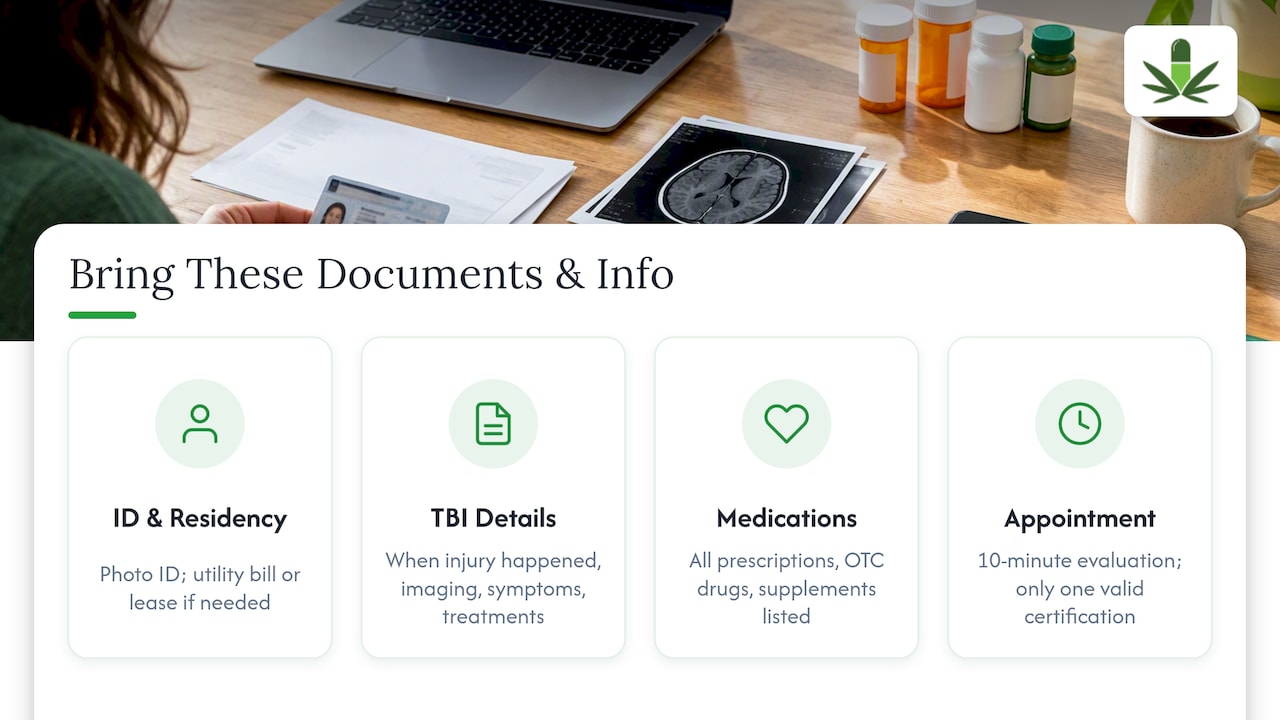
Before your telehealth visit, gather a few basics so the practitioner can make a fast, informed decision. You’ll need a valid government-issued photo ID, and if that ID doesn’t show a Virginia address, you may need a second document such as a utility bill or lease to confirm residency, according to Virginia Cannabis Control Authority patient guidance.
Beyond identification, come prepared to talk through your TBI diagnosis and how it affects you day to day. This includes when the injury happened, any imaging or hospital records you have access to, ongoing symptoms like headaches, sleep problems, mood changes or seizures, and how those symptoms have responded to other treatments. A short written summary helps, especially if speaking at length is tiring or difficult after a brain injury.
Your current medication list matters just as much. Practitioners need to know everything you’re taking, including over-the-counter drugs and supplements, because interactions and overall treatment history factor into their judgment. If you’ve changed practitioners recently or have a prior certification, mention that too, since Virginia law allows only one valid certification per patient at a time under the Code of Virginia § 4.1-1601. Having this information ready, rather than searching for it mid-appointment, keeps a ten-minute evaluation moving smoothly and gives the practitioner what they need to make a sound decision.
How to Receive and Use Your Written Certification
Once a practitioner approves you, your certification doesn’t arrive as a paper slip you carry around. It’s issued digitally through the CCA Portal, where you can view and access it electronically whenever you need to.
At the dispensary, staff typically verify your certification by scanning a QR code tied to your portal record, so having the portal set up on your phone or printed out makes check-in faster. You’ll also present your ID at that point, and if it doesn’t clearly show Virginia residency, bring the same secondary proof you used during certification, such as a lease or utility bill, per CCA patient guidance.
Keep your contact information current in the portal, especially if you’ve moved or changed phone numbers since a brain injury can sometimes come with memory or organizational challenges that make small administrative tasks easy to forget. A certification issued under Virginia law is valid for up to one year unless the practitioner specifies an earlier expiration, so mark that date somewhere you’ll actually see it.
If a dispensary ever has trouble verifying your certification, the fix is usually quick: confirm your portal login works and that your ID and residency documents match what’s on file. Most hiccups come down to mismatched addresses or an expired document, not an actual eligibility problem.
Why Your Current Medications Matter to the Practitioner
Part of what makes a Virginia telehealth evaluation thorough, even in a short visit, is that practitioners are required to check the Virginia Prescription Monitoring Program before issuing a certification, under 3VAC10-30-30. This database shows a patient’s history of controlled substance prescriptions, which gives the practitioner a fuller clinical picture before they decide whether cannabis is appropriate for you.
For TBI patients, this step often works in your favor rather than against you. Many people living with brain injury are already managing symptoms with anticonvulsants, pain medications, antidepressants or sleep aids, and a practitioner needs to understand that full picture before recommending anything additional. Being upfront about everything you’re taking, even medications you don’t think are relevant, helps the practitioner assess potential interactions and tailor their recommendation to your actual situation.
This is also why we encourage patients not to leave anything off their list, even supplements or occasional over-the-counter drugs. Withholding information doesn’t speed up your evaluation. It just means the practitioner is working with incomplete data, which can slow things down if questions come up later. Being transparent from the start is almost always the faster path to a confident, well-supported certification decision.
Getting Ready for Your Telehealth Visit
A little preparation makes your evaluation faster and less stressful, especially if concentration or fatigue is a challenge after a brain injury. Here’s what to have in place before you log on:
- Reliable video and audio. Virginia law requires real-time audiovisual technology for telehealth certifications, so test your camera and microphone on the device you’ll use, whether that’s a phone, tablet, or computer, before your appointment time.
- A quiet, well-lit space. Pick a spot with minimal background noise and enough light for the practitioner to see you clearly, which matters for a real-time visual assessment.
- Your documents within reach. Keep your ID, any residency proof, and your medication list open or printed nearby so you’re not searching for them mid-call.
- A stable internet connection. A wired connection or strong Wi-Fi signal avoids dropped calls that can interrupt a short evaluation window.
- Someone to assist, if helpful. If memory or attention is a challenge for you, having a caregiver or family member nearby to help answer questions or take notes is perfectly fine.
Because the evaluation itself typically takes about ten minutes, most of your prep time goes into logistics rather than the conversation. Once your tech and documents are ready, the actual visit moves quickly.
Choosing a Telehealth Provider You Can Trust
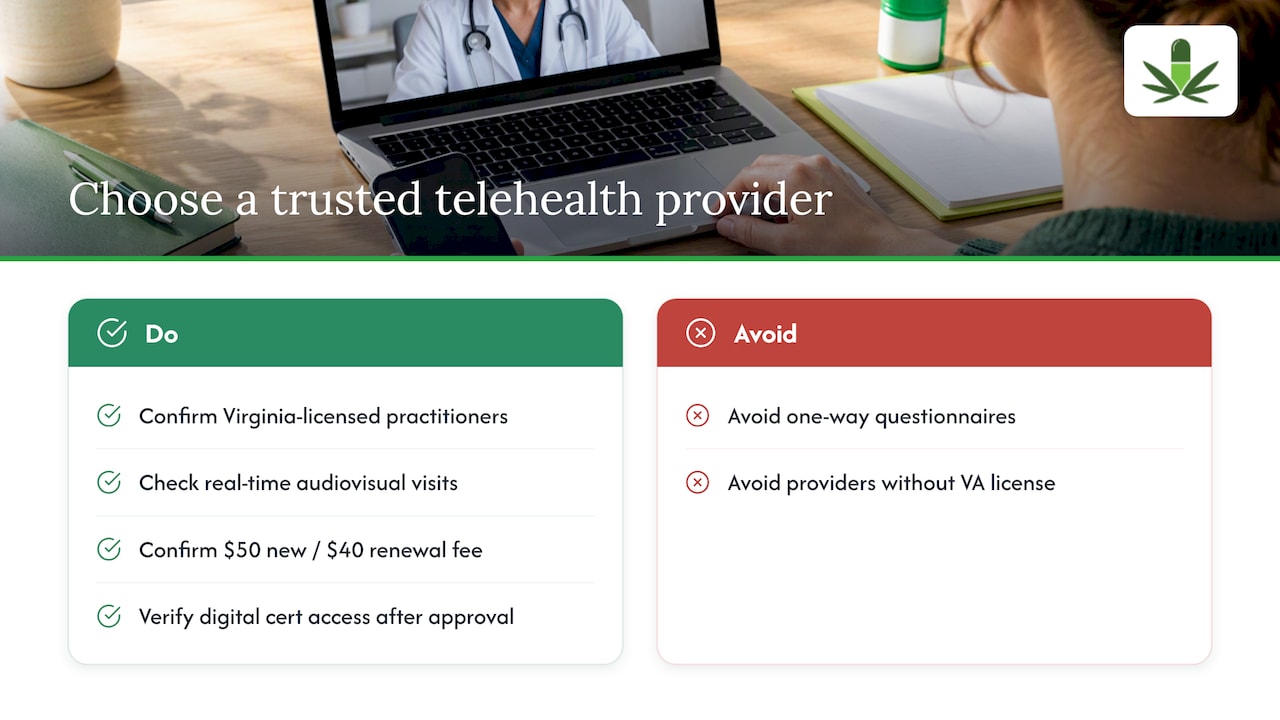
Not every telehealth service is set up the same way, so it’s worth knowing what to look for before you book. First, confirm the provider uses Virginia-licensed practitioners who meet the state’s professional requirements, since only a licensed practitioner can legally issue a certification under Code of Virginia § 4.1-1601. Second, check that the visit actually uses real-time audiovisual technology rather than a one-way questionnaire, which is what Virginia law requires for a valid telehealth certification.
Cost and turnaround time matter too, particularly if you’re dealing with symptoms that make waiting around frustrating. We built our own process around that need: new certifications are $50 and renewals are $40, with same-day telehealth visits and a fully refundable fee if you don’t qualify. That last point is worth asking any provider you’re considering, since a refund guarantee tells you something about how confident a service is in its own approval process.
It also helps to check how a provider handles documentation and follow-up access. We issue digital certifications through the CCA Portal immediately after approval, so you’re not waiting on paperwork before heading to a dispensary. If you’re researching your options more broadly, our guide to the certification process walks through what to expect at each step, and our page on checking the qualifying condition list is a useful read before you book anywhere.
Using Your Certification at a Virginia Dispensary
Once you’re certified, you can legally purchase medical cannabis at any licensed Virginia dispensary. Bring your ID and your digital certification from the CCA Portal, since staff will scan it to confirm your status before completing a sale, per CCA guidance.
For TBI patients, practitioners often discuss administration form during the certification visit, since botanical products, oils, and other processed forms can suit different symptoms and routines differently. If memory, mobility, or driving is a concern after a brain injury, ask your practitioner whether a registered agent or home delivery through a dispensary makes sense for your situation. Many patients find that having cannabis delivered removes a logistical barrier that otherwise makes consistent treatment harder to maintain.
It’s also worth checking dispensary access in your area, since the state’s Health Service Areas don’t all have the same number of locations. The CCA’s news updates note new dispensary openings by region, which is a good way to confirm you have a nearby option before you need one. Keep your certification valid by tracking your expiration date, since Virginia certifications last up to a year, and plan your renewal before that date arrives so you’re never without legal access. If you’re switching forms or products and want more background on what’s available, our overview of certification benefits covers the basics in plain terms.
A Few Honest Thoughts on Living With This Process
Getting certified is the easy part. Living with a traumatic brain injury and figuring out what actually helps day to day takes longer, and that’s where a little record-keeping goes a long way. We’d encourage you to keep a short symptom log, just a few lines a day on sleep, pain, mood, or whatever you’re tracking, so you have something concrete to bring to follow-up visits instead of relying on memory alone.
Be honest with your practitioner about what you’re hoping cannabis will actually do for you, whether that’s better sleep, fewer headaches, or steadier mood. Keep a copy of your written certification somewhere accessible, and double-check your contact details in the CCA Portal stay current. Organizations like Schizophrenic.NYC write thoughtfully about trauma’s broader effects on mental health, which is worth a look if you’re navigating more than just physical symptoms.
— Jonathan
Booking Your Same-Day Evaluation With Us
We built this process so a TBI diagnosis doesn’t mean weeks of waiting for relief. Booking takes a few minutes: pick a time on our services page, complete your ten-minute video evaluation with a Virginia-licensed practitioner, and receive your digital certification the same day if you’re approved.

Here’s what to have ready and what it costs:
- Your ID and residency proof, plus a quick summary of your TBI diagnosis and current medications.
- A device with camera and microphone access, tested beforehand for a smooth real-time visit.
- $50 for a new certification or $40 for a renewal, both one-time fees for the evaluation.
- A full refund if the practitioner determines you don’t qualify, no extra steps required on your end.
If you’re ready, book your evaluation now and get your answer today.
This article is general information, not a substitute for advice from a qualified doctor. Consult a qualified healthcare professional about your own circumstances before acting on anything here.
FAQ
Can a TBI qualify you for medical marijuana in Virginia?
Yes, if a licensed Virginia practitioner determines that cannabis may benefit your specific symptoms, they can issue a written certification under Code of Virginia § 4.1-1601. Virginia doesn’t require a fixed list of qualifying conditions, so the decision comes down to the practitioner’s professional judgment about your case.
Does Virginia accept telehealth visits for medical cannabis certification?
Yes, as long as the visit uses real-time audiovisual technology that lets the practitioner see and speak with you directly, per Virginia law. A one-way form or phone-only call doesn’t meet this standard.
What ID do I need to buy medical cannabis in Virginia?
You need a valid government-issued photo ID, and if it doesn’t show a Virginia address, dispensaries may ask for a second document such as a utility bill or lease to confirm residency, according to CCA patient guidance. Keep both on hand when you visit a dispensary.
How often do I need to renew my Virginia medical cannabis certification?
Certifications are valid for up to one year unless your practitioner sets an earlier expiration date. We offer same-day renewal evaluations for $40 so you can recertify before your current one expires.
What happens if I don’t qualify for a certification?
If a practitioner determines you don’t qualify, we fully refund your evaluation fee, so there’s no financial risk in finding out whether you’re eligible. You can always revisit the process later if your circumstances change.
Sources
- § 4.1-1601. Certification for use of cannabis for treatment
- Patients & Caregivers — Virginia Cannabis Control Authority
Recommended
- Virginia Medical Cannabis Card in Northern Virginia
- Virginia Medical Cannabis Card in Richmond
- Same Day $50 PTSD Marijuana Certification in Virginia – Virginia Medical Cannabis Certifications
- Same Day $50 Televisit to Visit a Virginia Dispensary: What Patients Need – Virginia Medical Cannabis Certifications