
Virginia sets no fixed minimum age for medical cannabis certification. A minor of any age can qualify when a practitioner determines cannabis would help their condition and a parent or legal guardian signs on. Once certified, patients under 21 are legally exempt from the state’s general 21-and-up possession rule, as long as they carry a valid written certification.
Table of Contents
- What Is the Virginia Medical Marijuana Age Requirement?
- Who Can Certify a Minor for Medical Cannabis in Virginia?
- How Does the CCA Portal Issue and Renew Certifications?
- What Are the Dispensing Rules for Minors and Adult Patients?
- Which Virginia Telemedicine Providers Offer Certifications?
- What Happens During a Same-Day Online Certification Visit?
- Where to Verify Virginia’s Medical Cannabis Age Rules
- Why Virginia’s Age Rules Make More Sense Than They First Appear
- A Faster, More Affordable Path to Certification
- Sources
- FAQ
What Is the Virginia Medical Marijuana Age Requirement?
There’s no statutory age floor in Virginia’s medical cannabis program, and that surprises a lot of parents who assume the rules mirror recreational law. Virginia’s recreational possession threshold sits at 21, but the medical program regulations treat minors, young adults, and older adults under one certification framework rather than three separate age tiers.
Here’s how the categories actually break down in practice:
- Under 18: Can be certified with a practitioner’s clinical judgment and a parent or legal guardian’s consent listed directly on the certification.
- 18 to 20: Can be certified as legal adults, but still fall under the 21+ recreational possession law for anything outside the medical program. A valid certification is what protects them.
- 21 and older: Face no special medical/recreational overlap issue, since they already meet the general possession age.
Parental or guardian consent for a minor isn’t a verbal formality. It gets documented as part of the written certification itself, and the parent or guardian typically needs to show proof of their own identity and Virginia residency, since they’re often the one picking up product at the pharmacy. Acceptable proof generally includes a Virginia driver’s license, state ID, or another government-issued document confirming address. When a minor doesn’t have their own ID, the parent or guardian’s documentation stands in for verification purposes.
Who Can Certify a Minor for Medical Cannabis in Virginia?
Not every clinician can issue a Virginia medical cannabis certification, and the bar for certifying a minor is a notch higher than for an adult patient. Eligible practitioners include physicians, physician assistants, and nurse practitioners licensed in Virginia, and their credentials get checked against state licensing systems before a certification is considered valid.
For adult patients, the practitioner’s job is relatively straightforward: confirm a qualifying condition exists and that cannabis is a reasonable option. For a minor, the standard of care goes further. The Code of Virginia requires the practitioner to exercise informed professional judgment and explicitly authorize botanical cannabis on the written certification if they believe it’s appropriate, since botanical (movable or plant-form) products carry different considerations for younger patients than oils or capsules.
A few structural safeguards apply across the board:
- Practitioners cannot issue certifications while working on dispensary premises.
- They cannot accept payment or compensation tied to a cannabis processor.
- For minors, they must document both the clinical rationale and the parent or legal guardian’s information on file.
Pro Tip: If you’re bringing in a minor for evaluation, ask directly whether botanical cannabis will be authorized on the certification itself. Getting it in writing up front avoids a second trip to sort it out with the pharmacist later.
How Does the CCA Portal Issue and Renew Certifications?
Every Virginia medical cannabis certification runs through the Virginia Cannabis Control Authority’s CCA Portal, the state’s official issuance and verification system. Here’s what that looks like step by step:
- The practitioner completes the clinical evaluation and enters the certification directly into the CCA Portal.
- The patient (or parent/guardian for a minor) gains access to a digital copy of the written certification, which can be downloaded, printed, or pulled up on a phone at the pharmacy.
- The certification stays valid for up to one year, unless the practitioner sets a shorter expiration based on the patient’s condition.
- There’s no separate annual state registration fee required beyond the certification itself, which simplifies renewal compared to some other state programs.
If a minor’s first certification didn’t explicitly authorize botanical cannabis and the family later decides it’s appropriate, the practitioner can communicate that authorization directly to the pharmacist at the time of dispensing, and the pharmacist documents it in the patient’s record. That flexibility matters if a family’s needs change mid-year and a full recertification visit isn’t practical.
What Are the Dispensing Rules for Minors and Adult Patients?
Getting certified is only half the process. Virginia pharmacies operate under specific rules about who can walk out with the product and how much they can legally receive. A patient can pick up their own medical cannabis, but a minor’s dispensing generally runs through a parent or legal guardian, or a registered agent designated on file with the Board.
At pickup, expect an ID and registration check every time. Supply limits apply uniformly regardless of age:
- No more than a 90-day supply within any 90-day period, as determined by the pharmacist’s professional judgment.
- A cap of a limited amount of botanical cannabis per 30-day period, when botanical products are part of the certification.
- Pharmacists must document each self-assessment and any special authorization, including botanical approvals for minors.
Pharmacists also retain discretion to decline dispensing if they believe doing so raises a safety concern, regardless of how complete the paperwork looks. That professional judgment clause exists precisely because a written certification, while necessary, isn’t the only checkpoint in the system.
A parent and a registered agent can both be authorized for the same minor patient, which gives families more than one adult who can legally handle pickups when schedules get complicated.

Which Virginia Telemedicine Providers Offer Certifications?
Virginia has no shortage of telemedicine options for medical cannabis certification, and most operate on a same-day or next-day model. The right pick depends less on brand recognition and more on what you actually need: speed, a refund policy if you’re not approved, veteran pricing, or help navigating CCA Portal paperwork.
A few things worth checking before you book with any provider on this list:
- Confirm the evaluation happens the same day you want it, not “within 24 to 48 hours.”
- Ask whether the fee is refundable if the practitioner determines you don’t qualify.
- Find out if the provider walks you through CCA Portal access, or just emails a PDF and leaves the rest to you.
Whichever provider you choose, verify the practitioner’s license and confirm the certification actually posts to the CCA Portal before you leave the appointment. A certification that only exists as an email attachment, with no portal record, can create headaches at the pharmacy counter.
What Happens During a Same-Day Online Certification Visit?
A same-day telemedicine certification with Virginia Medical Cannabis Certifications follows a predictable sequence, which is part of what makes it low-stress for first-time patients and parents alike:
- Book an appointment online and complete basic intake information.
- Join a 10-minute clinical evaluation with a licensed Virginia practitioner over video.
- If approved, the practitioner issues the written certification through the CCA Portal, and you receive an electronic copy by email the same day.
New certifications cost $50, and renewals cost $40, both one-time fees. If the practitioner determines you don’t qualify, the fee is fully refunded. That structure removes the guesswork of paying upfront with no guarantee of approval, which matters most for patients weighing whether cannabis is even worth exploring for their condition.
For a minor’s visit, the practitioner documents the parent or legal guardian’s information as part of the evaluation, and discusses botanical authorization directly with the family before finalizing the certification.
Pro Tip: Keep both a digital and printed copy of your certification. Some pharmacies pull it directly from the CCA Portal, but having a printed backup avoids delays if the system is slow or your phone battery dies at the counter.
Where to Verify Virginia’s Medical Cannabis Age Rules
A few official sources cover everything discussed here, and it’s worth bookmarking them if your situation changes:
- The CCA’s Patients & Caregivers page covers residency proof, parent/guardian documentation, and registered agent rules.
- 3VAC10-30 lays out the program’s certification eligibility rules in full.
- Title 4.1, Chapter 16 of the Code of Virginia governs practitioner responsibilities and minor authorization.
- 3VAC10-50-80 details pharmacist dispensing limits and documentation duties.
Why Virginia’s Age Rules Make More Sense Than They First Appear
Most people assume medical cannabis programs should track recreational age limits exactly, and get thrown off when Virginia doesn’t work that way. It shouldn’t. A 6-year-old with severe seizures and a 19-year-old with chronic pain have nothing in common except that both fall outside the 21+ recreational bracket, and treating them identically would fail the entire point of a medical program.
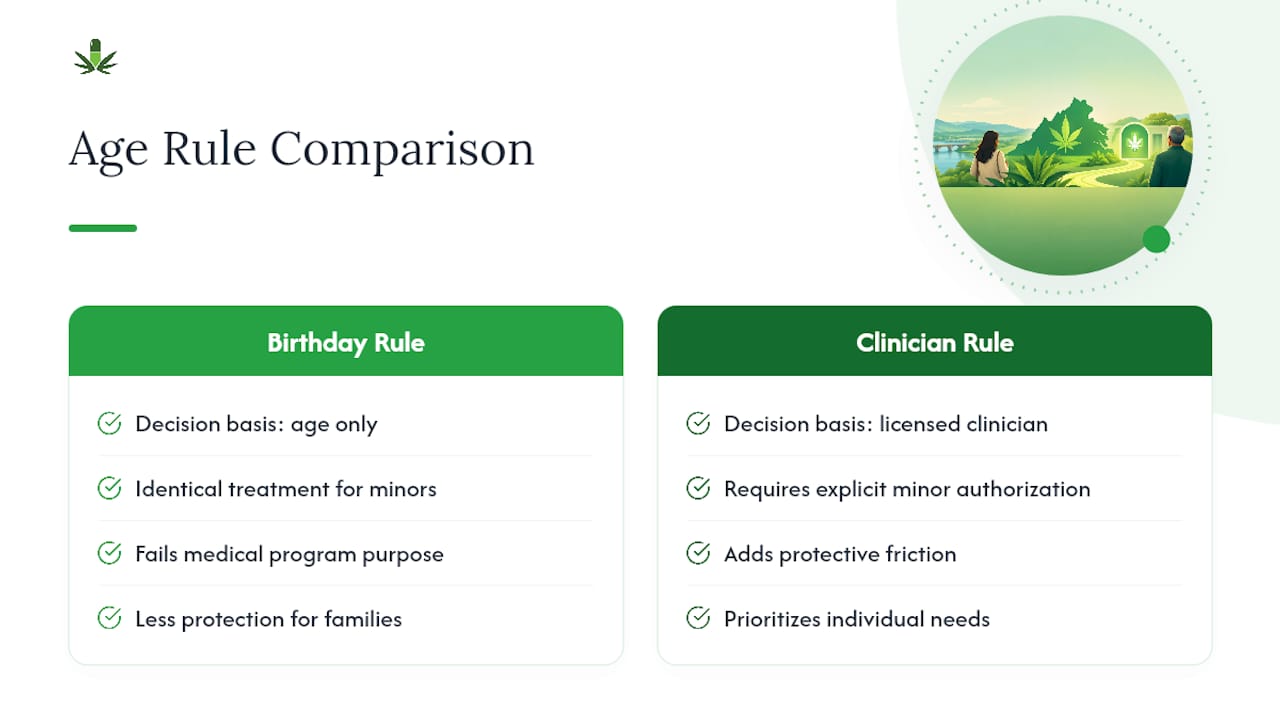
What the conventional advice gets wrong is framing this as a loophole. It isn’t. It’s a deliberate design choice that puts a licensed practitioner’s judgment, not a birthday, at the center of the decision. That’s a heavier lift for clinicians certifying minors, and it should be. The requirement to explicitly authorize botanical cannabis for a minor, rather than let a blanket certification cover it, is the kind of friction that protects families rather than slowing them down.
If you’re a parent researching this for a child, prioritize the practitioner’s willingness to explain their reasoning over how fast they can get you an appointment. Speed matters less than a clinician who actually documents why botanical authorization is or isn’t appropriate for your kid.
— Jonathan
A Faster, More Affordable Path to Certification
Beyond the statewide telemedicine names covered above, Virginia Medical Cannabis Certifications offers a straightforward alternative built around speed and low upfront risk. New patients pay $50 for a certification, renewals run $40, and if the evaluating practitioner determines you don’t qualify, that fee comes back to you in full. No other provider on this list advertises that same money-back structure as clearly.

The evaluation itself takes about 10 minutes online, with a Virginia-licensed clinician who documents your condition and, for minors, works directly with the parent or legal guardian on file. There’s no drive to a clinic, no waiting room, and no separate fee just to find out whether you qualify. If you’re ready to check your eligibility, book your same-day evaluation and get a decision, and your certification, before the day is over.
This article is general information, not a substitute for advice from a qualified doctor. Consult a qualified healthcare professional about your own circumstances before acting on anything here.
Sources
- Virginia Administrative Code — 3VAC10-30 (Medical Cannabis program regulations)
- Code of Virginia — Title 4.1, Chapter 16 (Medical Cannabis Program)
- Virginia Administrative Code — 3VAC10-50-80 (Dispensing of cannabis products)
FAQ
Can You Get a Medical Cannabis Card at 18 in Virginia?
Yes. At 18, you’re a legal adult and can be certified the same way any adult patient is, based on a practitioner’s determination that cannabis would help your qualifying condition. You don’t need parental consent once you turn 18, though you still fall under the state’s 21+ recreational possession law for anything outside your certification.
Can a Minor Get a Medical Marijuana Card in Virginia?
Yes, minors can be certified with no fixed minimum age, as long as a practitioner determines the benefit and a parent or legal guardian consents and is listed on the certification. The parent or guardian typically handles product pickup and identity verification at the pharmacy.
What States Allow 18-Year-Olds to Buy Recreational Marijuana? For guidance on state-level vaping and possession laws that may intersect with cannabis-related restrictions, see Which Vaping Behaviors Trigger Stops Across U.S. States.
No U.S. state currently allows 18 year olds to purchase recreational marijuana. Every state with legal recreational cannabis, including Virginia’s possession framework, sets the age at 21. Medical programs, including Virginia’s, operate under separate rules that allow certified patients under 21, including minors with guardian consent, to legally use cannabis.
What Are Virginia’s Legal Rules for Medical Marijuana?
Virginia requires a written certification from a licensed practitioner confirming a qualifying condition, issued through the CCA Portal and valid for up to one year. Patients must be Virginia residents, and certified patients under 21, including minors with guardian consent, are exempt from the general 21+ possession rule while holding a valid certification.
How Much Does a Medical Cannabis Certification Cost in Virginia?
Pricing varies by provider, but Virginia Medical Cannabis Certifications charges $50 for a new certification and $40 for a renewal, both one-time fees with a full refund if you’re not approved. Other providers typically don’t list pricing publicly, so it’s worth confirming cost and refund policy before booking.