
A cannabis tolerance break works: giving your body time off lowers your THC tolerance, and the usual target is a multi-week reset, commonly around 21 days, with some people needing closer to 28 days for things to settle. Your body starts adjusting within days, but full recovery builds gradually over the following weeks. If you use cannabis heavily or daily, or you’re managing a mental health condition alongside it, it’s worth looping in a doctor before you start.
Table of Contents
- What happens in your body during a tolerance break
- How long should your break actually be?
- What withdrawal actually feels like, day by day
- Your week-by-week tolerance break plan
- When it’s time to get professional support
- A realistic take on tolerance breaks
- FAQ
- Sources
- Reconsidering your certification after a break
What happens in your body during a tolerance break
A tolerance break, often shortened to “T-break,” is a planned pause from cannabis use with one goal: letting your tolerance drop so a smaller amount gets you the same effect it used to. The reason this works comes down to receptors in your brain. Regular THC use causes your CB1 receptors (the ones THC binds to) to become less responsive over time, a process called downregulation. Stop using, and those receptors gradually become sensitive again.
It helps to know where this guidance actually comes from:
- The “21 days” figure is a community rule of thumb, repeated across university wellness programs and online forums, not a formal medical standard.
- The biological piece, how fast receptors actually recover, comes from neuroimaging research, which we cover next.
- Both point in the same direction: a break measured in weeks, not days, gives your system real time to reset.
How long should your break actually be?
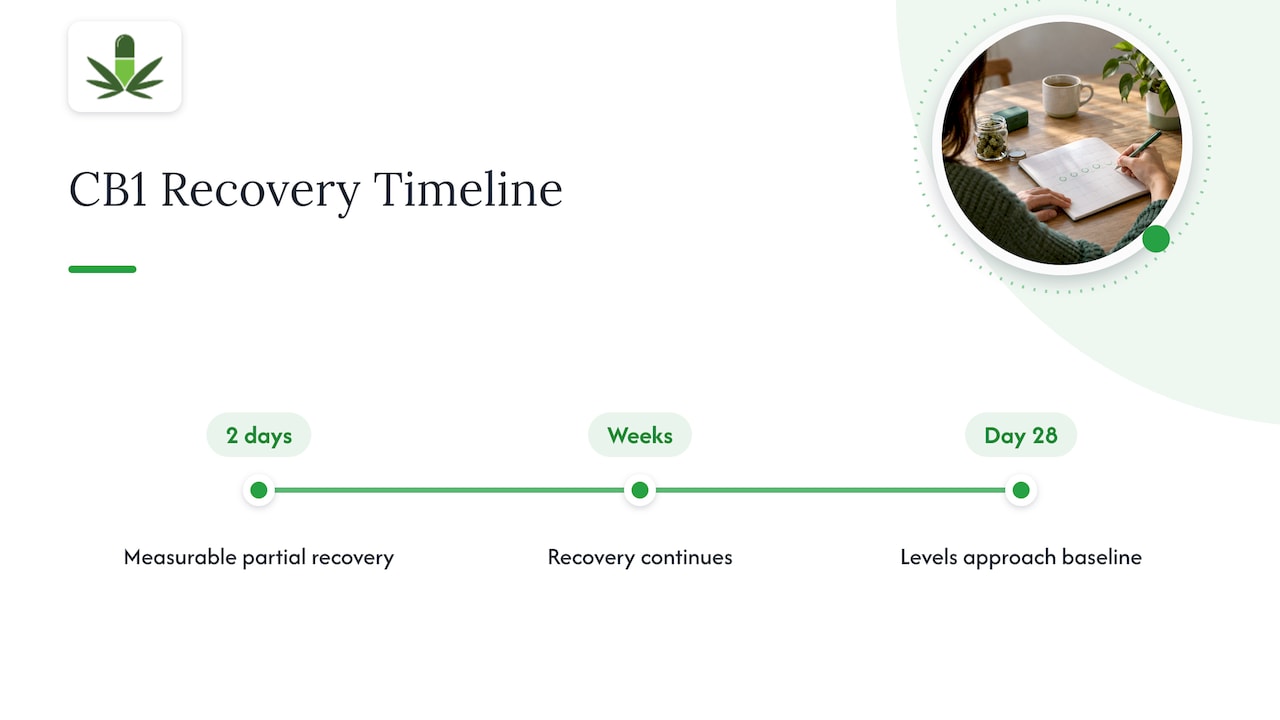
A 2016 imaging study found that CB1 receptor availability starts reversing within just a few days of abstinence, with recovery continuing toward near-normal levels by around 28 days of sustained abstinence.
Receptor recovery starts fast, but full normalization takes weeks. That imaging research found measurable partial recovery after just two days off, with levels approaching baseline by the 28-day mark, which is why some people notice a difference almost immediately while others need the full month.
Your own timeline depends on how you’ve been using. Someone smoking daily for years will likely need the longer end of that range, closer to four weeks, to feel a real shift. Someone using occasionally or at lower doses may notice their tolerance drop within a week or two. Product potency matters too: concentrates and high-THC flower build tolerance faster than lower-dose edibles or tinctures, so if you’ve been using concentrated products, expect your reset to take longer.
What withdrawal actually feels like, day by day
For regular users, stopping cannabis doesn’t just mean waiting out a craving. It can trigger a real, if usually mild, withdrawal course. A clinical review of cannabis withdrawal lays out what to expect.
- Symptoms typically start one to two days after your last use.
- Irritability, anxiety, sleep disruption, and appetite changes are the most common complaints.
- Symptoms usually peak between days 2 and 6, then begin to ease.
- Most symptoms fade within a week, though sleep problems can drag on longer, sometimes for up to three weeks or more in people who used heavily.
Most people who develop problematic use will experience withdrawal at some point. CDC data shows that 12.1% of frequent cannabis users report withdrawal symptoms, which gives a sense of how common this experience is among regular users, not just an unlucky few.
For most people, withdrawal is uncomfortable rather than dangerous. The main risk isn’t the symptoms themselves but relapsing to avoid them. Courses tend to be more severe for people managing a co-occurring mental health condition or using other substances alongside cannabis, which is worth keeping in mind as you plan your approach.
Your week-by-week tolerance break plan
A break goes better with a plan than without one. Here’s a structure that blends the community-standard 21-day window with what the clinical research supports.
Before you start:
- Pick a concrete end date (21 to 28 days out) and write down why you’re doing this.
- Remove cannabis and paraphernalia from easy reach.
- Tell one person who can check in on you.
- Line up a few non-cannabis activities for the first week, especially evenings.
- Plan a small reward for hitting day 7, day 14, and the finish line.
Week 1: get through the physical symptoms. This is when irritability, restlessness, and sleep trouble tend to peak. Stick to a consistent bedtime, cut caffeine after early afternoon, and get outside for even a short walk each day. Hydrate more than usual, and if sleep is rough, a short-term over-the-counter option like melatonin can take the edge off (our piece on cannabis and sleep covers more on this). Appetite dips are also common this week; small, regular meals work better than forcing three big ones (more on that in our guide to appetite changes).
Week 2: manage the mental side. Cravings shift from physical to psychological around this point. “Urge surfing,” noticing the craving, naming it, and letting it pass without acting on it, is a simple technique borrowed from cognitive behavioral approaches that works well here. Keep your days structured with specific plans rather than open stretches of free time.
Week 3 and beyond: reassess. By this stage, most people report noticeably reduced cravings and better sleep. Use this point to decide what comes next: continue to 28 days for a fuller reset, stop here, or taper back in gradually if that’s your goal.
Pro Tip: Keep a one-line daily log of your cravings and mood. Patterns jump out fast, and the log itself becomes proof of how far you’ve come.
When it’s time to get professional support
Most tolerance breaks don’t require medical intervention, but some signs mean it’s worth reaching out for help rather than toughing it out alone.
- Persistent low mood, hopelessness, or thoughts of self-harm.
- Symptoms of psychosis, such as confusion or unusual beliefs.
- Withdrawal severe enough to disrupt work, relationships, or daily functioning.
- Withdrawal from multiple substances at once.
If any of those apply, start with your primary care physician or a mental health clinician. Research on cannabis use disorder treatment finds that psychosocial approaches, cognitive behavioral therapy and motivational enhancement therapy in particular, are the most evidence-backed options, since no medication is currently FDA-approved specifically for cannabis withdrawal. SAMHSA’s free national helpline (1-800-662-4357) is available 24/7 if you need a confidential place to start.
A realistic take on tolerance breaks
Most people don’t nail their first tolerance break, and that’s worth saying out loud because nobody else does. Day 3 or 4 is usually where plans fall apart, right as irritability and sleep trouble peak and the novelty of “doing something healthy” has worn off. Treating a failed attempt as data rather than failure matters more than any single technique in this guide.
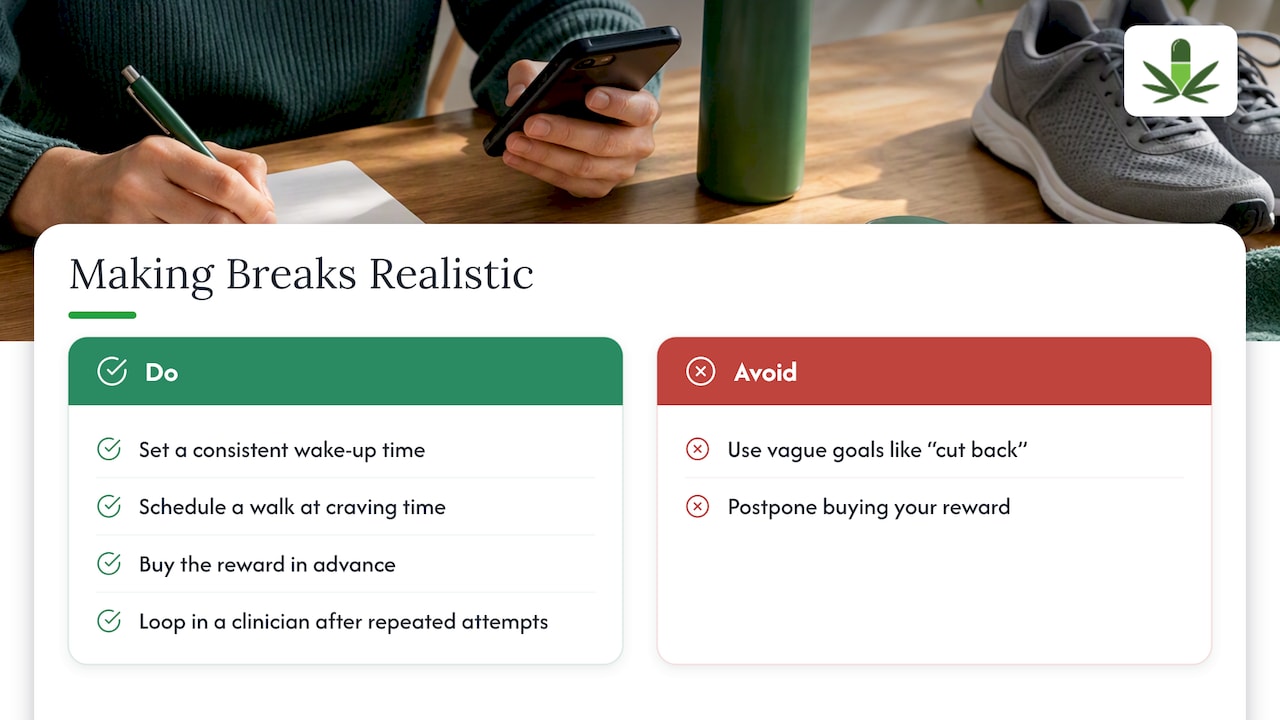
The plans that actually hold up are the boring, specific ones: a set wake-up time, a short walk scheduled at the exact hour cravings used to hit, a reward you’ve already bought rather than one you’ll “figure out later.” Vague goals like “cut back for a while” rarely survive past day 2.
If you’ve tried and failed more than a couple of times, or you’re noticing your mood sliding rather than just your patience, that’s a reasonable point to loop in a clinician rather than trying again solo. There’s no reward for doing this the hard way.
— Jonathan
This article is general information, not a substitute for advice from a qualified doctor. Consult a qualified healthcare professional about your own circumstances before acting on anything here.
FAQ
How long does cannabis tolerance take to reset completely?
Most people notice a meaningful drop in tolerance within 21 to 28 days of stopping, based on how quickly CB1 receptors regain sensitivity. Heavier or longer-term users often need the full 28 days, while lighter users may notice changes within one to two weeks.
What are the first signs you need a tolerance break?
Needing noticeably more cannabis to get the same effect, using earlier in the day than you used to, or feeling like cannabis has stopped doing much at all are the clearest signals. Some people also notice mild irritability or restlessness on days they don’t use, which points to developing dependence rather than simple habit.
Will a tolerance break affect a drug test?
Yes. THC is stored in fat tissue and clears slowly, so detection windows vary widely based on how often and how much you’ve used; a partner resource on drug test basics covers detection windows in more detail. A tolerance break reduces stored THC over time, but it isn’t a guaranteed or fast way to clear a specific test.
Is cannabis withdrawal dangerous?
For most people, withdrawal is uncomfortable but not medically dangerous, with symptoms peaking around days 2 through 6 and easing within a week or two. It can be more severe for people with a co-occurring mental health condition or those withdrawing from other substances at the same time, which is when professional support makes sense.
How do I safely start using cannabis again after a break?
Start at a noticeably lower dose than you were using before the break since your tolerance has dropped and the same amount will hit harder. Go slowly, pay attention to how you respond, and if you’re using cannabis for a medical condition, a quick check-in with your certifying provider can help you dial in the right amount again. If you’re due for a renewal certification around the same time, that visit is a natural point to discuss your new tolerance and any changes to your symptoms.
Sources
- Clinical management of cannabis withdrawal (PMC)
- CDC: Cannabis use disorder
- CB1 receptor recovery imaging study (2016)
- SAMHSA: Marijuana and treatment resources
Reconsidering your certification after a break
If your tolerance break changed how cannabis works for your condition, whether you need less than before or you’re reconsidering your treatment plan altogether, your medical certification should reflect that. We handle new certifications and renewals through a same-day virtual evaluation, built around patients managing qualifying medical conditions, with care from a practicing clinician. Our new certifications and renewals are completed online efficiently, and we offer a full refund if you don’t qualify.
Whether you’re resuming cannabis therapy post-break or renewing before your current card expires, you can start your evaluation today and have your certificate in hand the same day.