
If you want minimal intoxication, start with a CBD-predominant product or a balanced 1:1 ratio and titrate up slowly. If you need stronger symptom control and can tolerate psychoactive effects, a THC-leaning ratio may work better. Either way, “start low, go slow” is the rule, and pregnant or breastfeeding readers, or anyone on interacting medications, should check with a clinician first.
Table of Contents
- THC CBD Ratio Guide: Why the Numbers Actually Matter
- Does CBD Actually Cancel Out THC? What the Research Shows
- Common THC:CBD Ratios and What Users Typically Report
- How to Titrate THC and CBD Safely: A Step-by-Step Protocol
- Who Should Avoid THC and CBD, and Drug Interactions to Watch
- Choosing Your THC:CBD Ratio: A Practical Checklist
- Why Clinician Guidance Changes the Dosing Conversation
- Full-Spectrum, Broad-Spectrum, or Isolate: Which Fits Your Ratio Goals
- Is THC or CBD Legal Where You Live? What to Check First
- Why Most Ratio Advice Skips the Part That Matters Most
- Get Clinician Oversight Before You Start Titrating
- Sources
- FAQ
THC CBD Ratio Guide: Why the Numbers Actually Matter
THC and CBD behave differently in your body, and the ratio between them changes what you feel, how fast it kicks in, and how long it lasts. THC is the psychoactive cannabinoid. It produces the “high,” and it also drives much of cannabis’s pain relief and anti-nausea benefit. CBD does not intoxicate you the same way, but it is not inert. It gets processed by your liver’s CYP450 enzyme system, the same pathway that metabolizes a long list of prescription drugs.
Route of administration changes everything about how a given ratio feels:
- Inhaled products (smoking, vaping) hit within minutes, peak fast, and fade in two to four hours.
- Oral products (edibles, capsules) take 30 minutes to two hours to start working and can last six to eight hours or more.
- Tinctures held under the tongue sit somewhere in between, with partial absorption through oral tissue.
A 1:1 tincture and a 1:1 edible will feel different in timing even though the ratio on the label is identical.
Does CBD Actually Cancel Out THC? What the Research Shows
The “entourage effect” describes the idea that cannabinoids and terpenes work better together than any single compound alone. It is a reasonable hypothesis, and it is why full-spectrum products exist. But it does not mean CBD reliably neutralizes THC’s downsides, and the evidence on that specific claim is thinner than most marketing suggests.
A randomized, double-blind, cross-over trial tested inhaled combinations of 10 mg THC paired with 0, 10, 20, or 30 mg of CBD, covering common ratios from roughly 1:1 to 3:1. The result: CBD did not consistently reduce THC’s acute cognitive or psychotic effects at any of those ratios. Higher CBD content lowered relative THC exposure in the product, but it did not act as a dependable safety switch once THC was in your system.
Practically, this means choosing a higher CBD ratio mostly changes how much THC you are consuming and how the high feels subjectively. Treat it as dose management, not a guaranteed buffer against THC’s harsher edges.
Common THC:CBD Ratios and What Users Typically Report
Ratios are shorthand for intent. Here’s how the most common formulations tend to play out in practice.
- 50:1 and 20:1 (CBD-dominant). These are the go-to starting points for people who want symptom relief with essentially no intoxication. They show up most often in seizure management and general anxiety use, where a clear head matters as much as relief.
- 10:1 and 5:1 (CBD-leaning). Still low on the intoxication scale, but with enough THC to add analgesic or anti-nausea punch that CBD alone often can’t match. A common middle ground for chronic pain or inflammation.
- 1:1 (balanced). Many medical and recreational users start here because it blends CBD’s calming, non-intoxicating profile with THC’s stronger symptom relief. Expect noticeable but generally more manageable psychoactive effects than THC-heavy products.
- 2:1 and 5:1 THC-heavy (THC-predominant). These favor experienced users, and sometimes specific pain indications where CBD-forward options haven’t been enough. Intoxication is the trade-off, and it can be significant.
Format changes the math on every one of these. A 1:1 vape and a 1:1 gummy deliver the same ratio, but the edible’s slower onset and longer duration make overshooting your dose far easier, since the effects take longer to show up.
How to Titrate THC and CBD Safely: A Step-by-Step Protocol
Dosing is not a guessing game if you follow a structured protocol. Clinical dosing guidance built for medical cannabis administration lays out a clear starting point and pacing:
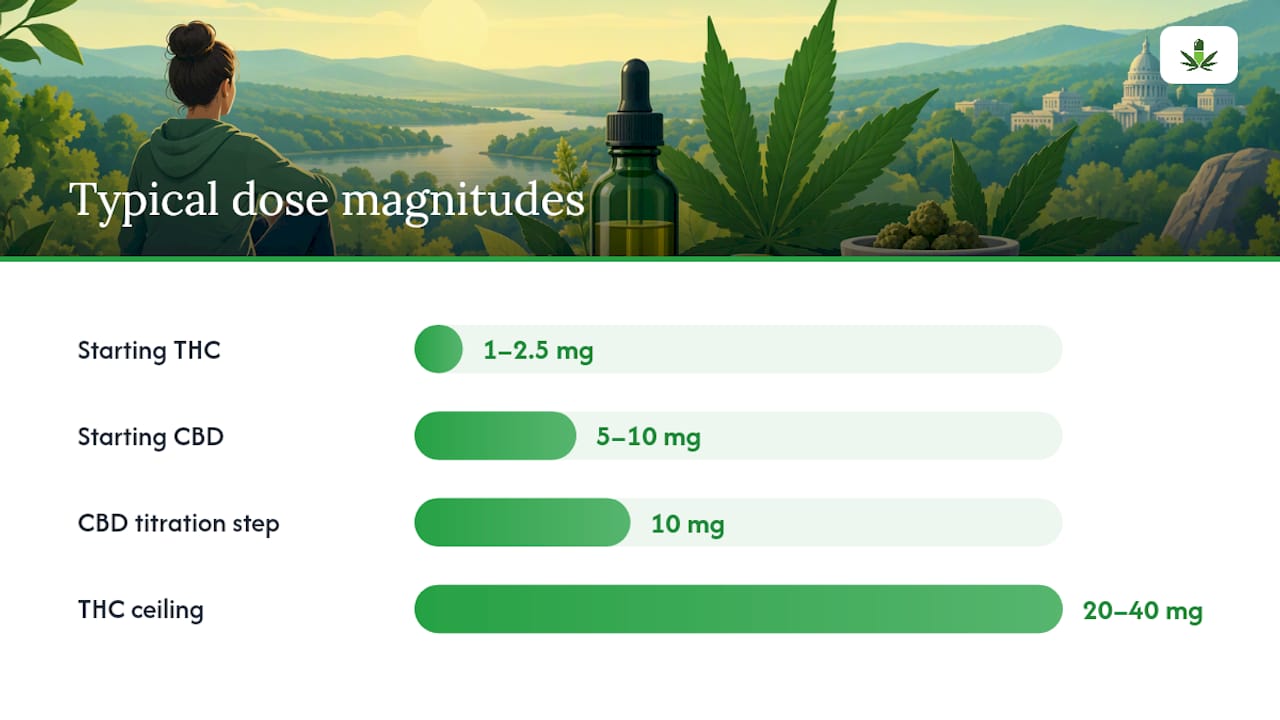
- Starting oral dose: CBD 5 to 10 mg and THC 1 to 2.5 mg, taken once or twice daily.
- CBD titration: increase by about 10 mg every two to three days until you reach your symptom goal.
- THC titration: add or increase in small 1 to 2.5 mg steps every three to seven days, only if CBD alone isn’t cutting it.
- Common THC ceiling: most guideline reviews cite 20 to 40 mg per day as the practical upper range for symptom relief, beyond which side effects tend to outweigh added benefit.
If you’re using tinctures, the slower sublingual absorption makes small, patient increases easier to manage than with edibles, where delayed onset tempts people into redosing too soon. Inhaled products let you feel effects almost immediately, which makes microdosing (one or two small puffs, then waiting) a more forgiving way to test a new ratio.
Statistic Callout: Consensus dosing guidance places typical THC ceilings between 20 and 40 mg per day, with CBD generally tolerated at much higher doses before diminishing returns set in.
Pro Tip: Keep a simple log with three columns: dose, time, and effect. After a week, patterns jump out that you’d never catch by memory alone, especially with slow-onset edibles.
If side effects outpace benefits at any step, hold your current dose for a few more days before increasing again. If nothing improves after a reasonable titration window, that’s your signal to check in with a clinician rather than keep pushing the dose higher.
Who Should Avoid THC and CBD, and Drug Interactions to Watch
Cannabis is not risk-free, and some situations call for a hard stop rather than a cautious dose.
The FDA is direct on this point: avoid cannabis, CBD, and THC entirely during pregnancy and breastfeeding. THC crosses the placenta and can appear in breastmilk for days after use, with risks including low birth weight and possible effects on neurological development.
CBD also interacts with the CYP450 liver enzymes that process many prescription drugs, particularly CYP2C19 and CYP3A4. That matters most for medications with a narrow safety margin, including blood thinners like warfarin and certain antiepileptic drugs, where even a modest shift in blood levels can cause real problems.
Watch for these red flags and stop use if they appear:
- Severe drowsiness or confusion that doesn’t resolve
- Worsening anxiety, mood changes, or any signs of psychosis
- Cannabinoid hyperemesis syndrome (cyclical vomiting with heavy, prolonged use)
Any of these warrants a call to your doctor, not just a lower dose next time.
Choosing Your THC:CBD Ratio: A Practical Checklist
Matching a ratio to your situation comes down to your primary goal and your tolerance for feeling high.
- Define the goal first. Anxiety and seizure control tend to favor CBD-dominant ratios. Pain and nausea often respond better once some THC is in the mix. Sleep issues vary person to person, and a 1:1 or mild THC-lean product is a common starting point.
- Check the label math. Verify milligrams per serving, not just the ratio, since a 1:1 product can range from 2 mg total to 20 mg total per dose.
- Confirm third-party lab testing. A reputable product shows a certificate of analysis confirming actual cannabinoid content matches the label.
- Match format to your schedule. Fast-onset inhaled products suit situational use; slower oral products suit steady, all-day symptom management.
- Loop in a clinician when your history is complicated. Interacting medications, pregnancy, breastfeeding, or a psychiatric history are all reasons to get medical guidance before you experiment on your own.
Why Clinician Guidance Changes the Dosing Conversation
Numeric titration steps only get you so far without someone checking your specific situation against them. That’s the gap a same-day medical evaluation is built to close: a 10-minute online visit, a $50 flat fee for new patients, and a full refund if you don’t qualify.
A clinician reviewing your medical history before you start can flag drug interactions through the CYP450 pathway, confirm whether a CBD-dominant or balanced ratio fits your condition, and adjust the titration pace for factors like age or other prescriptions. That oversight matters more than most people assume when the alternative is trial and error with products you bought based on a label ratio alone. If you’re pregnant, breastfeeding, or managing a complex medication list, a clinician conversation isn’t optional. It’s the step that keeps titration safe rather than theoretical.
Full-Spectrum, Broad-Spectrum, or Isolate: Which Fits Your Ratio Goals
The product type you buy determines how precisely your labeled ratio matches what you actually feel.
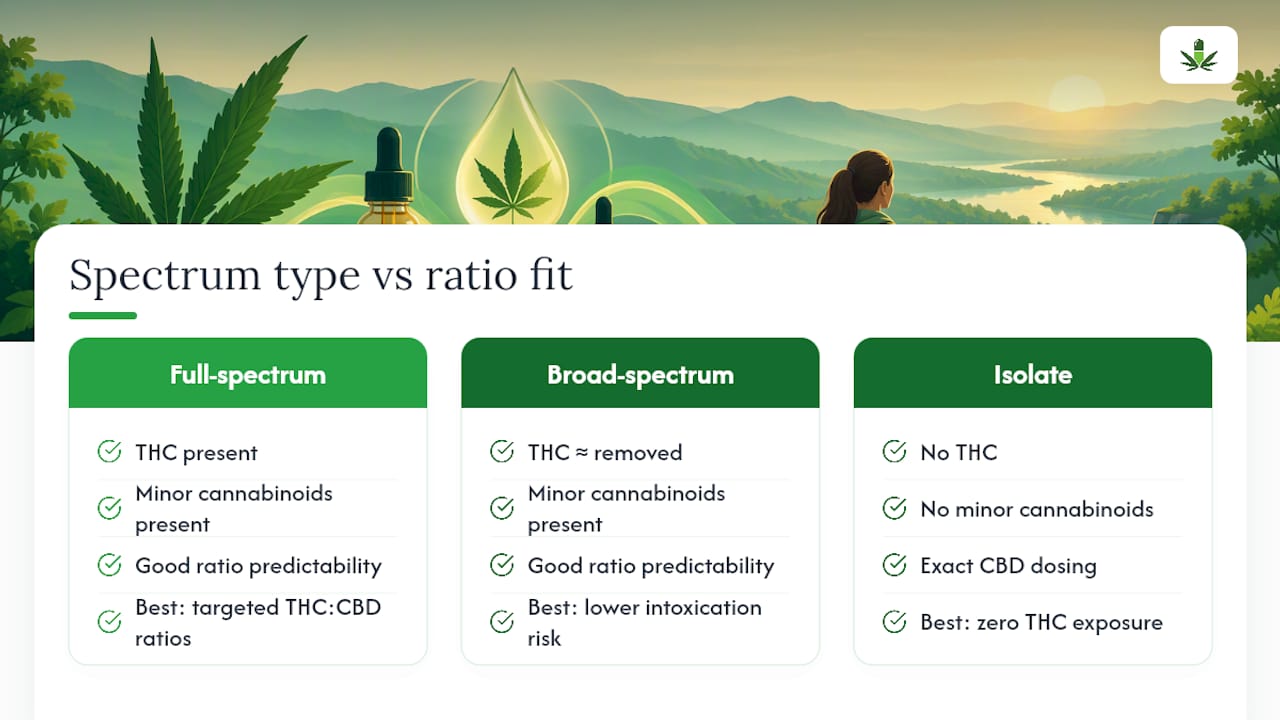
Full-spectrum products contain THC, CBD, and the full range of minor cannabinoids and terpenes naturally present in the plant. If you’re chasing a specific ratio like 5:1 or 1:1 for a targeted effect, full-spectrum is often the most predictable choice, because the labeled ratio reflects the dominant cannabinoids while minor compounds may still shape the overall feel.
Broad-spectrum products keep most of those minor cannabinoids and terpenes but strip out THC almost entirely. This matters if you want CBD’s effects without any measurable intoxication risk. It also matters for anyone concerned about workplace drug testing, since trace THC can theoretically still show up even in “THC-free” broad-spectrum products depending on manufacturing quality.
Isolate products contain a single cannabinoid, usually CBD, at 99% purity or higher, with nothing else from the plant. This gives you the cleanest, most exact dosing since there’s no THC and no terpene variability to account for. The trade-off is that some users report isolate feeling less effective than full-spectrum CBD at an equivalent milligram dose, a pattern often attributed to the entourage effect, though the evidence here is mixed rather than settled.
For ratio precision specifically, full-spectrum and broad-spectrum products let you dial in a THC:CBD number that means something. Isolate is really a CBD-only category, useful when your goal is zero THC exposure rather than a specific ratio at all.
Is THC or CBD Legal Where You Live? What to Check First
Legal status depends entirely on where you are and how the product is classified, and this is one area where guessing wrong carries real consequences.
In the United States, CBD derived from hemp with less than 0.3% THC by dry weight is federally legal under the 2018 Farm Bill, though individual states can and do impose additional restrictions. THC-containing cannabis products fall under a completely different framework. They remain federally classified as a controlled substance even though many states, including Virginia, have legalized medical or recreational use within their own borders.
For Virginia residents specifically, purchasing THC products from a licensed dispensary requires a valid medical cannabis certification from a registered practitioner. Without that certification, legal purchase and possession limits are far more restrictive. This is the practical reason a formal certification matters beyond convenience: it’s often the difference between legal dispensary access to lab-tested, ratio-labeled products and navigating an unregulated market with no quality assurance at all.
If you travel with cannabis products, note that crossing state lines with THC products, even ones purchased legally, can violate federal law and the laws of the state you’re entering. Rules vary enough state to state that assuming reciprocity is a mistake. Check your specific state’s current regulations before assuming a ratio-labeled product legal at home stays legal on a trip.
Why Most Ratio Advice Skips the Part That Matters Most
The cannabis industry sells ratios like they’re a settled science, complete with confident claims that a 2:1 or 20:1 product is scientifically optimized for a given condition. That framing oversells what the research actually supports. There’s no single validated ideal ratio for anxiety, pain, or anything else. What actually drives outcomes is individualized titration, patient response, and honest tracking over time.
The bigger blind spot in most consumer-facing guides is the entourage effect claim. It gets repeated as settled fact when the trial evidence on CBD modulating THC’s acute effects is genuinely mixed, and in some of the better-designed studies, unconvincing. That doesn’t mean ratios are meaningless. It means you should think of a ratio as a dial that controls THC exposure and subjective intensity, not a safety mechanism that lets you ignore dosing discipline.
If there’s one place conventional advice actually fails people, it’s oversimplifying THC-predominant use as universally riskier or CBD-dominant use as universally safe. Both carry considerations. CBD’s liver enzyme interactions get far less attention than THC’s psychoactivity, and for someone on the wrong medication, that’s the more dangerous oversight. Start with your medical history and your goal, not with a ratio someone told you is trending.
— Jonathan
Get Clinician Oversight Before You Start Titrating
Reading dosing charts only gets you so far. Legal access to lab-tested, ratio-labeled products at a Virginia dispensary requires a valid medical cannabis certification, and some services offer fast online evaluations with flat fees and refund policies.

A clinician review before you buy anything means someone is actually checking your medications, your health history, and your goals against the ratio you’re considering, not just handing you a certificate. That’s a materially different starting point than picking a ratio off a dispensary shelf and hoping it fits. If you’re ready to move from research to regulated access, start your evaluation and get your certification decision the same day.
Sources
For deeper reading beyond this guide, the dosing protocol study from PMC outlines the numeric titration steps referenced above, the cross-over trial on CBD and THC covers the entourage effect evidence directly, and the FDA’s pregnancy and breastfeeding guidance is worth reading in full if that applies to you.
This article is general information, not a substitute for advice from a qualified doctor. Consult a qualified healthcare professional about your own circumstances before acting on anything here.
- Practical considerations in medical cannabis administration and dosing (PMC8252988)
- What You Should Know About Using Cannabis, Including CBD, When Pregnant or Breastfeeding (FDA)
- Does cannabidiol make cannabis safer? A randomised, double-blind, cross-over trial (PMC10156730)
- Dosing considerations for medical cannabis in chronic pain (PMC10134049)
FAQ
What is the best THC:CBD ratio for anxiety?
Most people managing anxiety start with a CBD-dominant ratio like 20:1 or higher, since it offers calming effects with minimal intoxication. Some users add a small amount of THC, moving toward 10:1 or 5:1, if CBD alone isn’t providing enough relief, but individual response varies enough that titration matters more than the label ratio itself.
Does a 1:1 THC CBD ratio get you high?
Yes, a 1:1 ratio typically produces noticeable psychoactive effects, though often described as more manageable than THC-dominant products. Many medical and recreational users choose 1:1 specifically because it balances symptom relief with a less intense high than THC-heavy formulations.
How much CBD and THC should a beginner start with?
Clinical dosing guidance suggests starting with 5 to 10 mg of CBD and 1 to 2.5 mg of THC once or twice daily, then increasing slowly every few days based on response. This “start low, go slow” approach reduces the risk of overwhelming side effects while you find your effective dose.
Can CBD cancel out a THC high?
Not reliably. A randomized trial testing common ratios found that CBD did not consistently reduce THC’s acute cognitive or psychotic effects, so don’t count on CBD as a safety switch if you take too much THC.
How much does a medical cannabis certification cost in Virginia?
Virginia Medical Cannabis Certifications charges $50 for new patient certifications and $40 for renewals, both through the same-day online evaluation process. The fee is fully refunded if you don’t qualify, so there’s no financial risk in applying.