Delta-8 and delta-9 THC are chemical isomers, meaning they share the same molecular formula but differ in one structural detail. Delta-8 is generally less potent than delta-9, but being less potent does not mean it is safer. That distinction matters most when you are making decisions about your health.
- Potency: Delta-8 typically produces milder psychoactive effects than delta-9 at the same dose, but users often compensate by consuming more.
- Safety concern: The bigger risk with delta-8 is usually not the molecule itself. It is the manufacturing process. Commercial delta-8 is synthesized from hemp-derived CBD, and inadequate purification can leave harmful chemical residues in the final product.
- Drug testing: Both isomers will typically trigger a positive result on standard THC urine screens. Choosing delta-8 does not protect your employment status.
- Medical use: When cannabis is being used therapeutically, regulated delta-9 through a state medical program offers consistent dosing, third-party testing, and clinical oversight that unregulated delta-8 products cannot match.
The bottom line: if you have access to a regulated medical cannabis program, that path is safer than the unregulated delta-8 market for almost every therapeutic use case.
Key Takeaways
Delta-8 is less potent than delta-9 per milligram, but manufacturing contamination and drug-test implications make it no safer overall than regulated delta-9 THC.
| Point | Details |
|---|---|
| Potency difference | Delta-8 has weaker CB1 affinity than delta-9, producing milder effects at equivalent doses. |
| Manufacturing risk | Commercial delta-8 is synthesized from CBD; inadequate purification can leave harmful chemical residues. |
| Drug test result | Both delta-8 and delta-9 typically trigger a positive result on standard THC urine immunoassays. |
| Regulated access advantage | State medical programs provide standardized testing, consistent potency, and clinical oversight unavailable in the delta-8 market. |
| Virginia Medical Cannabis Certifications | Virginia residents can access regulated delta-9 through a same-day online certification for $50 with a full refund if not approved. |
Table of Contents
- How do delta-8 and delta-9 compare at a glance?
- What makes delta-8 and delta-9 chemically different?
- Why does how delta-8 is made matter for your safety?
- What is the legal status of delta-8 and delta-9 in the United States?
- What are the safety risks, and who is most at risk?
- Will delta-8 show up on a drug test?
- How can you reduce harm if you choose to use delta-8 or delta-9?
- Why does regulated medical access change the risk profile?
- When should you choose regulated delta-9 over delta-8?
- A clinician’s perspective on balancing access and safety
- Virginia residents: here is how to access regulated, tested cannabis
- Authoritative sources and further reading
How do delta-8 and delta-9 compare at a glance?
| Dimension | Delta-8 THC | Delta-9 THC |
|---|---|---|
| Chemical structure | Double bond at carbon-8 | Double bond at carbon-9 |
| Relative potency | Lower (weaker CB1 affinity) | Higher (stronger CB1 affinity) |
| Typical effects | Mild euphoria, relaxation, less anxiety reported | Stronger euphoria, more pronounced psychoactive effects |
| Typical dose range | Higher dose needed for equivalent effect | Lower dose for equivalent effect |
| Federal legal status | Ambiguous (Farm Bill gray area; DEA scrutiny) | Schedule I controlled substance (except state-licensed medical/adult-use) |
| Product quality risk | High (synthesized; inconsistent testing) | Lower in regulated dispensaries; higher in illicit market |
| Drug test result | Positive on standard THC immunoassay | Positive on standard THC immunoassay |
The single most important safety variable is not which isomer you choose. It is whether the product has been independently tested and verified clean. Both compounds cause positive drug tests, and neither carries zero risk.
What makes delta-8 and delta-9 chemically different?
Delta-8 and delta-9 are structural isomers. Both carry the molecular formula C₂₁H₃₀O₂, but the location of one double bond separates them. In delta-9, that bond sits at the ninth carbon in the cyclohexene ring. In delta-8, it shifts one position to the eighth carbon. That single difference changes how each molecule fits into the brain’s cannabinoid receptors.
The CB1 receptor, concentrated in the brain and central nervous system, is responsible for most of the psychoactive effects associated with cannabis. Delta-9 binds to CB1 with greater affinity than delta-8. A peer-reviewed pharmacology review in the British Journal of Pharmacology confirms that delta-8 has lower CB1 receptor affinity in human assays, which directly explains why it produces milder effects at equivalent doses. Binding studies show species variability, with delta-8 appearing roughly equipotent in some rodent assays, so animal data does not always translate cleanly to human outcomes.
“Delta-8-THC is a psychoactive cannabinoid found in the cannabis plant. It is an isomer of delta-9-THC, the compound commonly known as THC, with which it shares a similar molecular structure but differs in the location of a double bond.” — Britannica
Both compounds also interact with CB2 receptors, which are more prevalent in the immune system and peripheral tissues. CB2 activity is associated with anti-inflammatory effects rather than psychoactivity. The Leafly science overview notes that this shared isomeric structure means the two molecules behave similarly at a mechanistic level, with dose accounting for most of the perceived qualitative differences users report.
Why does how delta-8 is made matter for your safety?
Delta-8 occurs naturally in cannabis at trace levels, far too low to extract economically. Commercial delta-8 is almost always produced by chemically converting hemp-derived CBD through an isomerization process, typically using acid catalysts in a solvent. The conversion itself is not inherently dangerous, but inadequate purification afterward is.
When the synthesis is not properly controlled, the final product can contain residual solvents, unreacted reagents, and novel cannabinoid byproducts that have no established safety profile. The FDA has explicitly warned consumers that many delta-8 products on the market lack adequate testing and may contain harmful contaminants or inconsistent potency levels.
Contaminants and byproducts to watch for:
- Residual acid catalysts (e.g., p-toluenesulfonic acid, hydrochloric acid)
- Residual organic solvents (e.g., heptane, dichloromethane)
- Unknown isomers and novel cannabinoids formed as synthesis byproducts
- Heavy metals from equipment or reagents
- Pesticides carried over from the source hemp
- Microbial contamination from poor manufacturing hygiene
What a legitimate Certificate of Analysis (COA) should confirm:
| Test Category | What to Look For |
|---|---|
| Cannabinoid potency | Confirmed delta-8 percentage; delta-9 below 0.3% |
| Residual solvents | Below USP Class 2 limits |
| Heavy metals | Below state-regulated action levels |
| Pesticides | Non-detect or below action levels |
| Microbial | Non-detect for pathogens |
| Novel isomers | No unidentified cannabinoid peaks |
Always verify that the COA comes from an ISO-accredited third-party laboratory, not a lab affiliated with the manufacturer. Check that the batch number on the COA matches the product label.
Pro Tip: If a delta-8 product does not have a publicly accessible COA, treat that as a disqualifying red flag. Reputable manufacturers post COAs by batch number on their websites or via QR code on the packaging.
Regulated medical cannabis dispensaries operate under state-mandated testing requirements with documented chain-of-custody controls. That infrastructure is largely absent from the unregulated delta-8 market. If you are concerned about product quality issues causing adverse effects, the Virginia Medical Cannabis Certifications article on dab-related headaches covers how contaminants and residual solvents can drive symptoms that patients sometimes misattribute to the cannabinoid itself.
What is the legal status of delta-8 and delta-9 in the United States?
The legal picture for delta-8 is genuinely complicated, and it changes depending on which state you are in.
The 2018 Farm Bill defined hemp as cannabis containing less than 0.3% delta-9 THC by dry weight. That definition said nothing about delta-8. Producers quickly recognized that hemp-derived CBD could be chemically converted into delta-8, and because the resulting product was derived from legal hemp, they argued it fell outside federal controlled-substance restrictions. That regulatory gap is what created the commercial delta-8 market.
The DEA has not accepted that argument cleanly. The agency’s position is that synthetically derived tetrahydrocannabinols remain Schedule I controlled substances regardless of the source material. DEA drug scheduling places delta-9 THC firmly in Schedule I at the federal level, and the DEA’s interim final rule on hemp suggests that chemically converted cannabinoids may not qualify for the Farm Bill exemption.
“The FDA is concerned that delta-8 THC products have not been evaluated or approved by the FDA for safe use in any context. They may be marketed in ways that put the public health at risk and should especially be kept out of reach of children and pets.” — FDA Consumer Update
State-level variability is significant:
- Several states have explicitly banned delta-8, including Colorado, New York, and Oregon.
- Other states permit it with varying degrees of regulation.
- Some states have no specific statute addressing delta-8, creating enforcement uncertainty.
- State laws change frequently. What was legal in your state last year may not be legal today.
Purchasing delta-8 online and crossing state lines with it carries federal risk, regardless of the source state’s law. If you are in a state with a licensed medical cannabis program, that program operates under a clear legal framework. The unregulated delta-8 market does not.
What are the safety risks, and who is most at risk?
Both delta-8 and delta-9 carry real adverse-effect profiles. The difference in potency does not eliminate the risks; it shifts the dose at which they appear.
Acute adverse effects common to both isomers:
- Tachycardia (elevated heart rate)
- Anxiety and paranoia, particularly at higher doses
- Dizziness and impaired coordination
- Short-term cognitive impairment and memory disruption
- Dry mouth and red eyes
- Nausea, especially with oral products at high doses
More serious but less common events include severe anxiety reactions, psychosis-like episodes in predisposed individuals, and cardiovascular stress in people with underlying heart conditions.
Populations at elevated risk:
- Children and adolescents: The developing brain is particularly sensitive to cannabinoid exposure. Accidental pediatric ingestion of delta-8 edibles has been reported to poison control centers, often because products are packaged to resemble candy or snacks.
- Pregnant and breastfeeding people: THC crosses the placenta and is present in breast milk. PMC toxicology literature documents neurodevelopmental risk signals from prenatal THC exposure in animal models, with translational concerns for human pregnancies.
- People with psychotic disorders or family history of psychosis: Both isomers can precipitate or worsen psychotic symptoms. This risk is dose-dependent and not eliminated by choosing delta-8.
- People with cardiac disease: Tachycardia and blood pressure changes from THC exposure can be clinically significant in this group.
Animal toxicology studies at high doses show organ weight changes, particularly in the liver and spleen, though human translational data remain limited. The honest answer is that long-term human safety data for delta-8 specifically is sparse. Delta-9 has a longer research history, but even that literature has gaps.
If you suspect a poisoning or severe adverse reaction, call Poison Control at 1-800-222-1222 immediately. For symptoms like chest pain, difficulty breathing, or loss of consciousness, call 911.
THC’s effects on blood glucose regulation are also worth knowing if you have diabetes or metabolic conditions. The Virginia Medical Cannabis Certifications overview on THC and blood sugar covers that physiology in plain terms.
Will delta-8 show up on a drug test?
Yes. Delta-8 will typically produce a positive result on standard THC urine immunoassays. This is one of the most commonly misunderstood aspects of d8 vs d9 comparisons.
Standard workplace and forensic urine screens target THC-COOH, the primary metabolite of THC. Both delta-8 and delta-9 are metabolized through overlapping pathways that produce this compound. The immunoassay does not distinguish between isomers. It detects the metabolite, and both isomers produce it.
Practical implications:
- Do not assume delta-8 is “drug-test safe.” It is not.
- Confirmatory GC-MS or LC-MS tests can sometimes distinguish isomers, but standard workplace screens do not.
- Detection windows vary by frequency of use, body composition, and hydration, but THC-COOH can remain detectable in urine for days to weeks after use.
- If you are subject to occupational drug testing, any THC product, regulated or unregulated, carries employment risk.
- A medical cannabis card does not automatically protect you from employment consequences in states where employers retain the right to enforce drug-free workplace policies.
The safest approach if you face drug testing is to abstain and consult your employer’s policy and a legal professional before using any cannabinoid product.
How can you reduce harm if you choose to use delta-8 or delta-9?
Whether you are using delta-8 or regulated delta-9, these steps reduce your risk meaningfully.
Before you purchase:
- Verify the product has a current, batch-specific COA from an ISO-accredited third-party lab.
- Confirm the COA tests for residual solvents, heavy metals, pesticides, microbial contamination, and cannabinoid potency.
- Check that the delta-9 content is below 0.3% on any hemp-derived product claiming Farm Bill compliance.
- Research the manufacturer’s transparency: do they list their lab partners? Do they respond to consumer inquiries?
- Avoid products with vague labeling, missing batch numbers, or no accessible COA.
Dosing safely:
- Start with the lowest available dose and wait the full onset window before adding more.
- Avoid combining cannabis with alcohol, benzodiazepines, or opioids. These combinations amplify sedation and impairment unpredictably.
- Choose a reliable administration route. Inhalation gives faster feedback on effects; oral products have delayed, prolonged, and sometimes more intense effects.
- For non-intoxicating consumption methods and traditional cannabis preparations, cannabis tea represents one of the oldest documented approaches, though bioavailability and onset differ significantly from inhalation or tinctures.
Storage and child safety:
- Store all cannabis products in child-resistant, clearly labeled containers out of reach of children and pets.
- Never store cannabis products in food containers or alongside snacks.
- Keep Poison Control’s number accessible: 1-800-222-1222.
If you experience a severe adverse reaction:
- Stay calm and move to a safe, quiet environment.
- Call Poison Control (1-800-222-1222) for guidance on non-emergency symptoms.
- Call 911 for chest pain, difficulty breathing, loss of consciousness, or severe psychiatric symptoms.
- Do not drive.
Why does regulated medical access change the risk profile?
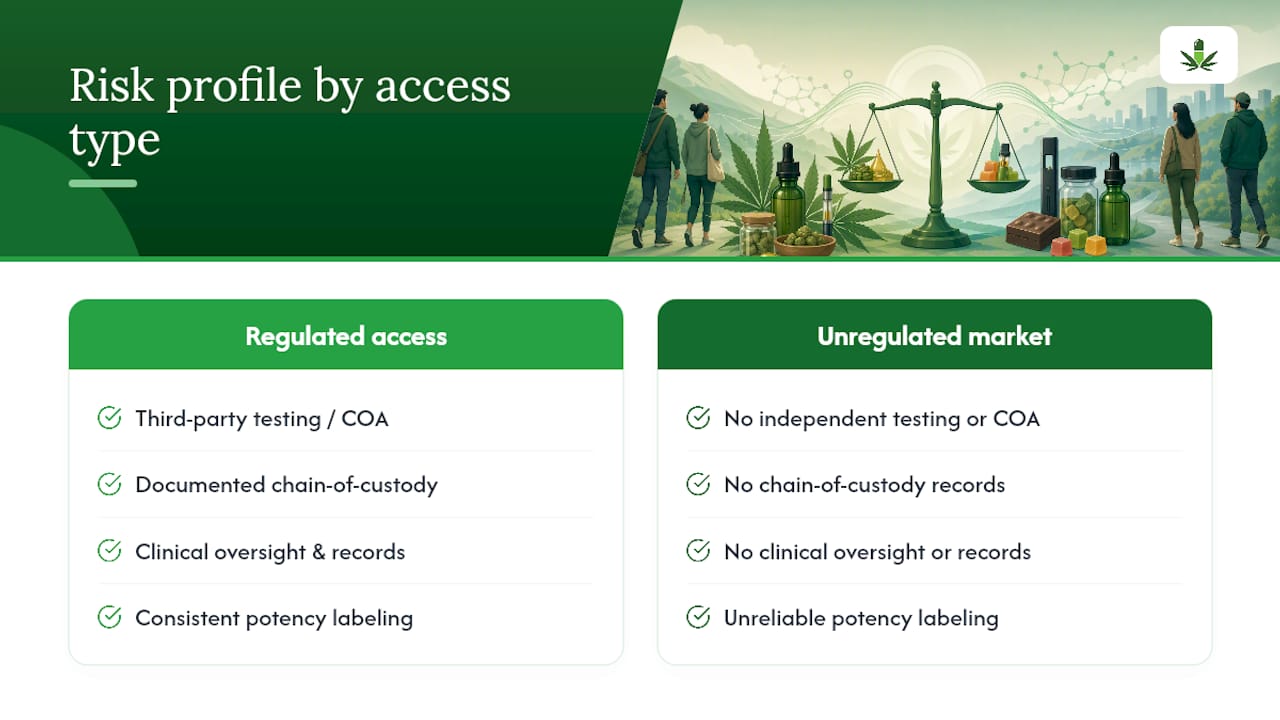
The core problem with the unregulated delta-8 market is not the molecule. It is the absence of the systems that make any drug product reliably safe: standardized testing, documented chain-of-custody, clinical oversight, and predictable dosing.
State medical cannabis programs address each of those gaps directly. Licensed dispensaries sell products that have passed state-mandated testing for potency, contaminants, and microbial safety. Cultivars and product formulations are documented, so patients and clinicians can track what works and adjust accordingly. Patient records create a clinical history that supports responsible ongoing care.
“Patients using cannabis through regulated medical programs benefit from consistent potency labeling, third-party testing requirements, and the ability to consult a licensed clinician about dosing, drug interactions, and contraindications — none of which are reliably available in the unregulated hemp-derived cannabinoid market.” — Clinical guidance principle, supported by state medical program frameworks
Regulated access also reduces the contamination risk that makes commercial delta-8 products genuinely hazardous. When a dispensary product carries a COA tied to a licensed testing laboratory and a documented production batch, you know what you are consuming. That certainty is not available from an online retailer selling synthesized delta-8 with no state oversight.
For patients considering cannabis for therapeutic purposes, including conditions like PTSD, chronic pain, or anxiety, the medical cannabis for PTSD overview illustrates how a structured clinical approach changes outcomes compared to self-directed use of unregulated products. Clinicians and patients alike should prefer regulated sources whenever they are available. The cannabinoid pharmacology guide for Virginia patients also provides useful context on how different cannabinoids interact with the endocannabinoid system.
When should you choose regulated delta-9 over delta-8?
The practical recommendation is straightforward.
- Avoid untested delta-8 — when you cannot verify purity through a current, batch-specific COA from an accredited lab. The manufacturing risks are real, and the FDA has documented them.
The legal and safety trade-offs favor regulated access at every level. Delta-8’s lower potency per milligram does not offset the contamination risk from unregulated synthesis, the legal ambiguity at the federal level, or the near-certain positive drug test result.
This article provides general health information, not medical or legal advice. Consult a licensed clinician and verify current laws in your state before making any decisions about cannabis use.
A clinician’s perspective on balancing access and safety
The conversation around delta-8 vs delta-9 often gets framed as a potency debate, but the more clinically relevant question is about the quality of the product and the context of use.
What concerns me most about the delta-8 market is not the pharmacology. It is the absence of accountability. When a patient uses a regulated dispensary product, there is a chain of custody, a tested batch, and a clinician who can review the interaction with other medications. When someone orders delta-8 online, none of those safeguards exist. The molecule may be less potent, but the product is less safe.
There is also a subtle risk in the “milder” framing. Patients who believe delta-8 is categorically safer sometimes use it more freely, skip the harm-reduction steps they would apply to delta-9, and end up with higher total exposure than they intended. Compensatory dosing behavior, documented in the clinical trial literature, is a real mechanism here, not a theoretical concern.
My practical recommendation: document cannabis use in any clinical encounter, screen for contraindications including psychiatric history, cardiac disease, and pregnancy, and consistently favor regulated programs for any therapeutic application. If a patient in Virginia is using cannabis for a qualifying condition, the path through a licensed dispensary is the one worth supporting.
For anyone seeking personalized guidance, please consult a licensed healthcare provider who can review your full medical history.
Virginia residents: here is how to access regulated, tested cannabis
Regulated medical cannabis gives you something the unregulated delta-8 market cannot: a tested product, a documented dose, and a clinical record. For Virginia residents, that access starts with a medical cannabis certification.
Virginia Medical Cannabis Certifications offers same-day online certifications for $50, completed in about 10 minutes from your phone or computer. New patients pay $50; renewals are $40. If you do not qualify, the fee is fully refunded. The evaluation is conducted by a licensed clinician, and your certificate is delivered by email so you can visit a licensed Virginia dispensary the same day.
Qualifying conditions include chronic pain, anxiety, PTSD, and a range of other medical diagnoses. See the full eligibility criteria and process steps to confirm whether you qualify before booking.
Medical cannabis laws vary by state. This service is available to Virginia residents only. Virginia Medical Cannabis Certifications does not guarantee specific medical outcomes. Always consult your clinician about how cannabis interacts with your current medications and conditions.
Authoritative sources and further reading
- A within-subject cross-over trial comparing the acute effects of vaporized delta-8-tetrahydrocannabinol and delta-9-tetrahydrocannabinol in healthy adults — Abstract – Europe PMC
- 5 things to know about delta-8 tetrahydrocannabinol (delta-8 THC) | FDA
- Cannabis-derived products like delta-8 THC and delta-10 THC have … | University of South Carolina
- Drug Scheduling | DEA
Recommended
- CBDA vs CBD: Which One Should You Try? – Virginia Medical Cannabis Certifications
- Why Do Dabs Give Me Headaches? Causes and Fixes – Virginia Medical Cannabis Certifications
- Indica vs Sativa for Cancer: What Patients Need to Know – Virginia Medical Cannabis Certifications
- CBC vs CBG vs CBD: A Virginia Patient’s Guide – Virginia Medical Cannabis Certifications